Natural wine is one of the most discussed and most contested categories in the wine world today. Wine bars list it prominently. Critics argue about whether it is a genuine improvement on conventional wine or a marketing concept prone to romanticising fault. Producers defend it with fervour. The debate generates more heat than clarity — which is unhelpful for anyone who simply wants to understand what natural wine actually means, how it differs from organic or biodynamic wine, and whether it is likely to be worth seeking out. This article answers those questions plainly, without taking a side in a debate that is genuinely more nuanced than most of its participants acknowledge.
In this article
What Natural Wine Actually Means
Natural wine has no single globally recognised legal definition. Unlike “organic” (certified by bodies such as the EU’s organic regulation or the USDA) or “biodynamic” (certified by Demeter or Biodyvin), “natural wine” is not a regulated term in most countries. A producer can use it without meeting any formal standard. This lack of definition is one of the movement’s persistent problems and one of the reasons debate about it continues.
In practice, however, most natural wine producers and advocates share a consistent set of principles, even if they apply them with different degrees of strictness:
- Organically or biodynamically farmed grapes: no synthetic pesticides, herbicides, or fertilisers in the vineyard. This is a non-negotiable element for virtually all producers who claim the natural label.
- Hand harvest: grapes picked by hand rather than by machine, which allows selection of healthy fruit and avoids the oxidation and grape damage associated with mechanical harvesting.
- Wild (indigenous) yeast fermentation: fermentation initiated by the naturally occurring yeasts on the grape skins and in the winery environment, rather than by commercially cultured, laboratory-produced yeasts. This is the most philosophically important distinction from conventional winemaking: the fermentation is uncontrolled, unpredictable, and specific to the place where the wine is made.
- No or minimal additions in the cellar: no added sugar (chaptalization), no added acid, no concentrated grape juice, no commercial fining agents (egg white, isinglass, casein), no added tannins or enzymes. The wine is made from grapes and nothing else.
- No or low added sulphites (SO₂): the most debated element. Conventional winemaking uses sulphur dioxide as a preservative and antimicrobial agent; natural wine either avoids it entirely (zero-zero wines, sometimes labelled “S/A” for sans ajout) or uses it only in tiny amounts at bottling (typically under 30–40 mg/litre total, versus the legal maximum of around 150–200 mg/litre for conventional wines).
- No fining or filtration: the wine goes from fermentation vessel to bottle without the processes that remove haziness, tannins, or other particles. This is why natural wines are often hazy or cloudy and may have sediment.
The simplest summary comes from author and natural wine advocate Alice Feiring: “Natural wine is made with organic viticulture, and then nothing added or taken away — except perhaps a very minimal amount of sulphites.”
Formal Recognition: Vin Méthode Nature
In March 2020, France became the first country to give natural wine formal legal recognition under the designation Vin Méthode Nature. To use this designation, producers must comply with a 12-point charter: certified organic grape farming, manual harvest, indigenous yeast fermentation, no additions in the cellar, and — the key split — two versions: one with no added sulphites (labelled “Sans Soufre Ajouté”) and one with up to 30 mg/litre total sulphites. A sticker can be affixed to the bottle indicating which version the wine is.
The French certification has been both welcomed and criticised. Welcomed, because it gives consumers a legally backed definition they can trust. Criticised, because some natural winemakers fear that formalising the category will allow larger industrial producers to co-opt it — the same concern raised when organic certification was formalised in the 1970s and the organic market subsequently became dominated by large-scale commercial producers.
Where Natural Wine Came From
Although wine was made without additives for most of human history, the modern natural wine movement has a specific origin: post-war France. The introduction of synthetic pesticides and chemical fertilisers into French viticulture in the 1950s and 1960s, combined with the spread of commercial yeasts, additives, and industrial winemaking techniques, prompted a backlash from a small group of producers in Beaujolais.
The central intellectual figure is Jules Chauvet, a negociant, scientist, and winemaker in Beaujolais who spent decades researching indigenous yeast fermentation and the role of sulphur dioxide in wine. His experiments in the 1950s and 1960s demonstrated that wine could be made successfully without added sulphites provided the grapes were pristine and the winery environment was scrupulously clean. Chauvet’s research and influence on a small circle of Beaujolais producers created what became known as the “Gang of Four”: Marcel Lapierre, Jean Foillard, Jean-Paul Thevenet, and Guy Breton. Their clean, vibrant, unfined Beaujolais from the 1980s onwards were a revelation to a generation of wine professionals who encountered them.
The movement spread gradually through France — to the Loire Valley (producers like Olivier Cousin, Thierry Puzelat, and Claude Courtois), to the Languedoc, and to producers in Bordeaux and Burgundy working outside the mainstream. By the 2000s, natural wine bars had opened in Paris, Tokyo, and London; by the 2010s, natural wine had become a global phenomenon, with dedicated wine bars, fairs (RAW WINE, La Dive Bouteille, La Rémoise), and importers in every major city.
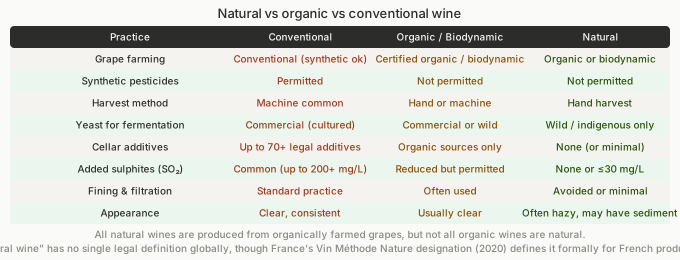
Natural Wine vs Organic vs Biodynamic
These three terms overlap but are not interchangeable, and the distinctions matter:
Organic Wine
Organic wine means the grapes were farmed without synthetic pesticides, herbicides, or fertilisers. The certification covers the vineyard only. Organic winemakers can still use commercial yeasts, add acid, fine, filter, and use sulphites (up to a regulated maximum). Most organic wine is made using conventional cellar techniques, simply with more carefully farmed grapes. An organic wine is not automatically a natural wine.
Biodynamic Wine
Biodynamic farming treats the vineyard as a self-sustaining ecosystem, following the holistic agricultural principles developed by Rudolf Steiner in the 1920s. It incorporates organic practices but goes further — using specific herbal and mineral preparations, timing vineyard work according to lunar and cosmic cycles, and maintaining biodiversity across the farm. Major certifying bodies include Demeter and Biodyvin.
Many natural wine producers farm biodynamically, and the philosophies align closely. But biodynamic certification addresses the vineyard, not the cellar — a certified biodynamic producer can still use commercial yeasts and standard cellar additions. And natural wine producers who farm organically but not biodynamically can still make wine that meets the natural philosophy in the cellar. The overlap is significant but not complete.
What Makes Natural Wine Different
Natural wine extends the minimal-intervention philosophy from the vineyard into the cellar. All natural wines start with organically farmed grapes, but the distinguishing practices are what happens next: wild yeast fermentation, no additions, no fining, no filtration, no or minimal sulphites. These cellar choices are what organic and biodynamic certification does not require or address.
What Natural Wine Tastes Like
Generalising about natural wine taste is difficult because the category encompasses an enormous range of styles — from clean, precise, energetic wines that taste indistinguishable from conventional wine, to deeply funky, cloudy, cidery, or oxidative wines that divide opinion sharply.
The characteristics most commonly associated with natural wines:
- Freshness and energy: wild yeast fermentations often produce wines with lively acidity and vibrant fruit character that feels more immediate and less polished than conventionally made wine.
- Textural complexity: unfiltered wines have a richer, slightly more textured feel in the mouth from the particles (yeast cells, phenolics) left in suspension.
- Haze and sediment: cloudiness in natural wine is not a fault — it is a result of no filtration. Sediment at the bottom of the bottle is normal and harmless.
- Variability between bottles and vintages: without the stabilising interventions of conventional winemaking, natural wines are more variable. The same wine from two different vintages may taste quite different; occasionally two bottles from the same case may taste different.
- Potential faults: this is the honest part of the conversation. Without adequate sulphites and cellar hygiene, natural wines are more vulnerable to bacterial spoilage. Volatile acidity (a vinegar-like sharpness), Brettanomyces (a barnyard, mousy, or band-aid character), and “mousiness” (a specific fault caused by certain bacteria that produces an intensely unpleasant aftertaste, detectable only after swallowing) are more common in natural wines than in conventional ones. Good natural wine producers manage these risks through scrupulous cellar hygiene and careful handling; less careful producers produce wines that can be genuinely faulty.
The Sulphites Question
No aspect of natural wine generates more misinformation than sulphites. Several myths are worth addressing directly:
- Myth: “Sulphite-free wine” exists. It does not. Fermentation naturally produces 10–40 mg/litre of sulphur dioxide as a by-product of yeast metabolism, regardless of whether the producer adds any. Every wine contains sulphites. “No added sulphites” means the producer did not add any beyond what fermentation produces — not that the wine is sulphite-free.
- Myth: Sulphites cause wine headaches. The science does not support this as a primary cause. Wine headaches are more likely caused by alcohol, histamines, and tyramine (which are actually higher in red wine regardless of sulphite levels). Dried fruit and processed food contain five to ten times more sulphites than high-sulphite wine, with far fewer reported reactions. A small proportion of asthmatics are genuinely sulphite-sensitive, but for most wine drinkers, sulphites are not the cause of the reaction they attribute to them.
- Myth: Natural wine is automatically healthier. Lower sulphites may benefit a small group of genuinely sensitive drinkers. But the absence of sulphites without compensating cellar hygiene makes wine more vulnerable to spoilage organisms that produce their own undesirable compounds. A faulty natural wine is not a health improvement over a well-made conventional wine.
What is true: sulphites are effective preservatives, and reducing or eliminating them requires greater skill and care in the cellar. The best no-added-sulphite wines — from producers like Marcel Lapierre, Cornelissen, or Thierry Allemand — demonstrate that it is possible to make exceptional wine without them. These are wines of genuine quality made by careful, skilled producers. The worst no-sulphite wines are simply unstable and faulty.
How to Find and Identify Natural Wine
Because “natural wine” has no legal definition in most countries, bottles are not consistently labelled. Look for:
- In France: the Vin Méthode Nature label or sticker is the most reliable indicator of a legally defined natural wine.
- On any label: terms like “minimal intervention,” “unfined and unfiltered,” “indigenous yeast,” “no added sulphites,” or “nothing added, nothing taken away.”
- At wine shops and bars: a natural wine specialist will know their producers’ practices. Wine bars with a dedicated natural wine list (RAW WINE accredited bars, for example) are a reliable source.
- Look for the Vin de France or Vino di Tavola designation: some natural producers deliberately declassify their wine to the lowest table wine category, partly to avoid the bureaucracy of appellation rules that may conflict with their practices. A Vin de France from a known natural producer is not a lesser wine — it may be exceptional.
For context on orange wine — a skin-contact white wine style closely associated with the natural wine movement — see our guide to what orange wine is. The two categories overlap but are not identical.
Frequently Asked Questions
What is natural wine?
Natural wine is wine made from organically or biodynamically farmed grapes with minimal intervention in the cellar. Key practices include: hand-harvesting, fermentation using only the wild yeasts naturally present on the grapes, no commercial fining or filtration, and no or minimal added sulphites. The goal is a wine that expresses its grape variety and vineyard character as directly as possible without manipulation. Natural wine has no single legal definition globally, though France established a formal Vin Méthode Nature designation in 2020. In most countries, the term is unregulated and requires knowledge of the individual producer rather than label trust.
What is the difference between natural wine and organic wine?
Organic wine certification covers the vineyard — the grapes must be grown without synthetic pesticides, herbicides, or fertilisers. It does not regulate what happens in the cellar: organic winemakers can still use commercial yeasts, add acid, fine, filter, and use sulphites up to the regulated maximum. Natural wine extends the minimal-intervention philosophy into the cellar: wild yeast fermentation only, no additions, no fining or filtration, no or minimal sulphites. All natural wine is produced from organically farmed grapes, but most organic wine is made using conventional cellar techniques and is not natural wine.
Is natural wine better for you than conventional wine?
The health claims made for natural wine are often overstated. Lower sulphites may benefit the small proportion of people who are genuinely sulphite-sensitive, but for most drinkers sulphites are not the cause of the reactions commonly attributed to them. The absence of sulphites without compensating cellar hygiene makes wine more vulnerable to spoilage bacteria, which produce their own undesirable compounds. A well-made natural wine from a careful producer is a clean, interesting drink; a poorly made natural wine can be genuinely faulty. Neither category is automatically healthier than the other.
Why is natural wine cloudy?
Natural wine is often cloudy or hazy because it is not filtered before bottling. Conventional winemaking uses filtration to remove the particles (dead yeast cells, grape solids, phenolic compounds) that cause haze. Natural winemakers avoid filtration as part of the minimal-intervention philosophy, leaving these particles in the wine. The cloudiness is not a fault or a sign of spoilage — it is a deliberate and expected characteristic of unfiltered wine. Sediment at the bottom of the bottle is similarly normal and harmless. Simply decant the wine carefully or pour gently to leave any settled sediment behind.
Does natural wine contain sulphites?
Yes — all wine contains sulphites, including natural wine, because fermentation naturally produces sulphur dioxide as a by-product of yeast metabolism, typically 10 to 40 mg/litre. “No added sulphites” means the producer did not add any SO₂ beyond this naturally occurring amount, not that the wine is sulphite-free. Conventional wine typically contains 100 to 200 mg/litre total sulphites after additions; natural wine with no added sulphites contains only the naturally produced 10 to 40 mg/litre. The label requirement “Contains Sulphites” applies to any wine with more than 10 mg/litre total sulphites — which means it applies to virtually all wine, natural or conventional.
What does natural wine taste like?
Natural wine is extremely variable — more so than conventional wine, because the intentional lack of controlling interventions means the specific yeasts, weather, and cellar conditions of each vintage have more influence on the result. At its best, natural wine is vivid, textured, energetic, and expressive of its grape variety and place — qualities that admirers describe as “alive.” At its worst, natural wine can suffer from volatile acidity (a vinegar sharpness), Brettanomyces (barnyard, band-aid), or other faults associated with inadequate preservation. Starting with bottles from well-regarded producers (Lapierre, Foillard, Cornelissen, Tom Shobbrook, Lucy Margaux) gives you the best chance of experiencing natural wine at its most compelling.