
The year printed on a wine label is the vintage. It tells you when the grapes were harvested — not when the wine was bottled, not when it arrived in shops, not how old it is now. One growing season, one harvest, one number. That definition is the same across every wine-producing country and every style of wine, and understanding it is the starting point for understanding almost everything else about reading a wine label. Whether a vintage year actually matters for the wine in your hand is a different question — and the answer depends significantly on where the wine comes from.
In this article
- 1 What Vintage Means: The Precise Definition
- 2 The Legal Definition: What Percentage Qualifies
- 3 Why Vintages Vary: The Role of Weather
- 4 When the Vintage Year Actually Matters
- 5 Vintage vs Non-Vintage Wine
- 6 Vintage, Age, and Drinking Windows
- 7 Vintage Charts: Useful Tool, Imperfect Guide
- 8 Vintage in the Age of Climate Change
- 9 Frequently Asked Questions
What Vintage Means: The Precise Definition
In winemaking, vintage refers to the year in which the grapes used to produce a wine were harvested. If a bottle of Burgundy shows 2018 on the label, it means the Pinot Noir grapes were picked during the 2018 harvest season. If a Napa Cabernet shows 2019, those grapes came in during September and October of 2019.
The vintage year is always the harvest year — never the year of bottling, release, or purchase. A wine from the 2018 harvest might not have been bottled until 2020, might not have been released until 2021, and might not be sitting on a shop shelf until 2022 — but it is still a 2018 vintage. The label reflects when the raw material was grown, not when the finished product appeared.
One useful clarification: the term “vintage” is also used in everyday language to mean something old, antique, or of a particular era — a “vintage car,” a “vintage dress.” In wine, this popular usage has drifted into the idea that a “vintage wine” is necessarily an old or special wine. That is not what the term means in winemaking. A 2023 Beaujolais-Villages is a vintage wine in the technical sense — it has a vintage year — but it is neither old nor particularly prestigious. The year on the label is simply information, not a quality claim.
The Legal Definition: What Percentage Qualifies
Most countries allow a small proportion of wine from other years to be included in a vintage-dated bottle without losing the right to display that vintage on the label. In Chile and South Africa, the requirement is 75% same-year content for vintage-dated wine. In Australia, New Zealand, and the member states of the European Union, the requirement is 85%. In the United States, the requirement is 85%, unless the wine is designated with an AVA (Appellation of American Viticultural Area, such as Napa Valley), in which case it is 95%.
The practical implication: a bottle labelled as a 2019 Bordeaux is guaranteed to contain at least 85% wine from the 2019 harvest, with up to 15% potentially from other years. In practice, most reputable producers use 100% of the stated year, but the legal tolerance exists for winemaking flexibility. It very rarely affects the character of the wine in any perceptible way.
Why Vintages Vary: The Role of Weather
The reason a vintage year carries information is that wine grapes are an agricultural product whose quality and character are profoundly shaped by the conditions under which they grew. Unlike industrial products that can be manufactured to a consistent specification, wine grapes are at the mercy of the weather during every stage of the growing season.
The Growing Season: What Matters and When
The critical period runs from bud break in spring through harvest in autumn — roughly 150 to 180 days during which almost every weather event leaves a mark on the eventual wine. The most important stretch happens between flowering and harvest, a span of about 100 days somewhere around May to September, give or take, in the northern hemisphere. The key weather variables and their effects:
- Spring frost: late frosts after bud break can kill young shoots and dramatically reduce yield. The 2017 Bordeaux harvest was severely reduced by spring frosts; so was Chablis in the same year. A frost at the wrong moment can destroy a significant proportion of the crop before it has even started growing properly.
- Flowering conditions: Champagne and other marginal climates require warm, dry weather during the brief flowering period (usually May–June) for successful pollination. Rain or cold during flowering causes poor fruit set, reducing yield and potentially creating quality inconsistencies across the bunch.
- Summer temperature and rainfall: heat drives sugar accumulation in the grapes, which converts to alcohol during fermentation. A warmer year produces a fuller wine; the opposite is the case for cooler years, when there’s less sugar but more acid. Drought stress can concentrate flavours; excessive rain in summer dilutes them.
- Harvest weather: rain just before harvest can swell grapes, diluting their flavour concentration. An extended sunny, dry period before harvest allows optimal ripeness. The timing of harvest relative to the weather is one of the most consequential decisions a winemaker makes.
- Disease pressure: prolonged wet or humid periods encourage fungal disease (mildew, botrytis) which, depending on the stage and style of wine, can either destroy a crop or — in the case of noble rot on certain sweet wine grapes — create extraordinary flavour complexity.
How Much Variation Is Possible
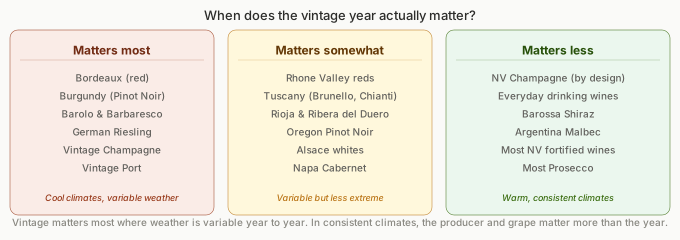
The range of variation between vintages is not uniform across the wine world. In warmer, more consistent wine regions, vintage variation tends to be less dramatic. Areas like much of Australia, California’s Central Valley, and Argentina’s Mendoza enjoy relatively stable climates where year-to-year differences are less pronounced. In these regions, the vintage on the label matters less, and the winemaker’s style and grape quality are the more important factors.
In contrast, regions with genuinely variable weather — Bordeaux, Burgundy, Champagne, Germany’s Mosel, Piedmont in Italy, and Oregon’s Willamette Valley — can see dramatic differences between years. The difference between a great Bordeaux vintage and a difficult one is not subtle: the finest bottles from 2009, 2010, or 2015 Bordeaux will age for 30–50 years; wines from the notoriously difficult 2013 vintage are considered much lighter and shorter-lived.
When the Vintage Year Actually Matters
Premium Old World Wine: Matters Most
For the following categories, the vintage year is genuinely consequential — worth researching before buying, particularly for wines intended for ageing or for special occasions:
- Bordeaux (classified growths and serious estates): the difference between a great vintage and a difficult one here is enormous. 2009, 2010, 2015, 2016, and 2022 are considered outstanding recent Bordeaux vintages; 2013 and 2017 are considered far weaker, and are priced accordingly.
- Burgundy: Pinot Noir’s thin skins make it exceptionally vulnerable to weather. A great Burgundy vintage (2015, 2019, 2023 are considered excellent) produces wines of concentration and longevity; a difficult vintage (2004, 2007) produces lighter, less age-worthy wines from even the best producers.
- Barolo and Barbaresco (Nebbiolo): Northern Italy’s harvest weather is highly variable. Top Barolo vintages (2010, 2013, 2016 are widely celebrated) age for 20–30 years; weaker vintages produce wines that should be consumed younger.
- German Riesling: the Mosel’s extreme growing conditions — steep slate slopes, cool temperatures — mean that vintage is critical for understanding both style and quality. The difference between an Auslese in a great year and one in a weak year is significant in terms of concentration, ageing potential, and price.
- Vintage Champagne: Champagne houses only declare a vintage in exceptional years — generally about four or five such vintages in a decade. Vintage Champagne is a deliberate expression of a specific outstanding year, making the year on the label highly meaningful information.
Quality Still Wines: Matters Somewhat
For quality table wines from regions with moderate climate variability — Tuscany, Rhône Valley, Rioja, Oregon, most of Napa — the vintage gives useful but less critical context. There are genuinely great and genuinely difficult years in these regions, but the differences are less extreme than in Bordeaux or Burgundy. A knowledgeable buyer can use vintage information here to find good value in off-years or to identify wines worth cellaring from celebrated years.
When Vintage Barely Matters
- Non-vintage Champagne: deliberately blended from multiple years specifically to eliminate vintage variation. The house style is the relevant variable, not the year.
- Everyday drinking wines: wines designed for prompt consumption and priced accordingly are not built to reflect vintage character. The vintage tells you to check freshness (buy the most recent vintage), but not much more.
- Warm, consistent-climate wines: Barossa Valley Shiraz, Mendoza Malbec, most of California’s Central Valley — year-to-year variation is modest and the producer’s approach matters far more than the harvest year.
- Non-vintage fortified wines: most Port, Sherry, and Madeira is non-vintage by design, blended across multiple years for consistency. Their quality comes from the system, not the harvest.
Vintage vs Non-Vintage Wine
A non-vintage wine (labelled NV, or simply with no year) blends wine from multiple harvests, deliberately removing the year-to-year variation that a single-vintage wine captures. The most important category of non-vintage wine is non-vintage Champagne, where houses blend reserve wines from previous years into the current year’s base wine to produce a consistent house style. Our guide to non-vintage Champagne explains how this works in detail.
Non-vintage wines are not inferior to vintage wines — they serve a different purpose. Non-vintage Champagne offers consistency and reliability; vintage Champagne offers a specific character. The choice between them is about what you want from the wine, not about one being better than the other.
Vintage, Age, and Drinking Windows
The vintage year also tells you the wine’s age — and therefore whether it is likely to be at, before, or past its drinking window. A 2019 Bordeaux in 2026 is seven years old; whether that is young, ready, or ageing depends entirely on the wine. An inexpensive Bordeaux from 2019 may be past its best; a Classified Growth from the same year may not reach peak drinking until 2030–2035.
For wines designed to be drunk young — most whites, light reds, rosé, and Prosecco — a recent vintage is a positive signal. Picking the most recent vintage from the shelf is sensible for these styles. For wines built to age — serious Bordeaux, Barolo, quality white Burgundy, German Riesling — the vintage year is the starting point for assessing where in its development the wine currently sits.
For a detailed look at which wines genuinely reward ageing and how long they last, see our guide to which white wines age well and our full-bodied red wine guide, which covers ageing potential by grape variety and region.
Vintage Charts: Useful Tool, Imperfect Guide
Vintage charts — tables showing which years were good, average, or poor for specific regions — are published by wine critics (Wine Spectator, Decanter, Robert Parker’s Wine Advocate) and are freely available online. They provide a useful first reference for understanding whether a specific year is likely to have produced wines of high, average, or lower quality in a given region.
Their limitation is that they are generalisations. James Laube of Wine Spectator has asserted that “even an average vintage can yield some grand wines.” A skilled producer in a difficult year can still make an excellent wine; a mediocre producer in a celebrated year can make a disappointing one. Vintage charts are best used as a starting filter rather than a definitive verdict — they tell you the conditions were challenging or exceptional, but not what any specific producer did with those conditions.
There is also evidence that vintage variation matters differently to different palates. Roman Weil, co-chairman of the Oenonomy Society of the US and professor at the University of Chicago, found that tasters could not distinguish between wines of good and bad vintages except for Bordeaux wines — and even when they could, the match between individual assessments and vintage chart preferences was little better than chance. This is a useful corrective to vintage anxiety: for most everyday wine drinking, the year on the label is far less important than the producer, the region, and the grape.
Vintage in the Age of Climate Change
Climate change is reshaping the meaning of vintage in ways that will matter increasingly to wine buyers. Regions that historically produced lean, high-acid wines in cooler years are now producing riper, richer wines more consistently — Burgundy’s recent run of warmer vintages has shifted what the region typically produces. At the same time, extreme weather events — wildfires, drought, hail, and flooding — are creating a new kind of vintage variation: not the gradual differences of temperature and rainfall, but catastrophic events that can destroy significant portions of a harvest entirely.
Severe drought and extreme flooding can destroy an entire harvest. Wildfires blazing through vineyards — and even smoke from fires that haven’t reached the vines — can affect the grapes and the resulting wines. These new realities mean that vintage information is becoming more rather than less important to track, even in historically consistent warm-climate regions that buyers previously treated as vintage-agnostic.
Frequently Asked Questions
What does vintage mean on a wine label?
Vintage on a wine label means the year the grapes were harvested. If a bottle shows 2019, the grapes were picked during the 2019 growing season. The vintage year is not the year the wine was bottled, released, or purchased — those can happen years later. It is always and only the harvest year. Most wine-producing countries require that at least 85% of the wine comes from the stated vintage year for the year to appear on the label (75% in Chile and South Africa, 95% for AVA-designated US wines). Non-vintage wines (marked NV or without a year) blend grapes from multiple harvests deliberately, to achieve consistency rather than single-year character.
Does a better vintage year mean better wine?
Not automatically, but in certain regions the vintage year is a meaningful quality indicator. In variable-weather regions like Bordeaux, Burgundy, Champagne, and Barolo, the difference between a great vintage and a difficult one significantly affects the quality and ageing potential of the wines. In warm, consistent-climate regions (Barossa Valley, Mendoza, much of California), vintage variation is much less pronounced and the producer’s approach matters far more than the harvest year. A skilled producer in a difficult year can still make excellent wine; a mediocre producer in a celebrated year can disappoint. Vintage charts are useful as a first filter, not a final verdict.
What is the difference between vintage and non-vintage wine?
A vintage wine carries a year on the label indicating that the majority of its grapes came from a single harvest season. A non-vintage (NV) wine blends grapes from multiple different harvest years. The most important non-vintage category is non-vintage Champagne, where houses deliberately blend reserve wines from previous years into the current year’s production to achieve a consistent house style year after year. Non-vintage is not a quality shortcoming — it is a deliberate production choice that prioritises consistency and style over single-year expression. Vintage wines, by contrast, are specifically intended to capture the character of a particular growing season.
Is vintage wine old wine?
How do you read a vintage year on a wine label?
The vintage year is the four-digit number on the front of the bottle, usually printed prominently on the main label. It tells you the year the grapes were harvested. To use this information: for wines meant to be drunk young (most whites, rosé, light reds, Prosecco), prefer the most recent available vintage for maximum freshness. For wines meant to age (serious Bordeaux, Barolo, quality white Burgundy), the vintage year tells you how old the wine is and helps you assess whether it is likely to be in its drinking window. For non-vintage wines (NV Champagne, most Port and Sherry), no year will be shown — look instead for the disgorgement date on the back label if available, which tells you when the wine was finalized.
Why do some wines not have a vintage year?
Wines without a vintage year on the label are non-vintage (NV) wines, made by blending grapes from two or more different harvest years. The most common examples are non-vintage Champagne (where houses blend reserve wines from previous years to maintain a consistent house style), most commercial Sherry (where the solera blending system deliberately combines wines from many different years), and most Tawny Port. Some very inexpensive table wines are also non-vintage, blending to achieve price consistency rather than stylistic purpose. The absence of a year is not necessarily a sign of lower quality — for Champagne especially, the non-vintage cuvee is often the house’s most important and carefully crafted wine.