

Somewhere between “this wine is fine” and “send it back” sits a lot of confused hesitation. A glass smells a bit funny, a bit flat, a bit off in some way that’s hard to name, and most people either swallow their doubt along with the wine or wave down a server without being able to say why. The truth is that most wine faults are genuinely easy to identify once you know what you’re smelling for, and a few of the most common ones aren’t faults you need to do anything about at all. This guide covers the wine faults that actually matter, what causes each one, and the one honest question worth asking before you send a bottle back: is this actually broken, or does it just need a minute of air?
In this article
- 1 Wine Faults, at a Glance
- 2 The Wine Fault So Notorious It Got a Funeral
- 3 Mapping Wine Faults: What’s Common, and What’s Fixable
- 4 Cork Taint (TCA): Wet Cardboard and Wet Dog
- 5 Oxidation: The Fault That Comes for Every Bottle Eventually
- 6 Reduction: The Rotten-Egg Smell That Usually Isn’t Fatal
- 7 Volatile Acidity, Heat Damage, and Light Strike
- 8 Is Brettanomyces Always a Wine Fault?
- 9 What to Actually Do at a Restaurant
- 10 Frequently Asked Questions About Wine Faults
- 10.1 What does corked wine actually smell like?
- 10.2 Can you fix a wine fault by decanting or swirling it?
- 10.3 What is the most common wine fault?
- 10.4 Is Brettanomyces always considered a wine fault?
- 10.5 Why do some wines smell like rotten eggs when first opened?
- 10.6 Should I send a wine back at a restaurant if it smells off?
Wine Faults, at a Glance
- Musty, wet cardboard, wet dog smell: cork taint (TCA). Not fixable — the bottle is done.
- Smells like a bruised apple or sherry, tastes flat and dull: oxidation. Not fixable.
- Rotten egg or burnt-match smell that fades with swirling: reduction. Often fixable with air.
- Nail polish remover or vinegar smell: volatile acidity. Not fixable.
- Wet wool or boiled cabbage smell in a white or sparkling wine: light strike. Not fixable.
- Jammy, stewed, slightly caramelised flavour with a pushed-up cork: heat damage. Not fixable.
- Barnyard, band-aid or wet-saddle smell: Brettanomyces. Debatable — see below.
If any of the vocabulary above is unfamiliar, our plain-English glossary of wine tasting terms covers the basics before we get into the detail below.
The Wine Fault So Notorious It Got a Funeral
Start with how absurdly sensitive the human nose is to the most infamous wine fault of all. The compound behind cork taint, 2,4,6-trichloroanisole (TCA), is detectable by a trained taster at around five parts per trillion, and some people can pick it up at one or two. To put that in perspective: dissolve roughly a quarter of a single drop into an entire Olympic swimming pool, and a sensitive taster could still notice something was wrong with the water. TCA doesn’t just add a bad smell either — even below the level most people consciously detect, it can quietly flatten a wine’s fruit character, which is part of why “maybe it’s just a boring bottle” is sometimes actually “this bottle is very mildly corked.”
How much wine this actually affects depends entirely on who’s counting and how. Industry cork-lot testing now rejects around 1% of incoming batches, professional tasting panels have logged rates as high as 3–6% in a given year, and the Australian Wine Research Institute found a 6.46% failure rate for TCA across 1,625 wines tasted in its own assessment courses. None of those numbers are wrong; they’re measuring different things with different noses, which is itself the point — cork taint is common enough that most regular wine drinkers have met it many times without knowing what they were tasting.
That inconsistency frustrated winemakers enough to fight back publicly. By the late 1990s and early 2000s, some producers were describing cork-taint rates in the double digits, and California winemaker Randall Grahm of Bonny Doon Vineyard had had enough: in 1999 he began sealing wines under Stelvin screwcaps, and by 2002 he’d committed his entire 80,000-case production to it. To make the point unmissable, he staged a mock funeral in New York’s Grand Central Station, complete with a cork “corpse” nicknamed Monsieur Bouchon, a printed obituary in wine trade magazines, and a ten-course all-black dinner — eulogised, fittingly, by wine critic Jancis Robinson. It was theatre, but it worked: New Zealand went from around 1% of wine bottled under screwcap in 2001 to roughly 70% by 2004, and sits near 90–99% today, while Australia now bottles somewhere around 70–80% of its wine the same way. The cork industry responded with its own fix, steam-extraction and quality-screening processes like ROSA that have driven rejection rates down significantly — which is exactly why the honest answer to “how common is cork taint” is “much less common than it used to be, and still not rare.”
Mapping Wine Faults: What’s Common, and What’s Fixable
The question that actually matters at the table isn’t “what is this smell” so much as “do I need to do anything about it.” Some faults happened before the bottle was ever opened and no amount of air will change them. Others are a normal, temporary side effect of how the wine was made, and a swirl or a few minutes in a decanter is often the entire fix. The chart below plots the six faults covered in this guide against both how often you’re actually likely to run into each one and whether it responds to air.
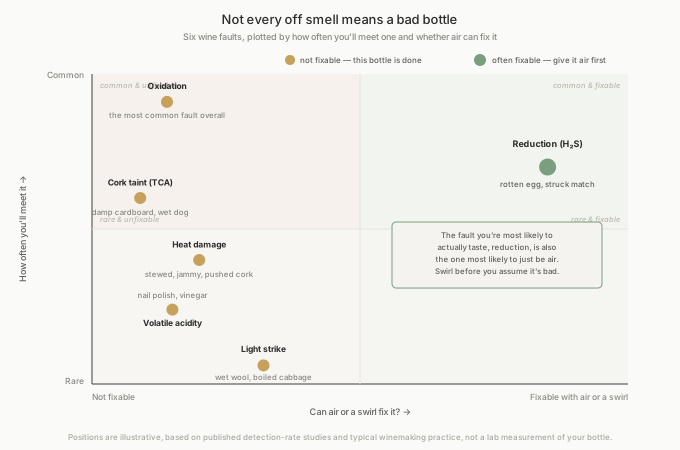
The genuinely useful insight sits in the top right corner. Reduction, the fault you’re statistically most likely to actually encounter in a young white or a screwcap-sealed red, is also the one most likely to just be air. Everything on the left side of the chart, by contrast, is a fault that happened during production or storage, sealed inside the bottle, and there is nothing a swirl can do about any of it.
Cork Taint (TCA): Wet Cardboard and Wet Dog
Cork taint is the easiest fault to describe and, once you’ve smelled it, hard to mistake for anything else: damp cardboard, a musty basement, wet newspaper, or — the classic shorthand — wet dog. It comes from TCA forming when certain moulds react with chlorine-based compounds once used to treat and bleach natural cork, though the AWRI has also shown TCA can form independently in oak barrels, so a “corked” character doesn’t always mean the cork itself is to blame. Whatever the source, there’s no fix. Decanting won’t help, letting it “breathe” won’t help, and a wine that’s flat-out corked will still be flat-out corked in an hour. If a bottle smells like a wet basement the moment it’s poured, it’s a fault, not a style, and it’s a legitimate reason to send it back at a restaurant or return it to a shop.
Oxidation: The Fault That Comes for Every Bottle Eventually
Oxidation is widely considered the most common fault of all, because it’s really just chemistry doing what chemistry does: too much contact with oxygen turns fresh fruit character into something duller, browner, and often sherry-like, the same way a sliced apple browns on the counter. A young white that’s oxidised loses its bright fruit and takes on a flat, slightly nutty or bruised-apple character; a red loses vibrancy and starts tasting tired well before its time. It can happen at the winery from a poor seal, in transit from heat and vibration, or simply from a bottle sitting upright and dried-out on a shelf for years, letting air creep past the cork. As with cork taint, there’s no fixing it after the fact — the same oxygen exposure that ages wine gracefully in tiny doses ruins it in large ones, and once a bottle has tipped over that line, air is the problem, not the solution.
Reduction: The Rotten-Egg Smell That Usually Isn’t Fatal
Reduction is the one genuine good-news story on this list. It shows up as a whiff of rotten egg, burnt rubber, or a just-struck match, caused by sulfur compounds — chiefly hydrogen sulfide — that form when yeast runs short of nutrients during a fermentation kept deliberately short of oxygen. It’s become more common as more winemakers use screwcaps and low-oxygen techniques specifically to preserve fresh fruit character, which ironically makes mild reduction more likely to survive into the bottle. The good news is that reduction is usually the most forgiving fault there is: a good hard swirl, a few minutes of air, or a proper decant is often all it takes for the smell to blow off completely. For a stubborn case, wine writers have long recommended an old chemist’s trick — dropping a clean copper coin into the glass, since copper reacts with hydrogen sulfide and pulls it out of the wine entirely. It sounds like a party trick, but the chemistry is real. A proper decant does the same job at a larger scale, which is exactly why the same technique recommended for opening up a young, tight red is often the fix for a reductive one.
Volatile Acidity, Heat Damage, and Light Strike
Three less common faults round out the list, and none of them are fixable at the table. Volatile acidity (VA) is the nail-polish-remover or vinegar smell that shows up when acetic acid bacteria get into the wine, usually during winemaking; a trace can add complexity in a big, rustic red, but past a certain point it just tastes like salad dressing, and there’s no swirling your way back from it. Heat damage, sometimes called “cooked” or maderised wine, happens when a bottle gets too hot in transit or storage — think a delivery truck with no climate control, or a case left in a hot car — and shows up as a stewed, jammy flavour with a noticeably pushed-up cork, since heat expands the liquid and forces it against the closure. Keeping bottles somewhere cool and stable matters more than most people assume precisely because of this. Light strike, or goût de lumière, is the least recognised of the three: certain wavelengths of light react with riboflavin in the wine to produce sulfur compounds, turning a crisp white or sparkling wine cabbage-y and dull in as little as a few hours of direct sun. It’s the reason white wine and Champagne are traditionally bottled in tinted glass, and the reason a bottle that’s been sitting in a sunny shop window is worth a second thought before you buy it.
Is Brettanomyces Always a Wine Fault?
This is the one fault on this list that doesn’t have a clean answer, and it’s worth being honest about that rather than pretending the wine world agrees. Brettanomyces — “Brett” — is a wild yeast that produces compounds smelling of barnyard, band-aid, leather, or a wet saddle. Most trained tasters and the wine industry mainstream treat any detectable Brett as a flaw, full stop, and it’s easy to see why: past a certain concentration, it reliably reads as unpleasant to most palates, and it’s technically a spoilage organism doing something a winemaker didn’t intend. But plenty of respected, traditional producers in the southern Rhône, Burgundy, and parts of Bordeaux have tolerated low-level Brett for generations as part of a wine’s regional signature, and it turns up constantly, deliberately or not, across the natural wine world, where minimal intervention is treated as a feature rather than a risk to manage out. The honest position is that Brett exists on a real spectrum: a faint, savoury whisper of it can add genuine complexity that some drinkers actively seek out, while a wine dominated by it smells like a barn, and reasonable, experienced tasters land in different places on exactly where that line sits. Sensory researchers describe the same pattern in more technical terms: once the compounds responsible cross an individual’s personal detection threshold, perception of them turns negative almost across the board, but that threshold varies enough from person to person that two trained tasters can disagree in good faith about the same glass. If you like it, that’s a legitimate preference, not a lack of a trained palate.
What to Actually Do at a Restaurant
The ritual of a server pouring a taste before the table is served exists for exactly this reason, and it’s worth using it properly rather than performing a quick, awkward sip out of politeness. Give the glass a real look, a real swirl, and a real sniff before tasting — most faults announce themselves on the nose well before they hit your tongue. If you get wet cardboard, vinegar, or a flat, dulled, sherry-like character on a wine that shouldn’t taste like sherry, that’s a legitimate, fixable-by-nobody fault, and any decent restaurant will replace the bottle without a fuss. If instead you get a brief whiff of rotten egg or a struck match that fades as you swirl, that’s very likely reduction doing exactly what reduction does — give it the two minutes it deserves in the glass before deciding anything. The one thing not to do is send back a wine simply because it tastes different from what you expected: an unfamiliar grape, an unusually savoury style, or a trace of Brett you’ve just never encountered before is a matter of taste, not a fault, and the two are worth telling apart with a clear head rather than an anxious first sip.
A bottle bought from a shop rather than a restaurant deserves the same fair test, just without a server watching you do it. Pull the cork, give the wine a proper swirl and sniff before writing it off, and if it’s genuinely corked, oxidised, or otherwise faulty, take it back with the receipt. Reputable retailers replace or refund a faulty bottle as a matter of course, because they’d rather absorb one bad cork than lose a customer over it, and cork taint in particular is common enough that most wine shops treat it as a routine, no-questions-asked return rather than something you need to argue your way through.
Frequently Asked Questions About Wine Faults
What does corked wine actually smell like?
Damp cardboard, a musty basement, wet newspaper, or wet dog. It’s caused by a compound called TCA and is detectable by trained tasters at just a few parts per trillion, so even a mild case is usually noticeable as a dulling of the wine’s fruit rather than a dramatic smell. It has nothing to do with small pieces of cork floating in your glass, which is a harmless, unrelated annoyance.
Can you fix a wine fault by decanting or swirling it?
Sometimes, but it depends entirely on which fault it is. Reduction, the rotten-egg or struck-match smell caused by sulfur compounds, often clears up completely with a swirl or a few minutes of air, since the smell is genuinely volatile. Cork taint, oxidation, volatile acidity, heat damage, and light strike are all permanent and will not improve with time in the glass or a decanter.
What is the most common wine fault?
Oxidation is generally considered the most common fault overall, since it can affect any wine that’s been exposed to too much oxygen, whether from age, poor storage, or a compromised seal. Cork taint is a close second in bottles sealed with natural cork, with widely cited rates ranging from roughly 1% to 6% depending on the study and tasting panel.
Is Brettanomyces always considered a wine fault?
No, and it’s genuinely debated. Most trained tasters treat any detectable Brett, which smells of barnyard, band-aid, or leather, as a flaw. But some traditional producers, especially in the southern Rhône and Burgundy, and much of the natural wine world tolerate or even welcome a low-level presence of it as part of a wine’s character. A faint trace is a matter of taste; a wine dominated by it is more widely agreed to be a fault.
Why do some wines smell like rotten eggs when first opened?
That smell is reduction, caused by hydrogen sulfide and related sulfur compounds forming during a low-oxygen fermentation, often when yeast runs short of certain nutrients. It’s become more common as more winemakers use screwcaps and minimal-oxygen techniques to preserve fresh fruit character. Unlike most other faults, it usually clears up quickly with a swirl, a decant, or brief contact with a clean copper coin.
Should I send a wine back at a restaurant if it smells off?
Give it a real swirl and a real sniff first. If you get wet cardboard, vinegar, or a flat, dulled character, that’s a genuine, unfixable fault and any decent restaurant will replace it without argument. If you get a brief rotten-egg or struck-match note that fades as you swirl, that’s likely reduction, not a fault, and worth giving a couple of minutes before deciding. A wine that’s simply unfamiliar or more savoury than you expected isn’t a fault at all.