Muscadet, the bone-dry white that smells of the sea, is made from a grape called Melon de Bourgogne, which was once ordered destroyed in Burgundy, the place it is named after. In the usual telling, it found a second home around Nantes after the winter of 1709 killed so many local vines that a replacement was needed. That is one stretch of one river. This guide to Loire Valley wine follows the Loire inland from Nantes to Sancerre, about 332 km apart in a straight line, through four wine regions that grow different grapes on different rocks: sea-spray Muscadet, Chenin Blanc in every style from bone dry to honeyed to sparkling, Cabernet Franc with its raspberries and pencil shavings, and the Sauvignon Blanc the world imitates. The organising idea is simple. On a Loire label the place name does the work the grape name does elsewhere, so the river is the key: learn where along it a name sits and you can predict the grape, the style and the dinner. InterLoire’s 2024 key figures show why you need one, because no colour or grape runs the show. In the three western regions they cover, white is the biggest colour at only 36% of the wine, and the biggest grape is a red, Cabernet Franc, at 29%.
In this article
- 1 Loire Valley Wine at a Glance
- 2 How to Read a Loire Valley Wine Label
- 3 One River, Four Wine Regions
- 4 The Pays Nantais: A Burgundian Grape by the Sea
- 5 Anjou and Saumur: Where Chenin Does Everything
- 6 Touraine: Vouvray, Chinon and the Garden of France
- 7 Sancerre and Pouilly-Fumé: Sauvignon at the Top of the River
- 8 Where the Loire’s Stories and Numbers Disagree
- 9 What to Eat with Loire Valley Wine
- 10 Loire Valley Wine: Your Questions Answered
Loire Valley Wine at a Glance
- The river: Wikipedia places the wine region along the Loire from Muscadet, near Nantes on the Atlantic coast, to Sancerre and Pouilly-Fumé, southeast of Orléans: about 332 km in a straight line from Nantes to Sancerre, and further by river.
- The regions: this guide uses four, running inland from the Atlantic: the Pays Nantais, Anjou-Saumur, Touraine and the Centre-Loire. Guides count the river’s regions differently, so four is a teaching number.
- The grapes: Melon de Bourgogne, Chenin Blanc, Cabernet Franc and Sauvignon Blanc carry most of the story. InterLoire’s key figures call the Loire the number one wine region in the world for Chenin, Cabernet Franc and Melon blanc.
- The styles: of the wine in InterLoire’s figures, 36% is white, 28% rosé, 19% red and 17% sparkling.
- The size: 42,000 hectares in InterLoire’s three regions and the Val de Loire IGP, and 56,000 across the wider basin, which its report says holds 53 AOP and 7 IGP.
- The label rule: names are places, not grapes. Sancerre means Sauvignon Blanc, Vouvray means Chenin Blanc and Chinon means Cabernet Franc.
- The sweetness catch: many Loire wines are dry, but Chenin Blanc is made in every style, so a Vouvray or Anjou label needs reading.
How to Read a Loire Valley Wine Label
Most Loire appellation wines do not name the grape, so start with the decoder. You are expected to know the grape from the place, and the sections below explain each place in turn. Our guide to French wine labels explains the place-not-grape convention and the Loire’s own vocabulary; this is the Loire-only cheat sheet.
- Muscadet, Muscadet Sèvre et Maine: Melon de Bourgogne, dry white. Sur lie means aged on the lees.
- Sancerre, Pouilly-Fumé, Menetou-Salon, Quincy, Reuilly: Sauvignon Blanc for the whites and Pinot Noir for the reds and rosés, the region’s two principal grapes. Pouilly-Fumé and Quincy are white only.
- Pouilly-sur-Loire: Chasselas, not Sauvignon Blanc. Pouilly-Fumé is the Sauvignon.
- Vouvray, Montlouis-sur-Loire, Savennières, Anjou Blanc, Coteaux du Layon, Bonnezeaux, Quarts de Chaume: Chenin Blanc, from bone dry to very sweet. Look for sec, demi-sec, moelleux and doux.
- Chinon, Bourgueil, Saint-Nicolas-de-Bourgueil, Saumur-Champigny: Cabernet Franc reds, called Breton locally.
- Rosé d’Anjou, Cabernet d’Anjou, Rosé de Loire: pink wines. Rosé d’Anjou is mostly Grolleau and Cabernet d’Anjou is Cabernet Franc, Cabernet Sauvignon or both, according to Wikipedia, while Rosé de Loire is dry and can use grapes from anywhere in the Loire, says Wine Folly.
- Crémant de Loire, Saumur Mousseux, Vouvray Mousseux: sparkling wine made by the traditional method. Crémant de Loire is the broadest of the three.
- Touraine: the broad appellation around Tours. Its white is Sauvignon Blanc, according to InterLoire.
One River, Four Wine Regions
Start with the map, because everything else follows from it. The Loire flows north towards Orléans, curves west in a great bend and runs on to the Atlantic, so the vineyards sit along a long arch rather than a straight line, as the chart below shows. Wine Folly’s Loire Valley guide splits the valley into zones running inland from the sea, and the climate changes with them.
Near the coast, Wine Folly says, the Pays Nantais is maritime, with the Atlantic 10–96 km (6–60 miles) to the west and cold, damp, stormy winters. Far upriver the Centre-Loire is continental, with warm summers, cold, snowy winters and very little Atlantic influence. In between, the river works as a radiator: Wikipedia says it adds the few degrees of warmth that let grapes ripen where the land to the north and south is unfavourable for vines. The rock changes too, from hard schist, gneiss and granite in the west to soft white tuffeau limestone in the middle and chalky limestone and flint at the top, and the same grape can taste different on each.
The river has been making wine for a long time. Wikipedia says archaeological evidence suggests the Romans planted the first Loire vineyards in the 1st century AD, and that Sancerre’s wines had a reputation across Europe by the 11th. Later, one set of customers left a mark on three different styles: the Dutch. Wikipedia’s entries say Dutch traders introduced sweet wine production to Anjou for the Rotterdam market, Dutch merchants oversaw plantings around Vouvray to supply London, Paris and Rotterdam, and Dutch buyers encouraged early-ripening Melon around Nantes to distil into brandy.
The common thread is cool-climate wine built on acidity. Wikipedia says Loire winemaking generally avoids barrel ageing and malolactic fermentation, and that the weather of the year matters more than in other French regions, because the risk is grapes that never ripen enough to balance their acidity. In a cool year Cabernet Franc turns paler and more vegetal; in a ripe one it shows raspberries and pencil shavings.
From the sea inwards, this guide uses four regions. The Pays Nantais makes Muscadet from Melon de Bourgogne. Anjou-Saumur is Chenin Blanc in every style, plus Cabernet Franc, rosé and a lot of sparkling wine. Touraine adds Vouvray, Chinon and Bourgueil, and Sauvignon Blanc. The Centre-Loire, at the top, is Sancerre and Pouilly-Fumé. The chart puts them on the map, and sets beside it what the Loire actually makes.
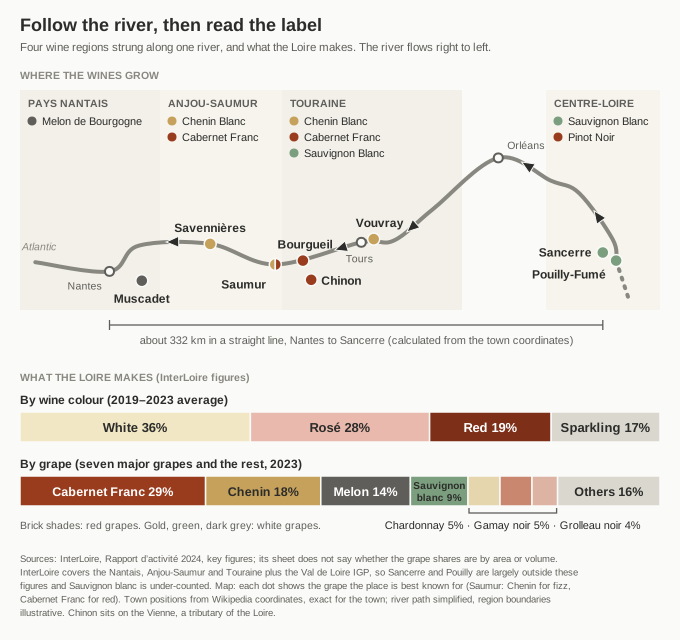
Read the lower half first, because it holds the surprise. Rosé (28%) and sparkling wine (17%) together outweigh white, and red, at 19%, is barely ahead of the fizz. By grape, the largest share belongs to a red, Cabernet Franc, at 29%, followed by Chenin at 18% and Melon blanc at 14%. InterLoire’s sheet does not say whether the grape shares are by area or by volume, so treat them as a portrait rather than a census.
Two cautions. Sauvignon Blanc’s 9% is partly an accident of the boundary: InterLoire’s remit is the Nantais, Anjou-Saumur and Touraine plus the Val de Loire IGP, while the Centre-Loire, home of Sancerre, has its own official website and sits largely outside the figures. And wine colour is not grape colour: Cabernet Franc also makes pink Cabernet d’Anjou, so its 29% cannot be read as red wine alone.
The Pays Nantais: A Burgundian Grape by the Sea
The westernmost region is Muscadet country, and Wine Folly describes it in one breath: the Pays Nantais is “all about white wines”, of “the bracing, citrusy, sea-spray-in-your-face type” that “scream for fresh oysters”. The best known of them, Muscadet, comes from one grape, Melon de Bourgogne, which despite the name has nothing to do with Muscat.
Melon’s relatives are more surprising. Wikipedia’s entry on Gouais Blanc, the medieval peasant grape, lists Melon de Bourgogne, Chardonnay and Gamay noir among its descendants, and its Melon page calls the grape a cross between a Pinot and Gouais Blanc. Melon, in other words, is a sibling of Chardonnay and Gamay, and our guide to Gamay vs Pinot Noir tells the story of another family member that Burgundy tried to banish.
How Melon came to rule here is usually told as a story of frost. Wikipedia and Wine Folly both say the winter of 1709 destroyed so many vines around Nantes that replanting was needed, and Wikipedia adds that Louis XIV ordered the frost-resistant Melon to be given preferential treatment. The details are less settled than the legend, as the section on disagreements below shows.
On a Muscadet label, look for sur lie, meaning aged on the lees, the dead yeast left after fermentation. Wikipedia says that since 1994 only the Sèvre et Maine, Coteaux de la Loire and Côtes de Grandlieu appellations may use the term, and the wine must spend at least a full winter on its lees and be bottled straight off them. Sèvre et Maine, south and east of Nantes, is the heartland, making about 80% of all Muscadet according to Wikipedia, and Wine Folly says three of its villages, Clisson, Gorges and Le Pallet, now have appellations of their own, with required lees ageing of 24–36, 24–40 and 18 months respectively.
Anjou and Saumur: Where Chenin Does Everything
Move inland and the sea fades, the rock softens and Chenin Blanc takes over. Wikipedia says Chenin has been planted in Anjou since at least 845 AD, at the Abbey of Glanfeuil, and Wine Folly says it is made in every style, dry, sweet and sparkling, and “pairs with almost every food because of its high level of acidity”. Our Chenin Blanc guide covers the grape in full, so this is the regional map.
Anjou splits in two by rock. Wine Folly describes dark schist in the west, called Anjou noir, which gives more powerful, structured wines, and pale tuffeau limestone in the east. Savennières, just south of Angers on the Loire’s right bank, is on the schist side: Wikipedia calls its Chenin usually dry, more full-bodied than dry Vouvray and often austere in youth, and Wine Folly says some consider it “the best dry Chenin in the world”. Its top enclave, Coulée de Serrant, is a single estate of about 7 hectares, first planted in 1130 by Cistercian monks, says Wikipedia.
South of the river, the Layon and the Aubance run parallel towards the Loire, and in good autumns their valleys grow noble rot, the same fungus behind Sauternes, which our dessert wine guide explains. Wine Folly says the Layon has some of the best conditions in the world for it, with morning fog, Chenin Blanc and dry winds, and calls Quarts de Chaume the Loire’s first Grand Cru for sweet wine. Wikipedia adds that Coteaux du Layon wines are never dry, though the sweetness varies.
Saumur is the sparkling half of the story. Wine Folly says miles of tunnels and caves carved from the limestone lie under its vineyards, the perfect place to age bright sparkling wine, and that the area is the heart of Crémant de Loire production. InterLoire’s key figures put the Loire second in France for sparkling AOP wine, after Champagne, and our guide to sparkling French wine beyond Champagne covers Crémant de Loire and Vouvray Mousseux in detail.
Then there are the reds and the pinks. Saumur-Champigny is Cabernet Franc, mostly since the 1800s on sandy, chalky soils, according to Wine Folly. Anjou is also rosé country: Wikipedia says Rosé d’Anjou, made mostly from Grolleau, was nearly 55% of all Anjou wine in the late 1980s and has declined since, while Wine Folly still puts rosé at half the region’s production. The share today depends on who you ask.
Touraine: Vouvray, Chinon and the Garden of France
Touraine, the stretch around Tours that Wine Folly calls the Garden of France, makes red, white, rosé and sparkling wine from some of the Loire’s most diverse plantings, according to Wikipedia, which adds that its soft limestone, tuffeau, is the same material used to build many of the famous Loire châteaux.
Vouvray is Chenin Blanc on a plateau just east of Tours. Wikipedia says the weather decides the style: cooler years favour dry and sparkling wine, warmer ones sweet wine from noble rot. The label tells you which, in four words that Wikipedia says are not strictly defined: sec (under 4 g/L of residual sugar), demi-sec (4–12), moelleux (12–45) and doux (over 45). Acidity masks sugar, so the same entry warns that a producer’s demi-sec can taste drier than their sec.
The reds are Cabernet Franc, which the Loire calls Breton. Wikipedia says Chinon, Bourgueil and Saint-Nicolas-de-Bourgueil make most of the Loire’s red Cabernet Franc, with Chinon the softest and richest, Bourgueil more tannic and firm, and Saint-Nicolas-de-Bourgueil the lightest in colour. Wine Folly describes the grape as light to medium in body, with a fresh tang of acidity, red fruit, pencil shavings and cedar, and Wikipedia says Chinon is typically served slightly cooler than most reds. Cabernet Franc is also one of the two parents of Cabernet Sauvignon, the other being the Sauvignon Blanc you will meet at the top of the river, and our Cabernet Sauvignon guide tells how the two met.
Touraine is also Sauvignon Blanc country. InterLoire’s Touraine page says the white wines of the Touraine appellation are 100% Sauvignon Blanc and account for 60% of its production.
Sancerre and Pouilly-Fumé: Sauvignon at the Top of the River
At the top of the river the Atlantic is a long way off, and the climate says so. Wine Folly describes the Centre-Loire as continental, with warm summers, cold, snowy winters and very little ocean influence, and Wikipedia gives Sancerre short, hot summers and long, cold winters. The region’s official website puts the style in a line: white wines from Sauvignon Blanc, and red and rosé wines from Pinot Noir.
Wikipedia gives Sancerre about 2,600 hectares, an AOC for white wine since 1936, and a red wine, made from Pinot Noir, that makes up roughly a fifth of output. Sauvignon’s grip is newer than its fame suggests. Wikipedia says the area’s traditional wines were Pinot Noir and Gamay reds until phylloxera in the late 19th century, when vineyards were replanted with Sauvignon Blanc, while Wine Folly says the area was originally planted with Chasselas. The accounts differ on what came first, but both have Sauvignon taking over afterwards.
Sancerre is a good place to watch one grape read the rock. Wine Folly describes three main soils: terres blanches, a Kimmeridgian marl that is slow to warm and lends richness and texture; caillottes, a stony limestone that warms quickly and gives lean, early-maturing wines; and silex, flint and clay, slow to warm, which it says gives white wines a reductive character that smells of smoke and gunflint.
Across the river, Pouilly-Fumé is the same grape on a near-identical soil profile, in Wine Folly’s words, and Wikipedia says it has been an AOC since 1937 and covers about 1,200 hectares. It is not Pouilly-Fuissé, a Chardonnay from the south of Burgundy, nor Pouilly-sur-Loire, the neighbouring appellation where Wine Folly says Chasselas is grown.
Menetou-Salon, Reuilly and Quincy are the smaller neighbours, Wikipedia says. For a sense of what Loire Sauvignon is not, our guide to New Zealand Sauvignon Blanc sets Marlborough’s tropical fruit against Sancerre’s quieter, more mineral style, and our goat cheese pairing guide explains why Sancerre and the local Crottin de Chavignol are such a famous match.
Where the Loire’s Stories and Numbers Disagree
A guide that repeats every figure it finds is not doing you a favour. The Loire is long, old and split between several trade bodies, and its numbers and stories change with the teller. Here are four places where the sources I read disagree.
How did Melon reach Muscadet? Wikipedia’s Muscadet entry says Melon was planted around Nantes in or before the 17th century and only became dominant after the 1709 freeze, so the frost is a story of takeover, not arrival. Most ampelographers credit Dutch traders looking for neutral white wine to distil, it adds, while one estate near Nantes, Château de la Cassemichère, claims its first Melon vines came from Burgundy in 1740. The royal order rests on the ampelographer Pierre Galet, who, according to Wikipedia, found evidence that Louis XIV ordered replanting with a grape called Muscadent blanc, most likely Melon. The frost appears in nearly every account. The rest is a good story with several versions.
How many regions, appellations and hectares? Wikipedia divides the Loire into three sections, Wine Folly into four areas that include an Upper Loire around Auvergne, and InterLoire’s website lists five vineyards: Nantes, Anjou-Saumur, Touraine, the Loir Valley and Haut-Poitou. Wikipedia counts 87 appellations under the AOC and IGP systems, while InterLoire’s report, citing INAO, counts 53 AOP and 7 IGP for the whole basin. On size, InterLoire gives 42,000 hectares for its remit and 56,000 for the basin, and Wikipedia says more than 185,000 acres, about 75,000 hectares. These probably reflect different boundaries and different years more than errors, which is why this guide quotes figures with their scope attached.
Where did Cabernet Franc start? Wikipedia’s tidy version is that Cardinal Richelieu transported cuttings to the Loire in the 17th century, to be planted at the Abbey of Bourgueil under an abbot called Breton, whose name became associated with the grape. The same entry says the grape was planted in the Loire long before it shows up in Bordeaux’s records, which go back to the end of the 18th century, and Wine Folly puts its origin somewhere between Bordeaux and the Spanish Basque Country, most likely the Basque region. Breton is still its name in the Loire. How it got there is a question mark.
Why is it called fumé? Wikipedia’s Pouilly-Fumé entry offers two explanations: the grey, smoke-coloured bloom on ripe Sauvignon grapes, and a smoky gunflint aroma credited to the vineyards’ soil. Its Loire Valley entry adds a third, the morning fog off the river. Whichever is right, read “flinty” as a description of the smell, not as proof about the soil.
What to Eat with Loire Valley Wine
Many Loire wines are built on acidity and freshness rather than oak, which makes them natural table wines, and the classic pairings come from the region itself. Muscadet goes with oysters, which Wine Folly says those wines scream for, and Sancerre goes with goat cheese. For everything else, match the style rather than the place: a dry, saline white with anything from the sea, a high-acid Chenin with almost anything, and a light, savoury Cabernet Franc, served a little cooler than most reds, with dry-cured ham. Sweet Chenin from the Layon, or a moelleux Vouvray, is closer to a dessert wine than a table wine.
Loire Valley Wine: Your Questions Answered
What is Loire Valley wine known for?
Variety along a single river. The Loire makes dry white from Melon de Bourgogne (Muscadet) and Sauvignon Blanc (Sancerre and Pouilly-Fumé), Chenin Blanc in every style from dry to sweet to sparkling (Vouvray, Savennières, Coteaux du Layon), red Cabernet Franc (Chinon and Bourgueil), rosé and Crémant de Loire.
Is Loire Valley wine sweet or dry?
It depends on the label. Muscadet and Sancerre are dry, and the Muscadet appellation caps residual sugar at 5 g/L. Chenin Blanc comes in every style: Vouvray labels use sec, demi-sec, moelleux and doux for dry to very sweet, Savennières is usually dry, and Coteaux du Layon wines are never dry. Rosé d’Anjou is medium-sweet, so check the label before pouring it with dinner.
What grapes are grown in the Loire Valley?
Four carry most of the story: Melon de Bourgogne in the Pays Nantais, Chenin Blanc and Cabernet Franc in Anjou-Saumur and Touraine, and Sauvignon Blanc in Touraine and the Centre-Loire, where Pinot Noir makes the red and rosé. InterLoire lists seven major grapes for its area in 2023: Cabernet Franc 29%, Chenin 18%, Melon blanc 14%, Sauvignon blanc 9%, Chardonnay 5%, Gamay noir 5% and Grolleau noir 4%, with other grapes making up the remaining 16%.
What is the difference between Sancerre and Pouilly-Fumé?
The white wines of both are dry and made only from Sauvignon Blanc, from vineyards that face each other across the Loire, and both can show the flinty, smoky note called gunflint. Wikipedia reports that Jancis Robinson, Hugh Johnson and Karen MacNeil say only very experienced tasters can tell them apart blind. The practical difference is that Sancerre also makes red and rosé from Pinot Noir, about a fifth of its output, while Pouilly-Fumé makes only white.
Is Muscadet the same as Muscat?
No. Muscadet is a place and a wine, made from the Melon de Bourgogne grape, which has no relation to the Muscat family. Despite the hint of muskiness in the name, the wine is neutral, dry and lean, often aged on its lees, and Wine Folly pairs it with fresh oysters.
Is Loire Valley wine a good choice for beginners?
Yes, with one warning. The wines tend to be fresh and crisp, and Wikipedia notes that winemaking in the region generally avoids barrel ageing, so there is little heavy oak to get past. The warning is the labels, which name places rather than grapes. Learn four names and you have the map: Muscadet for Melon de Bourgogne, Sancerre for Sauvignon Blanc, Vouvray for Chenin Blanc and Chinon for Cabernet Franc.