In 1920, 62.2% of the wine made in Alsace and Lorraine was exported. Two years later the figure was 9.2%. The German market that Alsace had supplied for almost five decades, since the German Empire took the region in 1871, had collapsed, and French drinkers did not want what was left: Alison Carrol of Brunel University London quotes the president of Strasbourg’s Chamber of Commerce explaining that French consumers found Alsatian wines “too green, too acidic and too expensive”. Today the Alsace wine region is best known for aromatic white wine, and it is the one major French region that puts the grape on the label. This guide explains how it got from one to the other and how to shop from it: why the vines get so little rain, which grapes matter, what Grand Cru and Vendange Tardive mean, and why, since the 2021 harvest, an Alsace still wine has to say on the label how sweet it is. The organising idea is that Alsace is shaped by a border and a wall. The border, which moved four times between 1871 and 1945, explains the label and the market. The wall, the Vosges mountains, explains the glass: in one Météo-France dataset a mountain station averages 2,334 mm of rain a year, while a station on the Rhine plain averages 606 mm.
In this article
- 1 Alsace Wine Region at a Glance
- 2 A Border That Moved Four Times in 74 Years
- 3 Why the Alsace Wine Region Is So Dry: A Wall of Mountains
- 4 Rift-Valley Soils and the 51 Grand Crus
- 5 The Grapes of Alsace: Four Noble, and the Rest
- 6 How to Read an Alsace Wine Label
- 7 Is Alsace Wine Dry or Sweet? The 2021 Sweetness Rule
- 8 Crémant d’Alsace and Pinot Noir: The Quiet Growth
- 9 What to Eat with Alsace Wine
- 10 Where the Alsace Wine Region’s Numbers Disagree
- 11 Alsace Wine: Your Questions Answered
Alsace Wine Region at a Glance
- The place: north-eastern France, on the German border. The vineyards run in a narrow strip along the lower eastern slopes of the Vosges mountains, at altitudes of 175–420 m, according to Wikipedia, with the Rhine and Germany just beyond.
- The size: about 15,500 hectares planted in 2023, according to Decanter’s guide to Alsace, up from 9,400 hectares in 1967 in figures Wikipedia cites.
- The colour: about 90% white, says the Oxford Companion to Wine as cited by Wikipedia. The reds and rosés are Pinot Noir, and sparkling Crémant d’Alsace is now about a third of production.
- The grapes: four noble grapes, Riesling, Gewurztraminer, Pinot Gris and Muscat, plus Pinot Blanc, Auxerrois, Sylvaner and Pinot Noir.
- The appellations: three: Alsace AOC, created in 1962, Alsace Grand Cru, with 51 named vineyards, and Crémant d’Alsace.
- The label rule: the grape is named, the bottle is a tall flûte, and since the 2021 harvest a still wine has to show a sweetness term or scale.
- The road: the Route des Vins d’Alsace, which Wikipedia describes as a road of about 170 km passing through 67 communes, crosses the main wine-producing areas.
A Border That Moved Four Times in 74 Years
Alsace changed hands four times in 74 years. Wikipedia’s Colmar entry gives the sequence: ceded to the new German Empire in 1871 after the Franco-Prussian War, returned to France after the First World War under the 1919 Treaty of Versailles, annexed by Nazi Germany in 1940, and back under French control after the battle of the Colmar Pocket in 1945. Wine followed the flag. Carrol’s study of the interwar years says Alsatian winemakers spent five decades making wine for German drinkers, then had to remake it for French ones.
It went badly at first. The Treaty of Versailles let Alsace and Lorraine send goods to Germany duty-free for five years, but the German mark collapsed and Germans boycotted French goods over the occupation of the Ruhr, and exports fell from 62.2% to 9.2% of production between 1920 and 1922. French buyers did not fill the gap. A 1921 session of the region’s consultative council despaired that even Alsatian wine dealers bought “almost all” of their wine from the French interior.
The industry’s answer was quality. Growers had argued over whether to keep making everyday wine from hybrid vines, and an overproduction crisis that peaked in 1929 “tipped the balance decisively in favour of quality plants”, in Carrol’s words. The vineyard shrank from 18,804 hectares in 1919 to 11,344 in 1938, and Wikipedia cites 9,400 hectares for 1967. By 2023 it had recovered to about 15,500, according to Decanter.
The law was slow to catch up. Wikipedia says German law stayed in force in Alsace as local law after 1919, which held up recognition of its wines. A 1945 ordinance on origin became the basis for the 1962 decree that created the Alsace AOC, and the Grand Cru classification followed in 1975.
The German decades still show. Decanter points out that Germanic influences loom large, from Grand Cru names such as Schlossberg and Rosacker to flute bottles bearing grape names like Riesling and Gewurztraminer, and Wikipedia adds that labelling by grape was a German tradition long before New World wines made it fashionable. Alsace also borrowed a Hungarian name: its Pinot Gris was labelled Tokay until the 2007 vintage, a story our Pinot Grigio guide tells.
Why the Alsace Wine Region Is So Dry: A Wall of Mountains
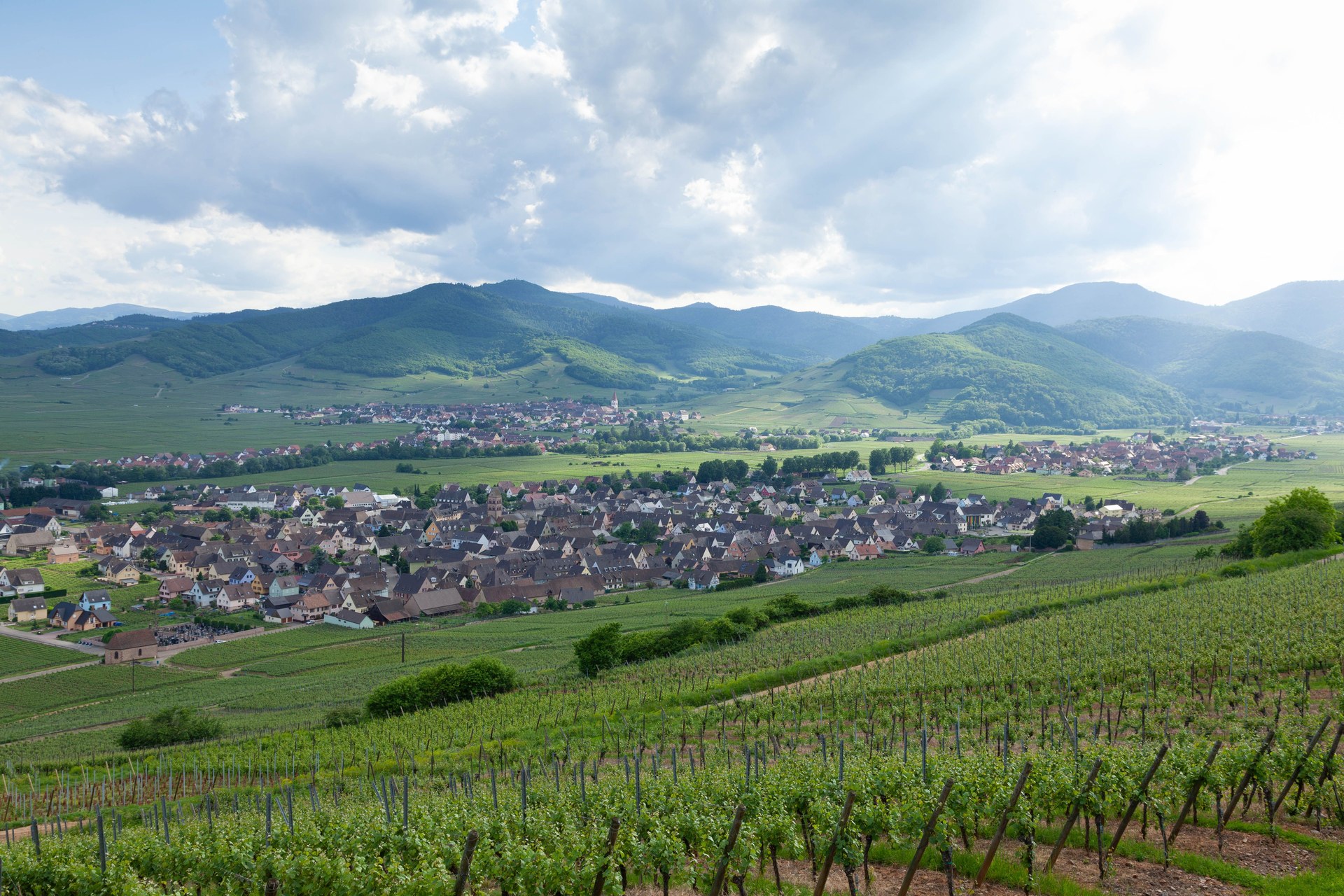
Look at Alsace on a relief map and the logic is plain. The vines sit on the lower eastern slopes of the Vosges, with the Rhine plain in front of them and the mountains behind. Jana Minářová of Charles University in Prague notes that the range lies almost perpendicular to the prevailing westerly air flow and is one of the first barriers the Atlantic westerlies meet. Wikipedia explains the dryness of Colmar the same way: the mountains force clouds arriving from the west to rise, most of their moisture falls over the higher ground, and the air is warm and dry by the time it reaches the town.
In a 2013 study of Vosges rainfall in AUC Geographica, Minářová used Météo-France daily records from 14 stations between 1950 and 2011. The chart plots the averages. The seven mountain stations, at 505–796 m, average 1,084–2,334 mm a year. The seven in the foothills and on the Rhine plain, at 139–248 m, average 606–730 mm. No station falls between the two groups. The wettest, Sewen – Lac Alfeld, gets 3.9 times as much as the driest, Oberentzen, a ratio the paper itself describes as almost four times.
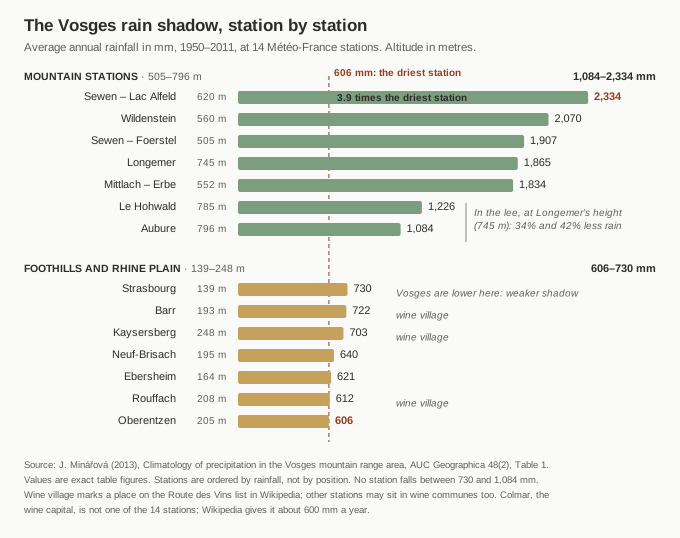
Three things stand out. First, the vineyards live on the dry side of the line: Barr, Kaysersberg and Rouffach, all on the Route des Vins, average 722, 703 and 612 mm. Second, altitude alone does not explain it. Aubure and Le Hohwald, at 796 and 785 m, are the two highest stations, yet they sit on the leeward slope and get 1,084 and 1,226 mm, which is 42% and 34% less than the 1,865 mm at Longemer, 745 m up on the windward side. Minářová reports that a dependence between a station’s altitude and its rainfall was not proved, and lists slope exposure and position relative to the Vosges among the other factors. Third, the shadow is not uniform. Strasbourg, where the Vosges are lower, is the wettest lowland station at 730 mm.
What does a dry slope do for wine? Decanter’s guide calls Alsace one of France’s driest and sunniest wine regions, where warm days and cool summer nights let grapes ripen evenly. Ripeness is the thread through the rest of this guide. It is why some Alsace wines reach 14–15% alcohol, according to Wine Folly, why late-harvest wines are a speciality, and why the question of how much sugar is left in the bottle eventually needed a law.
Rift-Valley Soils and the 51 Grand Crus
The ground is as unusual as the weather. Wikipedia says Alsace sits on the western part of the Rhine Graben, a block that dropped down between the Vosges and Germany’s Black Forest, and its Grand Cru article adds that the vineyards lie on the fault zone, covered by fans of sediment washed down from the heights. The result is a patchwork: granite, gneiss and slate on the upper slopes, limestone and marl, in places under wind-blown loess, lower down, and silt and gravel on the plain. Decanter’s guide sums up the range as sandstone and slate to limestone and clay.
That patchwork is the case for the Grand Cru system. As in Burgundy, where our Burgundy guide explains the idea, a Grand Cru belongs to a named vineyard rather than to a producer. Schlossberg at Kientzheim was recognised first, on 20 November 1975, and Kaefferkopf at Ammerschwihr became the 51st in January 2007. Decanter counts 37 of the 51 in the southern Haut-Rhin and 14 in the northern Bas-Rhin, and puts Grand Cru at about 3.5% of production in 2022. The rules are strict. Wikipedia lists a yield limit of 55 hl/ha, a single named vineyard and the vineyard’s name on the label, and only the four noble grapes may be used, with a few exceptions: Decanter names Sylvaner at Zotzenberg, Pinot Noir at Hengst, Kirchberg de Barr and Vorbourg, and blends at Altenberg de Bergheim and Kaefferkopf.
Here is the part people get wrong: Grand Cru guarantees the site and the paperwork, not a style. Wine Folly says Grand Cru wines are usually rich, honeyed even when dry, and age-worthy, and that the best sites face south and south-east for the sun. Late-harvest wines can carry Grand Cru status too, so the label still has to be read.
The Grapes of Alsace: Four Noble, and the Rest
Alsace calls four grapes noble: Riesling, Gewurztraminer, Pinot Gris and Muscat. Wine Folly boils the region down to two words, dry and Riesling, and says Alsace Riesling will change your idea of a grape you may know as sweet. Gewurztraminer and Pinot Gris are the richer, more aromatic pair, and Wikipedia says residual sugar is more common in them than in Riesling, Muscat or Sylvaner, because they reach higher sugar levels at ripeness. Muscat is the rare one, and Wine Folly says it is made dry. Across all of them the style is aroma over oak: Wine Folly says floral and stone-fruit scents fly out of the glass, and that most producers skip oak so that ripeness, alcohol and acidity carry the wine.
This is how the vineyard divided in 2008, the latest grape-by-grape split I could verify (CIVA figures reproduced by Wikipedia, 15,535 hectares in total):
- Riesling: 21.7%
- Gewurztraminer: 18.6%
- Pinot Gris: 15.2%
- Auxerrois: 14.2% and Pinot Blanc: 7.0% (CIVA reports the pair together as 21.2%)
- Pinot Noir: 9.6%
- Sylvaner: 8.9%
- Muscat: 2.3%
- Chasselas: 0.6%, other grapes 1.3% and mixed plantings 0.6%
The mix has moved. Wikipedia says that between 1967 and 2007 Pinot Gris grew from 4% of the vineyard to 15%, the biggest gain, while Sylvaner, once the most planted grape, fell the most. Pinot Gris is also the grape where Alsace and Italy part company most dramatically, and our Pinot Gris vs Pinot Grigio guide compares the rich Alsace style with the light Italian one.
How to Read an Alsace Wine Label
Alsace is the exception to the place-not-grape rule that governs most French labels, as our guide to French wine labels explains. Here the grape is on the front, and Wine Folly says a wine named for a grape must be made entirely from it. The rest of the vocabulary is short:
- Riesling, Gewurztraminer, Pinot Gris, Muscat: the noble grapes. A single-grape label means that grape alone.
- Edelzwicker and Gentil: blends. Edelzwicker can combine any grapes the appellation allows. Gentil is an older, unregulated term that Wikipedia says is generally understood to need at least 50% noble grapes, so think of it as a higher-end Edelzwicker.
- Pinot or Klevner: a wine from any mix of the Pinot family, Wikipedia says, including Pinot Noir made white.
- A village or a named plot: some labels carry one of 13 commune names or a lieu-dit, a named plot, with stricter rules than standard Alsace AOC, according to Wine Folly.
- Alsace Grand Cru plus a vineyard name: one of the 51 sites described above.
- Vendange Tardive (VT) and Sélection de Grains Nobles (SGN): late-harvest wines, open only to the four noble grapes and defined by how ripe the grapes were at picking, not by how sweet the finished wine is. Wikipedia lists minimums of 14% potential alcohol for Riesling and Muscat VT and 15.3% for Pinot Gris and Gewurztraminer VT, rising to 16.4% and 18.2% for SGN, which is made from grapes affected by noble rot. Wine Folly says VT is usually sweet, though some producers ferment it fully dry.
- The flûte: the tall, slim bottle is a legal requirement, Wikipedia says, officially the vin du Rhin bottle. German regions use the same shape without a law, particularly for Riesling.
Is Alsace Wine Dry or Sweet? The 2021 Sweetness Rule
For most of its modern history the honest answer was that it depends, and the label would not tell you. Alsace makes dry Riesling and Muscat as a rule, but Wikipedia says residual sugar is more common in Gewurztraminer and Pinot Gris, and until 2020 there was no official labelling that separated completely dry wines from off-dry ones. Decanter reported that the confusion could leave some “dry” wines tasting sweeter than others.
That changed with the 2021 harvest. IWC and Vitisphere both report that a sweetness indication is now mandatory on AOC Alsace still wines, either as a written term or as a mark on a sliding scale, and Decanter reports that it can sit on the front or back label as long as it is easy to read. The terms follow EU definitions: sec is up to 4 g/L of sugar, demi-sec 4–12 g/L, moelleux 12–45 g/L and doux above 45 g/L. Crémant d’Alsace is not affected, because sparkling wine already had its own sweetness terms. The sources I read do not say whether Grand Cru labels are covered, so check those bottles.
Here is the part people get wrong: sec is a legal category, not a promise of bone-dry. The EU definition lets a wine with up to 9 g/L of sugar be called sec if its total acidity, measured as tartaric acid, is no more than 2 g/L below the sugar figure, so a 9 g/L wine needs at least 7 g/L of acidity. Vitisphere gives exactly that example, and demi-sec stretches to 18 g/L on the same logic with a 10 g/L margin. IWC notes that acidity plays a part in how sweet a wine tastes, so the rule is defensible, but it does mean two bottles marked sec can taste different. Our explainer on what dry wine means covers the EU definition and why acidity masks sugar.
Riesling may face a tighter rule. Decanter reported that producers voted for non-late-harvest Alsace Riesling to be dry as the EU defines it from the 2021 vintage, subject to approval by France’s appellation body, with a maximum of 9 g/L of sugar and at least 7 g/L of acidity at that level. Not everyone liked it. Pierre Gassmann of Domaine Rolly Gassmann, which has championed medium-dry and sweet Rieslings, asked what would become of them: “Declassify them?” A later Decanter guide says plainly that non-late-harvest Alsace Riesling must now be dry. I could not reach the legal text, so treat dry as the norm for Riesling and still read the label.
Crémant d’Alsace and Pinot Noir: The Quiet Growth
Two corners of Alsace have grown while the famous whites held steady. Decanter says Crémant d’Alsace production rose from about 240,000 hectolitres in 2013 to nearly 325,000 in 2023, 33% of Alsace wine production, and that Pinot Noir rose from 85,000 hectolitres in 1989 to close to 130,000 more recently, its highest-ever share at 13%. It credits higher Burgundy and Champagne prices and better quality in recent years. Crémant is made by the traditional method, Wine Folly says; the white is mostly Pinot Blanc and its relatives, and the rosé is 100% Pinot Noir. Our guide to sparkling French wine beyond Champagne compares it with the other Crémants. Wine Folly’s advice for a first Alsace bottle is a Crémant d’Alsace rosé and a dry Riesling, which it says explain the region better than any map.
What to Eat with Alsace Wine
The classic partners are local, rich and often pork-based. Our Pinot Gris guides name choucroute garnie, the braised sauerkraut and pork dish, and tarte flambée as the regional matches for Alsace Pinot Gris. Our Riesling pairing guide says Alsatian Riesling is generally dry to off-dry and fuller than German Riesling, with choucroute, pork, rich seafood and washed-rind cheeses, and that in Alsace foie gras is often served with an off-dry or sweet Riesling rather than Sauternes. For cheese, our wine and cheese guide pairs Munster, the region’s pungent washed-rind cheese, with Alsatian Gewurztraminer, on the logic that a difficult cheese wants the wine from its own place. Now that the label tells you where a wine sits on the sweetness scale, use it: dry for seafood, off-dry for spice, pungent cheese and foie gras.
Where the Alsace Wine Region’s Numbers Disagree
A guide that repeats every figure it finds does you no favours. Alsace’s numbers change with the teller, and here are the places where the sources I read disagree.
How dry is Colmar? Minářová’s paper cites an older source for Colmar at less than 550 mm a year. Wikipedia’s Colmar page says 595 mm in its text and lists 606.6 mm in its Météo-France box, and its Alsace wine page says about 600 mm. Two stations south of Colmar in the 1950–2011 study average 606 mm at Oberentzen and 612 mm at Rouffach. The honest summary is roughly 550–610 mm. Wikipedia’s Grand Cru page goes further and says Alsace has the lowest rainfall of any French wine region. I did not test that, so this guide says, as Decanter does, one of the driest.
How far apart are the wettest and driest stations? Minářová’s text calls the gap “only about 70 km” west to east. The coordinates in the paper’s own table put the two stations about 40 km apart, by my calculation. Either way, it is a short hop for such a different climate.
How big was the vineyard between the wars? Carrol gives 26,000 hectares for 1920 in one paragraph and 18,804 hectares for 1919 in another. This guide uses the second, because it comes paired with a 1938 figure for the same measure, land used for vine-growing. Treat the early figures as a rough guide.
How many Grand Crus, and when? The total of 51 is firm. The dates are not. Wikipedia’s Grand Cru article lists the expansions as 1983, 1992 and 2007 in its introduction and mentions both 1983 and 1985 in its history, and its table dates one site to 1975, 24 to 1983, 25 to 1992 and one to 2007. This guide gives only the first and last, which the sources I read agree on.
What share is Crémant? Wine Folly gives Crémant d’Alsace 22% of the region’s wine in 2015, and Decanter gives 33% for 2023. Decanter’s other shares, about 70% for Alsace AOC and 3.5% for Grand Cru, would push its total past 100%, so treat all of them as a direction, not a ledger.
Alsace Wine: Your Questions Answered
What is the Alsace wine region known for?
Aromatic white wine from a dry, sunny strip of north-eastern France behind the Vosges mountains. Riesling, Gewurztraminer, Pinot Gris and Muscat are the four noble grapes, the grape is named on the label, and about 90% of the wine is white. Sparkling Crémant d’Alsace is now about a third of production. Wine Folly suggests starting with a Crémant d’Alsace rosé and a dry Riesling.
Is Alsace wine sweet or dry?
Either, which is why the label now has to say. Riesling and Muscat are usually dry, Pinot Gris and Gewurztraminer are often off-dry, and the late-harvest wines, Vendange Tardive and Sélection de Grains Nobles, are usually sweet. Since the 2021 harvest, AOC Alsace still wines must show sec (up to 4 g/L of sugar, or up to 9 g/L with enough acidity), demi-sec (4–12 g/L), moelleux (12–45 g/L) or doux (over 45 g/L), in words or on a scale.
What grapes are grown in Alsace?
Four noble grapes lead: Riesling (21.7% of the vineyard in 2008), Gewurztraminer (18.6%), Pinot Gris (15.2%) and Muscat (2.3%). The rest is mostly Auxerrois and Pinot Blanc (about 21% together), Pinot Noir (9.6%) and Sylvaner (8.9%). Only the noble grapes may make Grand Cru wine, with a few exceptions such as Sylvaner at Zotzenberg.
Is Alsace in France or Germany?
France. Alsace lies on the border and changed hands four times between 1871 and 1945, which is why so many grape names, bottle shapes and place names look German. It was part of the German Empire from 1871 to 1918, returned to France after the First World War, was annexed by Nazi Germany in 1940 and has been French since 1945. The wine law is French.
Why is Alsace wine sold in tall, slim bottles?
It is the law. Alsace AOC rules require the tall flûte, officially called the vin du Rhin bottle, according to Wikipedia. German regions use the same shape without a legal requirement, particularly for Riesling, which is one more sign of the region’s Germanic influence.
What does Alsace Grand Cru mean?
It means the grapes come from one of 51 named vineyards and the vineyard’s name appears on the label. Only the four noble grapes may be used, with a few exceptions, and Wikipedia gives the yield limit as 55 hl/ha. Schlossberg was recognised first, in 1975, and Kaefferkopf was the 51st, in 2007. Decanter puts Grand Cru at about 3.5% of production, so it is a small top tier.