Describe biodynamic wine to someone unfamiliar with it — grapes grown according to a philosophy that treats the vineyard as a living organism, fertilised with cow manure fermented inside a buried cow horn, harvested according to the moon’s position against the zodiac — and it can sound less like serious agriculture and more like a parody of it. And yet Domaine de la Romanée-Conti, arguably Burgundy’s most prestigious estate, farms biodynamically. So do Zind-Humbrecht in Alsace, M. Chapoutier in the Rhône, and Nikolaihof in Austria. This guide explains what biodynamic wine actually is: where the philosophy came from, what biodynamic farming actually involves in practice, how it differs from organic and natural wine, how it gets certified, and — honestly — how much scientific evidence actually supports it.
In this article
- 1 Biodynamic Wine, at a Glance
- 2 Where Biodynamics Comes From: Rudolf Steiner’s 1924 Lectures
- 3 The Core Idea: A Vineyard as a Living Organism
- 4 The Preparations: What Actually Goes Into Biodynamic Farming
- 5 The Biodynamic Calendar: Root, Flower, Fruit, and Leaf Days
- 6 Biodynamic vs Organic vs Natural Wine: What’s Actually Different
- 7 Certification: Demeter and Biodyvin
- 8 Does Biodynamic Farming Actually Work? An Honest Look at the Evidence
- 9 Notable Biodynamic Producers
- 10 Should You Seek Out Biodynamic Wine?
- 11 Common Misconceptions About Biodynamic Wine
- 12 Frequently Asked Questions About Biodynamic Wine
- 12.1 What exactly is biodynamic wine?
- 12.2 What is the difference between biodynamic and organic wine?
- 12.3 What is Preparation 500 in biodynamic farming?
- 12.4 Is there scientific evidence that biodynamic farming works?
- 12.5 Which famous wine producers are biodynamic?
- 12.6 Does biodynamic wine taste different from other wine?
Biodynamic Wine, at a Glance
- Origin: Rudolf Steiner’s 1924 agriculture lectures, predating the organic farming movement.
- Core idea: the vineyard is treated as a single, self-sustaining living organism.
- Requirements: full organic farming, plus specific numbered herbal and mineral preparations, plus a lunar planting and harvest calendar.
- Certification: primarily Demeter International, or Biodyvin in France.
- Not the same as: organic wine (a prerequisite, but less strict) or natural wine (a cellar philosophy, not a certification).
- Scientific status: genuinely contested — some soil-health effects are documented, the more mystical elements are not.
- Notable producers: Domaine de la Romanée-Conti, Zind-Humbrecht, M. Chapoutier, Nikolaihof.
Where Biodynamics Comes From: Rudolf Steiner’s 1924 Lectures
Biodynamic farming did not originate in the wine world at all, and predates the wider organic farming movement by a meaningful margin. In June 1924, Austrian philosopher and social reformer Rudolf Steiner delivered eight lectures on agriculture at Schloss Koberwitz, in what was then Silesia, to an audience of 111 farmers from six countries. Those farmers had approached Steiner directly, worried about early signs of soil degradation and declining seed vitality following the rapid post-war spread of synthetic fertilisers and chemical treatments in European agriculture. Steiner was not primarily an agricultural scientist; he was the founder of anthroposophy, a spiritual philosophy centred on the idea that a rigorous, disciplined path of inner development could give human beings genuine insight into a spiritual dimension underlying the physical world. His agricultural lectures applied that same worldview to farming, treating a farm not as a collection of separate inputs and outputs but as a single, interconnected living organism, influenced by forces well beyond soil chemistry alone.
Those lectures, published later in 1924, became the foundation of biodynamic agriculture, and their influence reached viticulture specifically only some decades later, as individual growers, particularly in France, Germany, and Austria, began applying Steiner’s principles to vineyards from the mid-20th century onward. Demeter International, now the primary global certifying body for biodynamic agriculture of all kinds, registered its trademark in 1928, making it one of the very first ecological certification labels for farming anywhere in the world, years before “organic” existed as a widely recognised term at all.
The Core Idea: A Vineyard as a Living Organism
The central concept underpinning everything else in biodynamic farming is that a vineyard should function as a single, self-sustaining organism rather than a collection of separate, independently manageable inputs — soil, vines, surrounding plant life, animals, and the people working the land are all treated as interconnected parts of one system, ideally capable of supplying most of what it needs internally rather than relying on imported fertiliser or treatments. In practical terms, this pushes biodynamic estates toward genuine crop diversity and, often, integrated livestock: cover crops planted between vine rows to build soil structure and attract beneficial insects, compost made on-site from the farm’s own plant and animal waste rather than purchased in, and sometimes sheep or other grazing animals used to manage undergrowth in place of mowing or herbicide.
This holistic framing is also why biodynamic certification, unlike most organic certification, extends beyond what happens purely in the vineyard: a fully biodynamic estate is expected to think about biodiversity, water management, and even the wellbeing of the people working the land as parts of the same interconnected system, not just about which sprays are permitted on the vines.
The Preparations: What Actually Goes Into Biodynamic Farming
Where biodynamics visibly departs from ordinary organic farming is in its use of nine numbered preparations, applied in extremely small, homeopathic-style doses to soil, compost, or the vines themselves. The two field sprays, applied directly to the vineyard, are the ones most commonly discussed. Preparation 500, horn manure, is made by packing fresh cow manure into a cow horn and burying it in the ground over winter; once exhumed in spring, the transformed material is “dynamised” by stirring vigorously in water for a full hour, creating alternating vortices in each direction, before being sprayed onto the soil in extremely dilute form to stimulate root development and microbial activity. Preparation 501, horn silica, follows a similar process using finely ground quartz instead of manure, buried through the summer months rather than winter, then diluted to a near-homeopathic concentration and sprayed onto the vines’ leaves, intended to enhance how the plant processes light and develops fruit.
A further six numbered preparations, 502 through 507, plus an eighth, 508, are added to compost rather than sprayed directly, each built from a specific plant — yarrow, chamomile, stinging nettle, oak bark, dandelion, valerian, and horsetail — with several traditionally packed inside a specific animal organ or part before burial, such as a deer bladder for the yarrow preparation or cattle intestine for chamomile. The stated purpose of each is to guide a specific aspect of the composting process and, ultimately, the resulting soil’s fertility and vitality. All of these preparations, and the vineyard operations that use them, are additionally timed according to a celestial calendar based on the moon’s position against the zodiac, adding a further, more esoteric layer that even committed biodynamic practitioners tend to discuss more cautiously with newcomers.
The Biodynamic Calendar: Root, Flower, Fruit, and Leaf Days
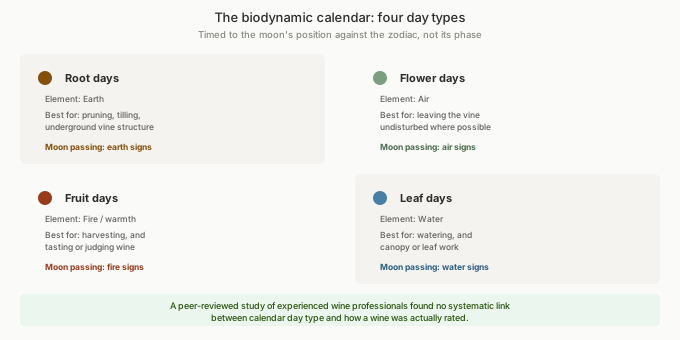
Biodynamic practice ties farm activity to the moon’s position as it passes in front of different zodiac constellations, sorting each day into one of four types associated with a classical element: root days (earth), considered favourable for pruning, tilling, and any work focused on the underground structure of the vine; flower days (air), often treated as a day to leave the vine largely undisturbed; fruit days (fire), considered the best days for harvesting grapes, and also, among many practitioners, the best days for tasting and judging wine, believed to show more aromatic lift and expressiveness; and leaf days (water), associated with irrigation and canopy management such as leaf-thinning.
Many wine professionals, biodynamic practitioners and sceptics alike, will privately admit this is the single hardest part of the philosophy to defend on scientific grounds, and it is worth being direct about that rather than presenting it uncritically. What is not in dispute is the discipline the calendar imposes on cellar and vineyard scheduling, which several producers credit with simply making them more careful, attentive farmers — whatever the underlying cosmological reasoning.
Biodynamic vs Organic vs Natural Wine: What’s Actually Different
These three terms get used almost interchangeably in casual wine conversation, but they describe genuinely different things, and only some of them carry legal weight. Organic wine means the grapes were grown without synthetic pesticides, herbicides, or fungicides, certified by a recognised body such as the USDA or an EU equivalent; it says nothing directly about what happens afterward in the cellar. Biodynamic wine requires full organic-standard farming as a baseline, then adds the numbered preparations, the lunar calendar, and the broader whole-farm philosophy described above, certified specifically by Demeter or Biodyvin rather than a general organic body.
Natural wine is different again, and has no single legal definition anywhere, though France’s voluntary “Vin Méthode Nature” charter, introduced in 2020, is the closest thing to an official standard. Natural wine generally means grapes grown organically or biodynamically, combined with minimal intervention in the cellar specifically: native rather than commercial yeast, little or no added sulfites, and no fining or filtering. A wine can be biodynamically farmed without being natural in this cellar sense, if the winemaker still uses commercial yeast, added sulfites, and conventional fining; equally, a wine can follow natural winemaking principles in the cellar without the vineyard being certified biodynamic or even organic. For the fuller picture of what natural wine does and does not require, see our guide to natural wine.
Certification: Demeter and Biodyvin
Demeter International is the oldest and most widely recognised biodynamic certifying body, operating in more than 65 countries and covering biodynamic agriculture of every kind, not wine specifically. Certification requires organic status as a baseline prerequisite, a minimum three-year conversion period during which a vineyard must farm biodynamically without yet being permitted to use the label, mandatory use of the core preparations, and annual audits to maintain the certification going forward. In France specifically, a second, wine-specific certification exists: Biodyvin, which applies exclusively to biodynamic winemaking and sets its own requirements around how many of the biodynamic preparations must be used and how consistently. Some highly regarded estates choose Biodyvin over Demeter for exactly this wine-specific focus; Domaine de la Romanée-Conti, for instance, holds Biodyvin rather than Demeter certification.
It is worth knowing that plenty of producers farm biodynamically, sometimes rigorously so, without seeking certification from either body at all, whether due to the cost, the administrative burden of annual audits, or simple philosophical discomfort with outsourcing validation of their own practices to a third party. Gravner in Friuli and La Stoppa in Emilia-Romagna are commonly cited examples of estates that apply biodynamic methods without carrying a Demeter or Biodyvin mark on the label. Certification, in other words, confirms that a specific agricultural method was followed — it is not, by itself, a guarantee of wine quality, and a certified biodynamic wine can still be a poorly made one, just as an uncertified biodynamic producer can make something extraordinary.
Does Biodynamic Farming Actually Work? An Honest Look at the Evidence
This is worth addressing directly rather than glossing over, because the honest scientific picture is genuinely mixed rather than settled in either direction. Wikipedia’s summary of biodynamic agriculture describes its foundations as pseudo-scientific and esoteric, and that characterisation is not unreasonable applied to the more mystical elements specifically — there is no credible, peer-reviewed evidence that lunar phases meaningfully affect crop yields, and a rigorously designed study of experienced wine professionals found no systematic relationship between the biodynamic calendar’s day types and how the same wines were actually rated in blind tasting conditions, a study worth reading in full for anyone who wants the primary source rather than a summary. The specific mechanism by which homeopathic-strength doses of a preparation like horn manure could meaningfully affect an entire vineyard’s soil chemistry also has no accepted scientific explanation, and mainstream soil science has been openly sceptical of these claims for decades. Jancis Robinson’s detailed look at biodynamics lays out both the preparations and this scepticism from a working wine critic’s perspective.
At the same time, it would be inaccurate to describe biodynamic farming as having no measurable effect at all. Some research into soil microbial activity following biodynamic preparation use has shown genuine, measurable differences, and biodynamic vineyards, taken as a group, do tend to show healthier soil biology and greater biodiversity than comparable conventionally farmed land nearby — though this may say as much about the type of meticulous, hands-on farmer who adopts biodynamics in the first place as it does about the preparations themselves. It remains a genuinely open question whether biodynamic viticulture’s real-world results come from its distinctive, esoteric elements specifically, or simply from the fact that it demands an unusually attentive, disciplined, soil-focused style of farming that would likely produce good results under almost any comparably rigorous philosophy.
The most defensible summary, and the one this guide takes: treat biodynamic certification as a reliable signal of genuinely careful, low-intervention, soil-focused farming, worth taking seriously for that reason alone, without needing to accept every specific mechanism the philosophy proposes for how or why it works.
Notable Biodynamic Producers
Biodynamic viticulture is no longer a fringe practice confined to small, idealistic estates; it counts some of the wine world’s most prestigious names among its practitioners. Domaine de la Romanée-Conti, producer of some of Burgundy’s most sought-after and expensive wine, has farmed biodynamically since the 1990s and holds Biodyvin certification. Domaine Zind-Humbrecht in Alsace and M. Chapoutier in the Rhône Valley are both long-standing, widely respected biodynamic converts, credited with helping bring the practice mainstream credibility in French fine wine circles during the 1990s and 2000s. In Austria, Nikolaihof, in the Wächau region, is among the longest-continuously-certified biodynamic estates in the world. Our guide to Burgundy wine covers the broader region several of these estates call home.
Should You Seek Out Biodynamic Wine?
If you are drawn to wines made with careful, low-intervention, soil-first farming, biodynamic certification is a genuinely useful signal to look for on a label, and the roster of acclaimed estates practising it is reason enough to take the category seriously. But it is worth buying based on the wine in the glass rather than the certification alone: biodynamic status describes a farming method, not a flavour profile or a guaranteed quality tier, and plenty of excellent wine is made without it, just as some biodynamic wine underwhelms despite the label. Approaching it with curiosity rather than either uncritical devotion or blanket dismissal is, honestly, the most useful attitude this guide can recommend.
Common Misconceptions About Biodynamic Wine
“Biodynamic wine has no added sulfites.” This is a common conflation with natural wine specifically, and it is not accurate. Demeter certification permits added sulfites, simply at somewhat lower maximum levels than conventional organic certification allows, and plenty of excellent biodynamic wine includes a modest, standard sulfite addition at bottling. Zero-sulfite winemaking is a natural wine practice, not a biodynamic requirement, and the two get bundled together far more often than the actual rules justify.
“Biodynamic wine is always rustic, funky, or a niche taste.” Some biodynamic producers do lean toward a more natural, hands-off cellar style, but biodynamic certification says nothing about winemaking technique in the cellar beyond farming and a handful of processing rules. Domaine de la Romanée-Conti’s biodynamically farmed wines are polished, classically structured, and rank among the most sought-after in the world, not rustic by any definition. Judging the category by its most rough-edged examples misses how broad a range of styles biodynamic farming actually supports.
“A winery can just call itself biodynamic.” Unlike “organic,” which carries legal weight in most wine-producing countries and requires government-recognised certification, “biodynamic” is not a legally protected term in the same way almost anywhere. In practice, reputable use of the word still requires third-party certification from Demeter or Biodyvin, and a wine claiming biodynamic status without either mark on the label is worth a second look, though, as noted above, some genuinely rigorous producers simply opt out of formal certification on principle.
Frequently Asked Questions About Biodynamic Wine
What exactly is biodynamic wine?
Biodynamic wine is made from grapes grown according to a farming philosophy developed by Rudolf Steiner in 1924, which treats the vineyard as a single, self-sustaining living organism. It requires full organic farming as a baseline, plus specific numbered herbal and mineral preparations applied to soil and compost, plus timing vineyard work according to a lunar and zodiac calendar. It is certified primarily by Demeter International or, in France, Biodyvin.
What is the difference between biodynamic and organic wine?
Organic wine simply means the grapes were grown without synthetic pesticides, herbicides, or fungicides. Biodynamic wine requires organic-standard farming as a starting point, then adds specific numbered preparations, a whole-farm philosophy treating the vineyard as one interconnected organism, and a lunar calendar for timing vineyard work. All biodynamic wine is organic, but not all organic wine is biodynamic.
What is Preparation 500 in biodynamic farming?
Preparation 500, or horn manure, is made by packing fresh cow manure into a cow horn and burying it in the ground over winter. Once exhumed in spring, it is diluted in water through a vigorous stirring process called dynamising, then sprayed onto vineyard soil in very dilute form, intended to stimulate root development and microbial activity.
Is there scientific evidence that biodynamic farming works?
The evidence is genuinely mixed. There is no credible scientific support for the more esoteric elements, such as lunar timing affecting how a wine tastes; a peer-reviewed study of experienced wine professionals found no systematic link between the biodynamic calendar’s day types and wine ratings. However, some research has shown measurable effects of biodynamic preparations on soil microbial activity, and biodynamic vineyards do tend to show healthier soil biology and greater biodiversity than comparable conventional farms.
Which famous wine producers are biodynamic?
Domaine de la Romanée-Conti in Burgundy, Domaine Zind-Humbrecht in Alsace, M. Chapoutier in the Rhône Valley, and Nikolaihof in Austria are among the most prestigious estates practising biodynamic viticulture. Their involvement has helped bring biodynamic farming considerable mainstream credibility within fine wine circles since the 1990s.
Does biodynamic wine taste different from other wine?
Biodynamic certification describes a farming method, not a specific flavour profile, so there is no single “biodynamic taste.” Many biodynamic producers and drinkers report that biodynamically farmed wines show more vivid, expressive fruit and a stronger sense of the vineyard’s specific character, though this is difficult to separate scientifically from the generally meticulous, attentive farming that biodynamic estates tend to practise regardless of the specific preparations used.