

Prosecco is the best-selling sparkling wine on the planet, with roughly 660 million bottles produced in 2024 alone — more than Champagne, Cava, and every other sparkling style combined sell in some markets. And yet most of what people think they know about it is a little off: the grape is not actually called Prosecco anymore, the sweetest-sounding label term is not the sweetest style, and a wine this ubiquitous still has a genuine hierarchy of quality running from everyday bottles up to a single 107-hectare hillside considered its grand cru. This guide covers what Prosecco actually is: the grape behind it, the region it comes from, exactly how the tank method makes it, its quality tiers, its label terms, and how to serve, pair, and choose it.
In this article
- 1 Prosecco, at a Glance
- 2 The Grape Behind Prosecco: Glera
- 3 Where Prosecco Comes From
- 4 How Prosecco Is Made: The Tank Method
- 5 Prosecco’s Quality Pyramid: DOC, DOCG, Rive, and Cartizze
- 6 Reading a Prosecco Label: Brut, Extra Dry, and Dry
- 7 Prosecco Rosé: The New Arrival
- 8 What Prosecco Tastes Like and How to Serve It
- 9 Food Pairing, Aperitivo, and the Spritz
- 10 Prosecco vs Champagne and Cava
- 11 Common Myths About Prosecco
- 12 Frequently Asked Questions About Prosecco
Prosecco, at a Glance
- Grape: Glera (renamed from “Prosecco” in 2009), at least 85% of every blend.
- Region: Veneto and Friuli Venezia Giulia, north-east Italy — mainly the province of Treviso.
- Method: the tank method (Charmat/Martinotti), a single tank-based second fermentation.
- Typical ABV: 10.5–11.5%, lower than Champagne.
- Sweetness labels: Brut (driest), Extra Dry (actually medium), Dry (sweetest of the three).
- Quality tiers: Prosecco DOC → DOCG → Rive → Cartizze (narrowest and most prestigious).
- Best drunk: young, usually within one to three years — though top DOCG examples can age longer.
- Serve at: 6–8°C (43–46°F), in a tulip glass or regular white wine glass.
The Grape Behind Prosecco: Glera
For most of its history, the grape now called Glera was simply known as Prosecco — the same word used for both the vine and the wine it made. That changed in 2009, in a move that sounds bureaucratic but has a genuinely interesting reason behind it. When Italian authorities sought to elevate Conegliano Valdobbiadene to DOCG status, Italy’s highest wine classification, they ran into a problem: if “Prosecco” remained the name of a grape variety, any producer anywhere in the world could legally plant that grape and call the resulting wine “Prosecco,” regardless of where it was grown. By renaming the grape Glera and reserving “Prosecco” exclusively as a protected place name, Italy closed that loophole — the same legal logic France uses to protect the word “Champagne.” Since then, wine made from this grape outside the protected zones must be labelled with the grape’s name, Glera, rather than Prosecco.
Glera itself is a fairly neutral, high-acid, green-skinned grape, which is precisely what makes it so well suited to sparkling wine: it ripens late, holds onto bright acidity, and does not compete with the fresh, primary fruit character winemakers want to preserve through the tank method. Left on flat, high-yield vineyard land, Glera can taste fairly generic; grown instead on the steep, low-yield hillsides of Conegliano Valdobbiadene, it develops real aromatic depth — white flowers, lemon, pear, apple, and white peach, sometimes with a faint honeyed or almond edge in the best examples. The grape is believed to take its original name from the village of Prosecco, near Trieste on the border with Slovenia, and some historians trace its story back even further, suggesting the Romans may have grown an ancestor of the same vine under the name vinum Pucinum, a wine praised by Pliny the Elder for its supposed health benefits. Wikipedia’s entry on the Glera grape has more on this etymology and its Roman-era origins.
By law, Prosecco must contain at least 85% Glera. The remaining share can include a handful of other varieties permitted by the appellation rules — Verdiso, Bianchetta Trevigiana, Perera, Chardonnay, Pinot Bianco, Pinot Grigio, and Pinot Nero vinified as a white wine — though in practice most producers stick close to 100% Glera.
Where Prosecco Comes From
Prosecco’s protected zone spans nine provinces across two regions in north-eastern Italy: five in the Veneto (Belluno, Venice, Padua, Treviso, and Vicenza) and four in Friuli Venezia Giulia (Gorizia, Pordenone, Trieste, and Udine). In practice, one province dominates: Treviso alone accounts for roughly 90% of all Prosecco produced, and it is the hills just north of the city of Treviso — around the towns of Conegliano and Valdobbiadene — that represent the style’s historic and qualitative heart.
Those hills are genuinely dramatic: steep terraced slopes, some inclined as much as 70 degrees, farmed by hand because no machinery can safely work them. Vineyards sit between 50 and 500 metres above sea level, close enough to the sea and the Alps to get a mild climate with constant breezes that dry the grapes quickly after rain — useful protection against rot for a thin-skinned variety like Glera. The dramatic terracing and centuries of continuous cultivation earned the hills of Conegliano and Valdobbiadene UNESCO World Heritage status in 2019, a rare distinction for a working vineyard landscape. Outside this historic heartland, the wider Prosecco DOC zone includes flatter, more easily mechanised land that produces the vast majority of Prosecco’s total volume — the everyday bottles found on supermarket shelves worldwide.
How Prosecco Is Made: The Tank Method
Almost all Prosecco is made using the tank method, known in Italy as the Charmat method after French inventor Eugène Charmat, or sometimes the Martinotti method after Italian scientist Federico Martinotti, who patented a very similar process a few years earlier in 1895. The logic is the same as any sparkling wine: trap the carbon dioxide produced by a second fermentation instead of letting it escape. Where Champagne triggers that second fermentation inside each individual bottle, the tank method triggers it inside one large, sealed, pressurised steel tank holding the entire batch at once. A still base wine gets a dose of sugar and yeast, ferments under pressure in the tank for a few weeks, and is then filtered and bottled under counter-pressure to keep the bubbles intact.
This approach is faster, cheaper, and fundamentally aimed at a different result than Champagne’s bottle-fermentation. Because the wine spends only weeks, not years, in contact with its fermentation yeast, and because that yeast is filtered out before bottling rather than aged alongside the wine, tank-method Prosecco keeps the fresh, primary fruit and floral character of the Glera grape front and centre, rather than developing the toasty, bready complexity that comes from extended lees contact. Neither approach is objectively better — they are built to showcase completely different things, fruit versus yeast-derived complexity, and Prosecco’s tank method is a deliberate choice, not a shortcut. One small exception exists: a handful of traditional producers still make Col Fondo Prosecco, an old-style version fermented once in the bottle and left unfiltered on its lees, sitting somewhere between Prosecco and a pet-nat in character.
Prosecco’s Quality Pyramid: DOC, DOCG, Rive, and Cartizze
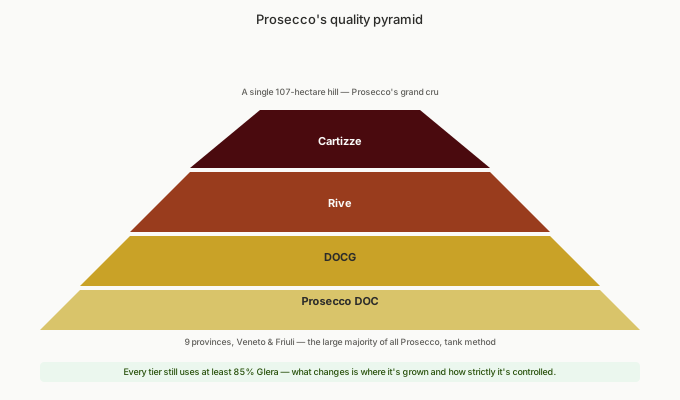
Prosecco DOC is the broad base of the pyramid, created in 2009 to cover the full nine-province zone described above. This single designation absorbed a patchwork of older, looser regional labels and now accounts for the overwhelming majority of Prosecco by volume — the everyday, widely exported bottles most people picture when they hear the name. Minimum alcohol for this tier is 10.5%, and yields are relatively generous compared with the tiers above it.
Above DOC sit two smaller, stricter DOCG zones: Conegliano Valdobbiadene Prosecco DOCG, the historic hillside heartland described above, and Asolo Prosecco DOCG, a neighbouring hillside zone around the town of Asolo, created the same year as a complementary designation. Wines from Conegliano Valdobbiadene DOCG are entitled to add “Superiore” to the label, reflecting lower yields, mandatory hand-harvesting on steep terrain, and closer regulatory oversight than DOC requires.
Within Conegliano Valdobbiadene DOCG, an even narrower category exists: Rive, from the Italian dialect word for the region’s steep slopes. There are 43 officially recognised Rive, each corresponding to a single named village or hamlet, and wines labelled with a Rive name must come entirely from that one location, be hand-picked, and carry a vintage year — unusual specificity for a wine style generally associated with anonymous, non-vintage blending.
At the very top sits Superiore di Cartizze, often described as Prosecco’s grand cru: a single hillside of just 107 hectares near the town of Valdobbiadene, with ancient soils of clay, sandstone, and glacial moraine that consistently produce Prosecco’s most complex, structured expressions. Total output from Cartizze is only around 1.2 million bottles a year — a rounding error next to Prosecco DOC’s 660 million, and a useful reminder that “Prosecco” covers an enormous range of quality and ambition under one increasingly famous name. Italian Wine Central has a detailed breakdown of the Conegliano Valdobbiadene DOCG rules for anyone who wants the full regulatory detail.
Reading a Prosecco Label: Brut, Extra Dry, and Dry
Prosecco uses the same EU sweetness scale as other sparkling wines, but the terminology trips up more beginners here than almost anywhere else in wine, because the common-sense reading of the words is backwards. Brut is the driest style, with up to 12 grams of residual sugar per litre. Extra Dry sits in the middle, at 12 to 17 grams per litre, despite “extra dry” sounding like it should be the driest option on the shelf. Dry is, confusingly, the sweetest of the three widely available styles, at 17 to 32 grams per litre. For decades, Extra Dry was the dominant historical style and what most people pictured when they thought of Prosecco; in recent years Brut has grown significantly as international drinkers increasingly favour a crisper, less overtly fruity style.
This labelling quirk is not unique to Prosecco — it is a hangover from a period when sparkling wine across Europe generally ran sweeter, and “Extra Dry” originally meant genuinely dry relative to that baseline. It just happens that Prosecco is one of the few widely available styles where a shopper is likely to see all three terms side by side on a shelf, which is exactly when the mismatch between the label and the actual sweetness becomes a practical problem rather than a historical curiosity.
Prosecco Rosé: The New Arrival
Prosecco Rosé is a genuinely recent addition to the category, only permitted since the 2020 harvest. Unlike the white version, it must include a small amount of Pinot Nero (Pinot Noir) vinified as a red wine, blended at 10 to 15% alongside a minimum 85% Glera — the only case where Prosecco is deliberately made by blending, rather than relying on skin contact or saignée the way most still rosé is. Crucially, Prosecco Rosé exists only at the DOC level; the two DOCG zones considered and rejected the idea, so a genuine DOCG-labelled Prosecco Rosé does not exist. It has become one of the fastest-growing segments of the category since its introduction, offering the same tank-method freshness with a layer of red berry fruit alongside the classic apple and pear.
What Prosecco Tastes Like and How to Serve It
Prosecco’s flavour profile is built around fresh orchard and stone fruit: green and yellow apple, pear, white peach, and citrus, often with a light floral lift of white blossom and, occasionally, a faint soapy or almond note that is characteristic of Glera rather than a fault. It is generally light-bodied and low in alcohol, with 10.5% the legal minimum for the category, and is designed to be immediate and refreshing rather than complex or contemplative — though top Rive and Cartizze bottlings genuinely reward more attention, developing real texture and length that basic DOC examples do not attempt.
Serve Prosecco cold, around 6–8°C, straight from the fridge or an ice bucket. A tall flute concentrates the bubbles and aroma, but a tulip-shaped glass, wider at the base and narrowing slightly at the rim, is increasingly the preferred choice among sommeliers, since it shows off Prosecco’s fruit and florals better than a narrow flute does. Most Prosecco is built to be drunk young and fresh, ideally within one to three years of release, and does not benefit from cellaring the way vintage Champagne does; DOCG examples, particularly from Cartizze, are a partial exception and can hold and even improve for five years or more in a good vintage, though this remains the exception rather than the rule.
Food Pairing, Aperitivo, and the Spritz
Prosecco’s role in Italian food culture is inseparable from the concept of aperitivo: a light, sociable pre-dinner drink meant to open the appetite rather than accompany a full meal. Poured on its own, it pairs naturally with the salty, savoury snacks that traditionally come with aperitivo — olives, cured meats, hard cheese, and simple fried finger food — for exactly the acid-cuts-fat logic covered in our guide to wine pairing principles. At the table, its bright acidity and modest weight make it a genuinely versatile match for light pasta dishes, seafood, sushi, and fresh vegetable-based starters.
Prosecco is also the backbone of two of the world’s most popular cocktails: the Aperol Spritz (Prosecco, Aperol, and a splash of soda water over ice) and the Hugo (Prosecco, elderflower liqueur or syrup, and mint), both of which lean on Prosecco’s fresh acidity and modest alcohol to stay light and sessionable. This cocktail role, more than any specific food pairing, is a large part of why Prosecco has become the default “drink something bubbly without the Champagne price tag” choice worldwide.
Prosecco vs Champagne and Cava
Prosecco, Champagne, and Cava are often reached for interchangeably, but they differ in grape, method, and price for real structural reasons rather than mere branding: Champagne uses the traditional method and ages on its lees for years, Cava uses that same traditional method but from Spanish grapes at a fraction of Champagne’s price, and Prosecco uses the tank method to preserve fresh fruit rather than develop yeasty complexity. We cover this three-way comparison, including specific style and price differences, in full in our guide to Prosecco vs Champagne vs Cava. For the full landscape of how sparkling wine fits alongside every other style, our guide to the types of wine and our piece on non-vintage Champagne are useful next stops.
Common Myths About Prosecco
“Prosecco is always cheap and simple.” Most of it genuinely is inexpensive, and there is no shame in that — affordability is a large part of why it sells 660 million bottles a year. But treating the whole category as uniformly basic misses the point of its quality pyramid entirely. A hand-harvested Rive from a single named village, or a bottle of Superiore di Cartizze from that 107-hectare hillside, is built with the same ambition, restricted yields, and site-specific focus that define fine wine anywhere else in the world; it simply happens to share a name with wine costing a tenth of the price.
“Prosecco can’t age.” This is mostly true and worth taking seriously — the vast majority of Prosecco is built for immediate, youthful drinking, and holding a basic DOC bottle for years will only dull its fruit. But it is not a universal law. A well-documented tasting of top Conegliano Valdobbiadene producers spanning three decades of vintages demonstrated real ageing potential in serious examples, and that pattern is confirmed by producers who release older library bottlings specifically to prove the point. The honest version of this rule is: assume your bottle should be drunk young, unless you have a specific reason — a serious DOCG producer, a Cartizze bottling — to think otherwise.
“Prosecco is just cheap Champagne.” This one gets the relationship backwards. Prosecco is not an inferior attempt at Champagne’s traditional method; it is a different method entirely, built around a different grape, in pursuit of a genuinely different style. Judging Prosecco by whether it delivers Champagne’s toasty, bottle-aged complexity is like judging a fresh, unoaked Sauvignon Blanc by whether it tastes enough like a barrel-aged Chardonnay. Prosecco’s entire design goal is fresh, primary fruit rather than yeast-derived depth, and a well-made bottle succeeds or fails on those terms, not Champagne’s.
Frequently Asked Questions About Prosecco
What exactly is Prosecco?
Prosecco is an Italian sparkling wine made mainly from the Glera grape in Veneto and Friuli Venezia Giulia, using the tank method, in which the second fermentation that creates its bubbles happens inside a large sealed tank rather than in individual bottles. It is a protected place name, not a grape variety name, and covers a range of quality tiers from broad, everyday Prosecco DOC up to the tiny, prestigious Cartizze hillside.
Is Prosecco the same as the grape it’s made from?
Not anymore. The grape was historically called Prosecco too, but was officially renamed Glera in 2009, when Italy sought DOCG status for Conegliano Valdobbiadene. Separating the grape’s name from the protected wine name prevented producers elsewhere in the world from growing the same grape and legally calling their wine Prosecco, mirroring how France protects the word Champagne.
Which Prosecco is sweeter: Brut, Extra Dry, or Dry?
Dry is the sweetest of the three common labels, followed by Extra Dry in the middle, with Brut the driest. This runs counter to how the words sound, since “Extra Dry” reads as though it should be the driest option; the terminology is a historical holdover from when European sparkling wine generally ran sweeter across the board.
What is the difference between Prosecco DOC and DOCG?
Prosecco DOC is the broad designation covering nine provinces across Veneto and Friuli Venezia Giulia and accounts for the large majority of all Prosecco produced. DOCG is a smaller, stricter designation limited to two hillside zones, Conegliano Valdobbiadene and Asolo, with lower yields, mandatory hand-harvesting on steep terrain, and generally higher quality than the broader DOC tier.
What is Cartizze Prosecco?
Cartizze, officially Superiore di Cartizze, is a single 107-hectare hillside within the Valdobbiadene area, widely considered the grand cru of Prosecco. Its distinctive soils of clay, sandstone, and glacial moraine consistently produce Prosecco’s most complex and structured wines, though total output is tiny, around 1.2 million bottles a year, compared with roughly 660 million bottles of Prosecco DOC overall.
Does Prosecco Rosé exist, and how is it made?
Yes, but only since the 2020 harvest, and only at the DOC level. It is made by blending a minimum of 85% Glera with 10 to 15% Pinot Nero vinified as a red wine, which is unusual, since most Prosecco is produced from Glera alone. The two DOCG zones both declined to permit a rosé version, so a genuine DOCG Prosecco Rosé does not exist.