

Pick up a bottle of French wine expecting to find the grape variety printed anywhere on it, and you will very often come away disappointed — and that omission is not an oversight, it is the entire philosophy of French wine labelling in one detail. Where a New World label leads with “Cabernet Sauvignon,” a French label leads with a place: Pauillac, Chablis, Gevrey-Chambertin. The assumption baked into every French label is that place determines grape, style, and quality all at once, so specifying the place makes naming the grape unnecessary. Once you understand that one substitution, most of what looks like impenetrable French wine jargon turns out to be a fairly logical system — with one genuine trap waiting even for experienced drinkers: the same prestige terms, Grand Cru and Premier Cru chief among them, mean different things depending on which region put them on the bottle. This guide walks through how to actually read a French wine label, region by region, including that trap.
In this article
- 1 French Wine Labels, at a Glance
- 2 The Big Idea: Place, Not Grape
- 3 The AOC/AOP System: France’s Wine Quality Pyramid
- 4 Grand Cru and Premier Cru Don’t Mean the Same Thing Twice
- 5 Reading a Bordeaux Label
- 6 Reading a Burgundy Label
- 7 Reading a Champagne Label
- 8 Reading an Alsace Label: France’s Exception
- 9 Common French Label Terms Worth Knowing
- 10 A Quick Practical Method for Shopping
- 11 Why This System Exists: A Brief History
- 12 Reading a Rhône or Loire Label
- 13 Frequently Asked Questions About French Wine Labels
- 13.1 Why don’t French wine labels list the grape variety?
- 13.2 What does AOC or AOP mean on a French wine label?
- 13.3 Does Grand Cru mean the same thing on every French wine label?
- 13.4 What do NM and RM mean on a Champagne label?
- 13.5 Which French region actually puts the grape variety on the label?
- 13.6 What does “Mis en bouteille au Château” mean?
French Wine Labels, at a Glance
- Place, not grape: French labels name the appellation; the grape is implied by regional law.
- Three quality tiers: AOC/AOP (strictest) sits above IGP, which sits above Vin de France (broadest).
- The narrower the place named, the higher the quality tier — “Bordeaux” is broader than “Pauillac.”
- Grand Cru and Premier Cru mean different things in Burgundy, Bordeaux, Alsace, and Champagne.
- Alsace is the exception — the one major French region that does put the grape on the label.
- Common terms worth knowing: Vieilles Vignes (old vines), Sur Lie (aged on lees), Mis en bouteille au château (estate-bottled).
The Big Idea: Place, Not Grape
French wine law is built on the concept of terroir — the belief that a specific patch of land, with its own soil, slope, and microclimate, shapes a wine’s character more than the grape variety does. Once that premise is accepted, naming the grape on the label becomes almost beside the point: if you know a bottle is labelled Chablis, French law already tells you it is Chardonnay, because Chablis’ appellation rules permit no other grape. If you know a bottle is labelled Pauillac, you know it is a Cabernet Sauvignon-led Bordeaux blend, because that is what Pauillac’s rules require. The place name is doing double duty as both a geographic marker and, implicitly, a grape and style guarantee.
This is precisely why so many first-time French wine shoppers feel lost: without already knowing that Chablis means Chardonnay, or that Sancerre (mostly) means Sauvignon Blanc, or that Châteauneuf-du-Pape means a Grenache-led blend, the label offers no direct shortcut. Learning to read a French wine label is, in large part, learning this reference list of place-to-grape associations — which sounds daunting stated all at once, but becomes second nature quickly for the handful of regions any given shopper actually buys from regularly. Wine Folly’s glossary of French wine label terms is a handy reference to keep bookmarked for exactly this purpose.
The AOC/AOP System: France’s Wine Quality Pyramid
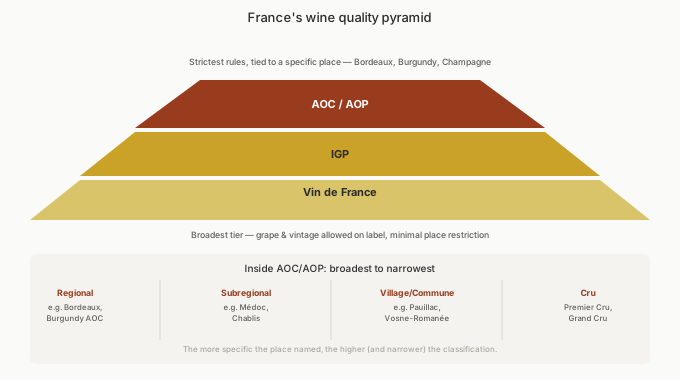
France’s wine classification runs across three tiers, and where a wine sits tells you roughly how tightly its production is regulated. At the base sits Vin de France, the broadest category, introduced in its modern form in 2009; it carries minimal geographic restriction, and is actually the one tier of French wine legally permitted to print the grape variety and vintage directly on the label, since it is not tied to a specific place’s rules. Above that sits IGP (Indication Géographique Protégée), tied to a broader named region — IGP Pays d’Oc, covering much of the south of France, is the most commonly seen example — with moderate rules on yield and permitted grapes, roughly comparable to Italy’s IGT tier.
At the top sits AOC (Appellation d’Origine Contrôlée), or its EU-wide equivalent AOP (Appellation d’Origine Protégée) — the two labels are legally interchangeable and many producers still use the older AOC term out of habit. This is the tier governing Bordeaux, Burgundy, Champagne, and every other prestigious French wine region, with the strictest rules on permitted grape varieties, maximum yields, minimum alcohol, and production method. Crucially, AOC/AOP itself has internal levels, running from broadest to narrowest: a Regional appellation like straight “Bordeaux” or “Bourgogne” covers an enormous area with relatively loose rules; a Subregional appellation like Médoc or Chablis narrows the area and tightens the rules; a Village or Commune appellation like Pauillac or Vosne-Romanée narrows further still; and, in regions that recognise it, a Cru designation — Premier Cru, Grand Cru — sits at the very top, naming an individual vineyard rather than a village. The general rule holds throughout: the more specific the place named on the label, the higher the wine sits in this hierarchy.
Grand Cru and Premier Cru Don’t Mean the Same Thing Twice
Here is the genuine trap in French wine labelling, and it catches out even fairly experienced drinkers: “Grand Cru” and “Premier Cru” are used across several French regions, but each region applies them to a different unit and a different hierarchy, and the terms are not directly comparable between regions.
In Burgundy, Grand Cru refers to an individual vineyard plot — there are 33 of them in total, covering roughly 2% of Burgundy’s total vineyard area — sitting at the very top of the hierarchy, above Premier Cru (a larger group of very good, but slightly less exceptional, individual vineyards), which itself sits above Village-level and Regional wines. In Bordeaux, by contrast, Grand Cru status generally attaches to a château, not a specific plot of vines, following the logic of the 1855 Classification and similar rankings developed for other Bordeaux subregions since. Saint-Émilion’s own classification even nests Bordeaux’s terms differently again, with Premier Grand Cru Classé A sitting above Premier Grand Cru Classé B, which sits above plain Grand Cru Classé — a structure with no real equivalent in Burgundy’s plot-based system.
In Alsace, Grand Cru again refers to a specific named vineyard site, or lieu-dit, similar in spirit to Burgundy’s approach; there are 51 recognised Alsace Grand Cru sites, each with its own strict yield and ripeness requirements. In Champagne, the terms work differently again, rating entire villages rather than individual vineyards or châteaux: a small number of villages hold Grand Cru status, a somewhat larger group hold Premier Cru status, and the rating attaches to grapes grown within that village’s boundaries generally, feeding into blends that may combine fruit from several villages of varying rank. The practical lesson: never assume a Grand Cru from one region signals the same thing, or the same price tier, as a Grand Cru from another — always read the term in the context of the specific region printed alongside it. Wine-Searcher’s breakdown of French label components covers these regional differences with real label examples.
Reading a Bordeaux Label
A Bordeaux label typically leads with the château name in the largest type, since Bordeaux’s classification system ranks producers rather than plots — the château name is doing most of the quality signalling here, more than on a Burgundy label. Below that sits the appellation (Pauillac, Saint-Émilion, or simply Bordeaux for a broader, more everyday wine) and the vintage year. Classification terms appear where relevant: Grand Cru Classé signals inclusion in the 1855 Classification or a comparable regional ranking; Cru Bourgeois is a separate, respected mid-tier classification for Médoc châteaux that fall outside the 1855 rankings but still meet defined quality standards; and the phrase “Mis en bouteille au Château” confirms the wine was bottled at the estate itself, generally a mark of quality and traceability rather than being bottled elsewhere by a merchant. For the fuller picture of how Bordeaux’s own internal regions and grapes differ, see our comparison of Bordeaux and Burgundy.
Reading a Burgundy Label
A Burgundy label inverts Bordeaux’s emphasis: the vineyard or village name — Gevrey-Chambertin, Meursault, Chablis — usually appears in the largest, most prominent type, since Burgundy’s whole classification system ranks land rather than producers. The domaine or producer name still matters enormously in practice, given how fragmented Burgundy’s best vineyards are among many small owners, but it typically appears in smaller type beneath the vineyard name rather than above it. Watch for the word “Monopole”, which indicates a Grand Cru or Premier Cru vineyard owned entirely by a single producer rather than split among several — genuinely rare in Burgundy, and worth noting when you see it. Our dedicated Burgundy guide covers the region’s villages and classification tiers in much more depth.
Reading a Champagne Label
Champagne labels carry a few conventions found nowhere else in French wine. A two-letter code followed by a registration number, printed in small type, reveals what kind of producer made the wine: NM (Négociant-Manipulant) means a merchant house that buys grapes from growers and makes the wine itself — most of the famous Champagne houses fall into this category; RM (Récoltant-Manipulant) means a grower who farms their own grapes and makes their own wine, often called “grower Champagne”; and CM (Coopérative-Manipulant) indicates a cooperative winery working with member growers’ fruit. Sweetness terms follow the same Brut-to-Doux scale used across sparkling wine generally, and Blanc de Blancs (white wine made only from white grapes, meaning 100% Chardonnay) and Blanc de Noirs (white wine made from black grapes, typically Pinot Noir and Pinot Meunier) describe the grape makeup even though Champagne otherwise avoids naming grapes directly. A vintage year on a Champagne label, rather than “NV” for non-vintage, signals a wine made entirely from a single exceptional year’s harvest — our guide to non-vintage Champagne covers exactly what that distinction means for style and price.
Reading an Alsace Label: France’s Exception
Alsace breaks France’s central labelling rule more completely than any other major region: it is the one place in France where the grape variety is routinely printed directly on the label — Riesling, Gewürztraminer, Pinot Gris — much like a New World wine. This exception exists partly for historical reasons tied to the region’s shifting German and French governance over the centuries, and partly because Alsace, unlike Bordeaux or Burgundy, generally makes single-varietal wines rather than regional blends, making the grape name genuinely informative rather than redundant. Alsace still layers its own Grand Cru system on top of this varietal labelling, naming one of 51 recognised single vineyard sites (lieux-dits) alongside the grape variety on its most prestigious bottlings.
Common French Label Terms Worth Knowing
- Vieilles Vignes: “Old vines” — an unregulated but generally meaningful term, since older vines typically produce more concentrated, complex fruit.
- Sur Lie: Aged on its spent yeast (lees) before bottling, most commonly seen on Muscadet from the Loire Valley, adding creamy texture and depth.
- Cuvée: Simply “a blend” or “a specific batch” — used loosely across French wine and not itself a quality indicator without further context.
- Domaine / Château / Clos: All broadly mean “estate,” with Château favoured in Bordeaux, Domaine in Burgundy and the Rhône, and Clos specifically indicating a historically walled vineyard.
- Négociant: A merchant who buys grapes, juice, or finished wine from growers and bottles it under their own name, common throughout Burgundy and Champagne.
- Sec / Demi-Sec / Moelleux: Dry, medium-sweet, and sweet respectively — the French sweetness scale, distinct from the Brut-based scale used for sparkling wine specifically.
- Vendange Tardive: “Late harvest,” seen mainly in Alsace, indicating a richer, often sweeter wine from grapes picked well past standard ripeness.
A Quick Practical Method for Shopping
Faced with an unfamiliar French bottle, a reasonably reliable shortcut is: read the appellation first, since it tells you both the grape and the general style if you recognise the name; check whether a Cru designation appears, and if so, remember which region’s specific Cru system you are looking at rather than assuming it matches another region’s; and treat the vintage year as more important for age-worthy regions like Bordeaux and Burgundy than for everyday, drink-now bottles. For the equivalent method applied to labels from outside France — including how New World labels differ from this entire system — see our broader guide to reading a wine label.
Why This System Exists: A Brief History
France’s AOC system did not appear all at once; it grew out of a genuine crisis. In the early twentieth century, fraud was rampant, with unscrupulous merchants selling cheap, adulterated wine under famous regional names, damaging the reputation of legitimate producers everywhere from Bordeaux to the Rhone. Winemaker Baron Pierre Le Roy, based in Châteauneuf-du-Pape, led the push for a legal framework to protect regional names, and in 1935 France established the INAO (Institut National des Appellations d’Origine) to enforce it nationally. Châteauneuf-du-Pape itself became France’s first AOC as a direct result of that advocacy, with Bordeaux, Burgundy, and Champagne all receiving their own AOC status within the following two years, by 1937.
That history is worth knowing because it explains why the system is so specifically about protecting a name from misuse, rather than primarily about ranking quality in the abstract. The rules exist to guarantee that a bottle labelled Châteauneuf-du-Pape genuinely came from that place, made under those specific conditions, not to certify that every single bottle bearing an AOC label is objectively excellent. A well-made Bordeaux AOC wine and a mediocre one can sit on the same shelf; the appellation guarantees origin and method, not a specific quality score.
Reading a Rhône or Loire Label
The Rhone Valley layers a village system similar in spirit to Burgundy’s onto very different grapes. A simple Côtes du Rhône label covers a broad, everyday tier; Côtes du Rhône Villages narrows this to a smaller, higher-quality zone; and individual villages with their own recognised character, such as Cairanne or Vacqueyras, can carry their own standalone AOC name entirely, dropping the broader Côtes du Rhône label altogether. Châteauneuf-du-Pape sits above all of these as its own prestigious appellation, permitting up to thirteen different grape varieties in its blend, led by Grenache, though most producers use only a handful of them.
The Loire Valley introduces its own distinctive vocabulary. Sur Lie, mentioned above, appears almost exclusively on Muscadet here. Crémant, meaning sparkling wine made outside Champagne using the same traditional bottle-fermentation method, appears across several French regions as Crémant de Loire, Crémant d’Alsace, and others, offering a genuine alternative to Champagne at a lower price point. Sancerre and Pouilly-Fumé, the Loire’s best-known Sauvignon Blanc appellations, follow the same place-not-grape convention as the rest of France, so recognising these two names is effectively the same as recognising the grape itself.
Frequently Asked Questions About French Wine Labels
Why don’t French wine labels list the grape variety?
French wine law is built around the idea of terroir, that a specific place shapes a wine more than the grape does, so labels name the place instead. Because each appellation’s rules already specify which grapes are permitted, naming the place implicitly tells you the grape too, for anyone who knows the region. Alsace is the main exception, and does print the grape variety directly on the label.
What does AOC or AOP mean on a French wine label?
AOC (Appellation d’Origine Contrôlée) and its EU equivalent AOP (Appellation d’Origine Protégée) mark France’s strictest wine classification tier, tied to a specific place with defined rules on permitted grapes, yields, and production methods. It sits above IGP and Vin de France, France’s two broader, less restricted classification tiers.
Does Grand Cru mean the same thing on every French wine label?
No. In Burgundy and Alsace, Grand Cru refers to a specific, individually named vineyard plot. In Bordeaux, it generally refers to a classified château rather than a specific plot of vines. In Champagne, it refers to an entire top-rated village. The term signals top quality in every case, but the unit it actually describes, plot, château, or village, differs by region.
What do NM and RM mean on a Champagne label?
NM (Négociant-Manipulant) indicates a merchant house that buys grapes and makes the wine itself, the category most major Champagne brands fall into. RM (Récoltant-Manipulant), often called grower Champagne, indicates a producer who farms their own grapes and makes their own wine. Both codes appear in small print alongside a registration number.
Which French region actually puts the grape variety on the label?
Alsace is the main exception to France’s place-not-grape convention, routinely printing the grape variety, such as Riesling or Gewürztraminer, directly on the label. This reflects both the region’s history and the fact that Alsace typically makes single-varietal wines rather than the regional blends common elsewhere in France.
What does “Mis en bouteille au Château” mean?
It means the wine was bottled at the producing estate itself, rather than sold in bulk to a merchant who bottled it elsewhere under their own label. This phrase, common on Bordeaux labels, is generally regarded as a mark of quality and direct traceability back to the estate that actually grew and made the wine.