Our last article covered Nebbiolo, the grape behind Barolo and Barbaresco. But Nebbiolo is only around 10% of what actually grows in the Piedmont wine region — the region itself is a far stranger and busier place than its most famous grape suggests. Piedmont packs more DOCG appellations into one region than anywhere else in Italy, grows at least half a dozen red and white grapes that barely exist outside its own hills, and happens to be the place where Carlo Petrini started the Slow Food movement — a coincidence that isn’t really a coincidence at all, once you understand how this region does everything. This guide covers the geography, the appellations beyond Barolo, the everyday wines actually drunk at Piedmontese tables, and the deeper cultural habit of patience that connects all of it.
In this article
- 1 Piedmont, at a Glance
- 2 The Land Between Two Mountain Ranges
- 3 A Region That Runs on Nineteen Appellations
- 4 The Three Wine Countries Inside Piedmont
- 5 The Reds Piedmont Actually Drinks Most Days
- 6 The Whites: Moscato, Gavi, and Arneis
- 7 Slow Food Was Never Really a Movement Here — Just a Habit
- 8 Piedmont’s Other Famous Exports: Truffles and Vermouth
- 9 How Piedmont Shaped Italy Itself
- 10 Getting to Know Piedmont: Where to Start
- 11 Frequently Asked Questions About Piedmont Wine
- 11.1 What is Piedmont known for in wine?
- 11.2 What is the difference between Barolo, Barbaresco, and Langhe Nebbiolo?
- 11.3 What grape is most planted in Piedmont?
- 11.4 Why is Piedmont connected to the Slow Food movement?
- 11.5 What white wines come from Piedmont?
- 11.6 Is the Piedmont wine region a UNESCO World Heritage Site?
Piedmont, at a Glance
- Location: Northwest Italy, bordered by the Alps to the north and west and the Apennines to the south, with the Po River running through the middle.
- Appellations: 19 DOCGs — more than any other Italian region — and 41 DOCs, tied with Tuscany for the most in the country.
- Vineyard area: roughly 43,500 hectares under vine as of 2022.
- Famous wines: Barolo and Barbaresco (100% Nebbiolo) — but together they make up only about 3% of everything Piedmont actually produces.
- Everyday reds: Barbera (the most-planted grape in the region), Dolcetto, and the little-known Grignolino.
- Whites: Moscato d’Asti, Cortese (Gavi), and Arneis (Roero).
- UNESCO status: the Langhe-Roero and Monferrato vineyard landscape has been a World Heritage Site since 2014.
- Food culture: birthplace of the Slow Food movement and home to the Alba white truffle, one of the most prized ingredients in European cooking.
The Land Between Two Mountain Ranges
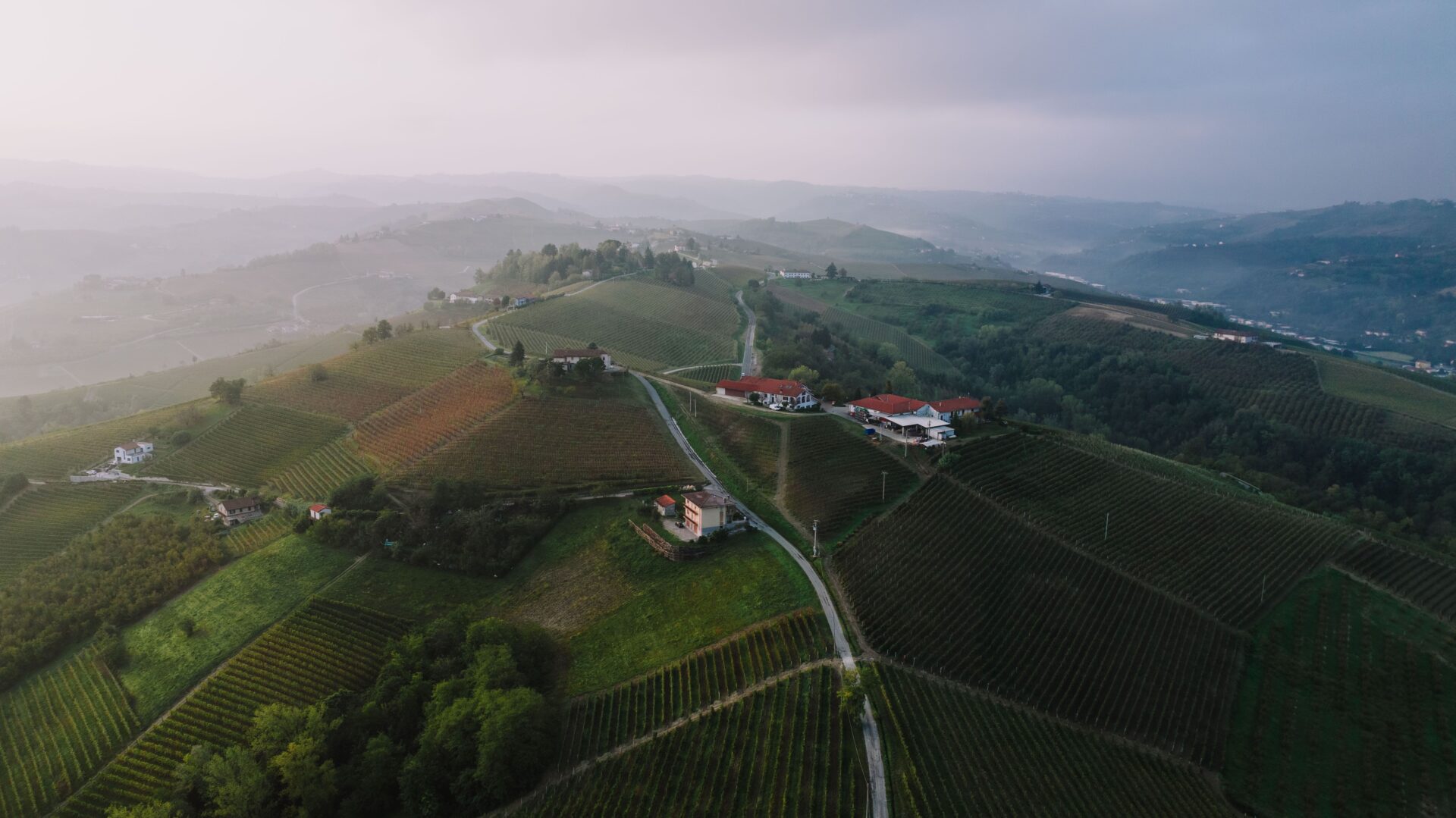
Piedmont means “foot of the mountains,” and the name is literal: the region sits in a wide bowl formed by the Alps curving around its north and west and the Apennines closing it off to the south, with the Po River — Italy’s longest — running through the middle of it before continuing east toward Venice. That bowl shape is exactly what makes Piedmont’s wine country work. Cold air drains down from the mountains at night and pools in the valleys, creating the dense morning fog that gives Nebbiolo its name and that regularly blankets the Langhe hills through the October and November harvest. By midday the same fog usually burns off into bright, dry sunshine, giving vines both the cool nights that preserve acidity and the daytime warmth that ripens fruit — a combination few wine regions get in equal measure.
This is also, it turns out, genuinely old wine country. Pollen evidence from the region has been dated to the 5th century BC, pointing to Etruscan and Celtic winegrowing long before Rome arrived. By the 1st century AD, the naturalist Pliny the Elder was already singling the area out, calling it one of the most favorable places in ancient Italy for growing vines. This is the same underlying idea covered in our guide to terroir: place shaping wine, and wine in turn shaping how a place gets used. Two thousand years later, UNESCO reached roughly the same conclusion: in 2014, the Vineyard Landscape of Piedmont: Langhe-Roero and Monferrato was inscribed as a World Heritage Site, recognized across five component zones — the Langhe hills around Barolo, the Barbaresco hills, Roero, the Barbera country around Nizza Monferrato, and the Asti Spumante and Canelli area — as “the combined work of nature and man,” a landscape genuinely shaped by centuries of a single, continuous activity.
A Region That Runs on Nineteen Appellations
If there’s one number that captures how Piedmont thinks about wine, it’s this: the region has 19 DOCGs, Italy’s highest classification, more than any other region in the country, plus 41 DOCs, tied with Tuscany for the national lead. For comparison, plenty of well-known wine countries operate on a handful of top-tier appellations; Piedmont has nineteen, each one legally defining a specific place, grape, and style rather than letting a single regional label cover everything. That fragmentation isn’t bureaucratic clutter — it reflects a real belief, held since long before DOCG laws existed, that a hillside in Serralunga d’Alba and a hillside in La Morra, four miles apart, produce genuinely different wine and deserve to say so on the label. For how that kind of information actually gets printed on an Italian bottle, see our guide to reading wine labels, which covers the same underlying appellation logic applied to France.
It also explains why Barolo and Barbaresco, despite being what most people picture when they hear “Piedmont,” represent only around 3% of the region’s total wine production. The other 97% is everything else on this page — and most of it is built to be drunk far sooner and far more often than a bottle of Barolo ever will be.
The Three Wine Countries Inside Piedmont
It helps to think of the Piedmont wine region as three loosely connected wine countries rather than one uniform block, each with its own grapes, soils, and personality despite all three sitting inside a single Italian region roughly the size of Vermont.
Langhe and Roero
South and east of Alba, the Langhe hills hold Barolo, Barbaresco, and the everyday Dolcetto and Barbera appellations that surround them — covered in detail in our guide to Nebbiolo. Just across the Tanaro river, Roero flips the geology: sandier, lighter soils instead of the Langhe’s dense limestone marl, which is exactly why Roero produces both a gentler, earlier-drinking Nebbiolo and Arneis, Piedmont’s main native white.
Monferrato and Asti
East of the Langhe, the Monferrato hills are Barbera’s true home, especially around Nizza Monferrato, whose best sites now have their own dedicated Nizza DOCG carved out of the broader Barbera d’Asti appellation. The town of Asti itself gives its name to Italy’s best-known sweet sparkling wine, Moscato d’Asti, while nearby Gavi, on the region’s southeastern edge, makes crisp Cortese-based whites that have little in common with anything else in Piedmont.
Alto Piemonte
North of Turin, in the foothills below the Alps proper, Alto Piemonte is Nebbiolo under an alias: Spanna, in the appellations of Gattinara and Ghemme, making leaner, higher-acid wines that some tasters compare to red Burgundy rather than to Barolo. It’s a smaller, quieter wine country, largely overlooked for decades — though as covered in our Nebbiolo guide, a warming climate is starting to change that.
The Reds Piedmont Actually Drinks Most Days
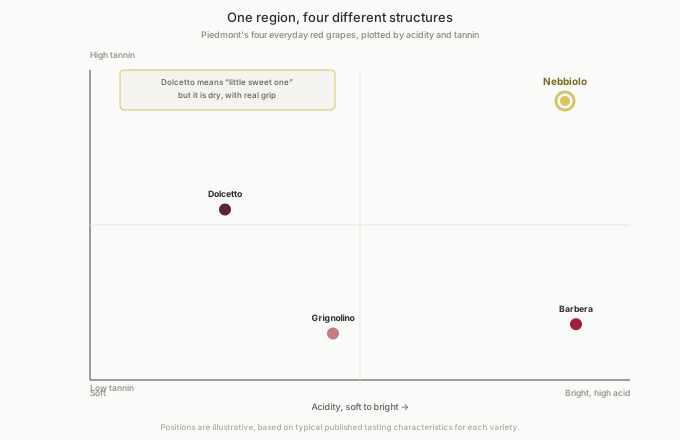
Nebbiolo gets the reputation, but Piedmont’s most-planted red grape by a wide margin is Barbera — deeply colored, structurally almost the opposite of Nebbiolo, with naturally high acidity and notably low tannin, which is exactly why it stays approachable young while Nebbiolo demands years. A good Barbera d’Asti or Barbera d’Alba delivers dark cherry, blackberry, and a savory, espresso-like edge, and functions in Piedmont roughly the way a house red functions anywhere else: the wine on the table on an ordinary Tuesday.
Dolcetto carries the best joke in Piedmontese wine naming. The word means “little sweet one,” and the wine is bone dry — low in acidity, yes, which gives it a soft, immediately drinkable first impression, but with a distinctly grippy, mouth-drying tannin on the finish that catches newcomers off guard. It’s built to be drunk within a year or two of the vintage, and in Piedmont it usually is.
Grignolino is the region’s most obscure red, pale enough to be mistaken for a dark rosé, light-bodied and low in tannin, and genuinely difficult to grow well — poor sites produce something thin and astringent, while good ones produce something piquant, peppery, and refreshing that rewards a slight chill. It rarely leaves the region, which is part of why almost nobody outside Piedmont has heard of it.
Put the four together — Nebbiolo, Barbera, Dolcetto, and Grignolino — and Piedmont’s reds cover nearly every combination of acid and tannin a red wine can have, despite all four growing within a short drive of each other. For the underlying vocabulary of tannin and acid used throughout this section, see our guide to tannin in wine.
The Whites: Moscato, Gavi, and Arneis
Piedmont’s reputation is built on red wine, but its whites are genuinely distinct rather than an afterthought. Moscato d’Asti is low in alcohol (typically 5–7% ABV), gently sweet, and lightly frizzante rather than fully sparkling, built around the intensely floral, grapey aromatics of the Moscato Bianco grape — honeydew melon, ripe pear, mandarin orange. It’s a different production method entirely from Champagne or traditional-method sparkling wine, and one of the few genuinely food-friendly sweet wines that doesn’t require a dedicated dessert course to make sense.
Gavi, made from the Cortese grape in the region’s southeastern corner near Genoa, is Piedmont’s answer to a crisp, mineral-driven white — lemon, green apple, and a characteristically long, chalky finish, closer in spirit to a Chablis than to anything else on this page. Arneis, grown mainly in Roero, is rounder and more textured, with peach and almond notes and a herbal, faintly bitter finish that keeps it from tipping into flabbiness. Both are proof that Piedmont’s obsession with site-specific, single-purpose appellations applies just as much to its whites as to Barolo.
Slow Food Was Never Really a Movement Here — Just a Habit
In March 1986, the opening of a fast-food restaurant near Rome’s Spanish Steps sparked a national protest, and out of that protest came the Slow Food movement, co-founded by Carlo Petrini. Petrini was from Bra, a small town in the Piedmontese Langhe — and Bra, not Rome, is where Slow Food actually built its home, hosting the movement’s first major public event, the Salone del Gusto, a decade later in 1996, and remaining its institutional base ever since.
The connection to wine here isn’t incidental. A movement built on the idea that food and drink are worth doing slowly, deliberately, and locally could hardly have picked a more fitting home than a region where the top wine law requires 38 months of aging before release and 62 for a Riserva, where truffle hunters still work with trained dogs rather than machinery, and where a wine style like Barbera exists specifically because not every glass in Piedmont is meant to wait a decade. Piedmont didn’t need a manifesto to explain why patience matters — its wine law had already been saying so for over a century.
Piedmont’s Other Famous Exports: Truffles and Vermouth
Alba gives its name to the white truffle (Tuber magnatum), one of the most expensive ingredients in the world and one that has resisted every attempt at cultivation — it can only be found wild, hunted with trained dogs in the same hills that grow Barolo and Barbaresco. The composer Gioachino Rossini reportedly called it “the Mozart of mushrooms,” and its modern fame owes a great deal to Giacomo Morra, a local hotelier who spent decades promoting the Alba truffle internationally and was crowned “King of Truffles” by the London Times in 1933. The truffle season runs roughly from October through January, overlapping almost exactly with the Nebbiolo harvest and the region’s biggest tourist season — which is no accident, since the two have been sold as a package, in restaurants and in marketing, for the better part of a century.
Piedmont’s other, less-discussed export is sitting in most home bars right now. In 1786, a Turin herbalist named Antonio Benedetto Carpano invented what’s recognized as modern vermouth — a white wine base infused with more than thirty herbs and spices, then fortified and sweetened, originally aimed at customers who found the region’s structured local reds too intense. It caught on so quickly that his shop reportedly stayed open around the clock to keep up with demand. Every bottle of Italian sweet vermouth used in a Negroni or Manhattan today traces its lineage back to that shop in Turin, a few miles from where Barolo was being reinvented at almost exactly the same moment in history.
How Piedmont Shaped Italy Itself
Piedmont’s influence on Italy goes well beyond wine. As the Kingdom of Sardinia, it was the political engine behind the unification of Italy in the 19th century, and Turin — Piedmont’s capital — briefly served as the first capital of the newly unified Kingdom of Italy from 1861 to 1865, before the seat of government moved on to Florence and eventually Rome. Camillo Benso, Count of Cavour, the Piedmontese statesman who did more than anyone to engineer unification, was also personally involved in modernizing Barolo production in the mid-1800s. It’s a strange, specific bit of history: the region that gave Italy its political center also happened to be quietly quality-controlling what would become its most prestigious wine, at almost exactly the same moment.
Getting to Know Piedmont: Where to Start
For a first bottle, a Barbera d’Asti or Barbera d’Alba is the easiest entry point — inexpensive relative to Barolo, ready to drink immediately, and genuinely representative of what most Piedmontese wine actually tastes like day to day. From there, a Roero or Langhe Nebbiolo (covered in more depth in our Nebbiolo guide) shows the family resemblance to Barolo at a fraction of the price and the wait. If visiting in person, October and November line up truffle season, harvest, and the fog that gives the whole region its character — though the UNESCO-listed Langhe and Monferrato hills reward a visit at almost any time of year, since the landscape itself, not just what’s happening in it that week, is the main attraction. And whenever you do open a serious bottle of Barolo or Barbaresco, our guide to decanting wine covers exactly how much time to give it first.
Frequently Asked Questions About Piedmont Wine
What is Piedmont known for in wine?
Piedmont, in northwest Italy, is best known for Barolo and Barbaresco, both made entirely from Nebbiolo. But those two wines represent only about 3% of the region’s total production. Piedmont also has more DOCG appellations (19) than any other Italian region and is tied with Tuscany for the most DOCs (41), covering everyday reds like Barbera and Dolcetto, whites like Gavi and Moscato d’Asti, and the smaller Alto Piemonte zone in the north.
What is the difference between Barolo, Barbaresco, and Langhe Nebbiolo?
All three are made from the same grape, Nebbiolo, grown in the same general area around Alba. Barolo requires the longest legal aging (38 months, 62 for Riserva) and is generally the most powerful and tannic. Barbaresco requires shorter aging (26 months, 50 for Riserva) and is typically softer and earlier-drinking. Langhe Nebbiolo is a declassified, more affordable category built to drink within a few years, sharing the same grape and general area but without Barolo or Barbaresco’s stricter zoning and aging requirements.
What grape is most planted in Piedmont?
Barbera is Piedmont’s most widely planted red grape, well ahead of Nebbiolo. It has naturally high acidity and low tannin, making it approachable young, and functions as the everyday table wine across the region — the opposite structural profile to the more famous, slower-aging Nebbiolo.
Why is Piedmont connected to the Slow Food movement?
Slow Food was founded in 1986 in response to a fast-food restaurant opening near Rome’s Spanish Steps, but its co-founder, Carlo Petrini, was from Bra, a small town in Piedmont’s Langhe wine country, and Bra has been the movement’s institutional home ever since, hosting its first Salone del Gusto event in 1996. Piedmont’s wine culture, with legally mandated multi-year aging for wines like Barolo, already embodied a similar philosophy of patience and local specificity decades before Slow Food had a name for it.
What white wines come from Piedmont?
Piedmont’s main whites are Moscato d’Asti (low-alcohol, lightly sparkling and sweet, made from Moscato Bianco), Gavi (crisp and mineral, made from Cortese in the region’s southeastern corner), and Arneis (rounder and more textured, grown mainly in Roero). All three are distinct native varieties rarely grown outside Piedmont in any serious volume.
Is the Piedmont wine region a UNESCO World Heritage Site?
Part of it is. The Vineyard Landscape of Piedmont: Langhe-Roero and Monferrato was inscribed as a UNESCO World Heritage Site in 2014, covering five zones: the Langhe hills around Barolo, the Barbaresco hills, Roero, the Barbera country around Nizza Monferrato, and the Asti Spumante and Canelli area. It was recognized for the outstanding value of a wine culture that has visibly shaped the landscape over centuries.