The best wine with prime rib is a structured red: Cabernet Sauvignon or a Cabernet-based blend such as red Bordeaux is the classic, with Rioja Reserva, Syrah and aged Barolo as the usual alternatives. The reason is fat. In USDA figures a cooked standing rib roast is about 28% fat by weight, against 8% for a trimmed tenderloin and 4.5% for a top round roast, and fat softens the grip of a tannic red. This guide covers wine with prime rib at every doneness, what au jus, gravy, horseradish and Yorkshire pudding change, beef Wellington, and how many bottles a table of 8 to 12 needs. Its organising idea is that the fat in the joint sets how much tannin it can take, and everything else on the plate only nudges the choice up or down.
In this article
- 1 Wine with Prime Rib at a Glance
- 2 What Prime Rib Actually Means (It Is Not the Grade)
- 3 Wine with Prime Rib Starts with the Fat
- 4 One Joint, Every Doneness
- 5 Au Jus, Gravy, Horseradish and Yorkshire Pudding
- 6 Beef Wellington and Leaner Roasts
- 7 Wine with Prime Rib for 8 to 12 Guests
- 8 Where the Evidence Stops and the Advice Splits
- 9 Wine with Prime Rib: Your Questions Answered
Wine with Prime Rib at a Glance
- The classic: a full-bodied red, meaning Cabernet Sauvignon or a Cabernet-based blend such as red Bordeaux. Decanter’s Christmas beef guide lists these, plus Syrah/Shiraz and Malbec, as the classic choices for a hearty roast.
- A step up: Rioja Reserva. Wine Folly’s holiday guide picks it for prime rib because it has “enough delicacy” for the meat and still carries the tannin to cleanse the palate.
- One bottle for a mixed table: a Merlot-led Right Bank Bordeaux, a Cabernet-Merlot blend or Rioja Reserva.
- A special bottle: aged Barolo or Barbaresco, once their bold tannins have softened, which Decanter also recommends.
- Beef Wellington or a trimmed fillet: Pinot Noir, Merlot or Garnacha.
- White wine: a stretch, but Decanter names barrel-aged Chardonnay, Viognier and white Rioja as the whites with enough heft.
What Prime Rib Actually Means (It Is Not the Grade)
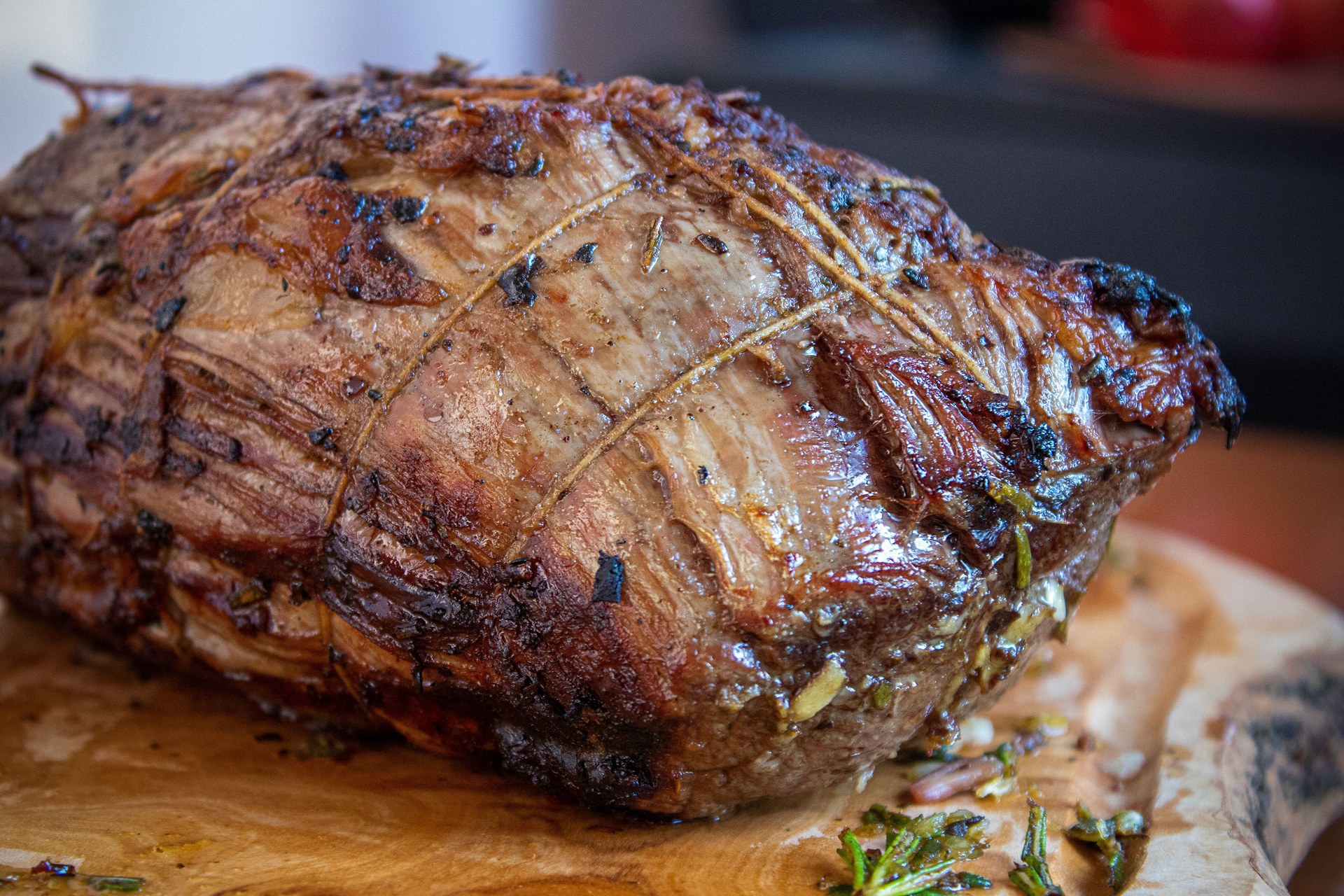
Prime rib is a place on the animal, not a grade of beef. A standing rib roast comes from the primal rib, which runs from the sixth rib to the twelfth, and a roast can hold anywhere from two to seven of those ribs. It is usually roasted standing on its own bones. Wikipedia points out that although the cut is often called prime rib, the USDA does not require it to come from USDA Prime beef. Every slice has the “eye” of the rib and, around it, the fat-marbled outer muscle called the cap (spinalis dorsi).
Grade matters for wine because it changes the fat on the plate, but less than you might expect. USDA’s figures for a cooked whole rib roast (ribs 6 to 12, with a thin layer of fat left) are 25.6 g of fat per 100 g for Select, 29.8 g for Choice and 33.7 g for Prime. The two ends of the rib are close: 27.1 g for the small end (ribs 10 to 12) and 28.5 g for the large end (ribs 6 to 9), all grades. Which roast you cook moves the number much further, as the chart below shows.
Wine with Prime Rib Starts with the Fat
Tannin is what makes a young red feel dry and gripping: it binds to proteins in your saliva. Our steak guide argues that fat, not the word “steak”, should pick the wine, because the protein and fat in the meat give the tannin something else to bind to. A roast makes the same case on a bigger scale: a slice of rib roast softens a big Cabernet in a way that a lean cut cannot.
The fat half of that claim has been tested. In March 2021 Ahmad Saad and colleagues at the University of Bordeaux published “New Insights into Wine Taste: Impact of Dietary Lipids on Sensory Perceptions of Grape Tannins” in the Journal of Agricultural and Food Chemistry. Their abstract says the sensory analysis “demonstrated that dietary oils decrease the perception of astringency of grape tannin solutions”. News reports of the work (ZME Science and Inverse) add that volunteers ate a spoonful of rapeseed, grapeseed or olive oil before tasting the tannin solution, and that with olive oil the tannin even tasted fruity.
That was plant oil and a tannin solution, not beef and not wine, so treat it as support for the rule rather than proof of it (more on the limits below). What the roast brings is easy to count, and the chart below counts it for each Christmas roast once cooked. Read it as a ceiling: a roast in the top half has the fat to meet a Cabernet-weight red, and a roast in the bottom half does not, so the same bottle will taste hard beside it. The shading is my suggestion, not a measurement, and the line between the bands is a judgement call.
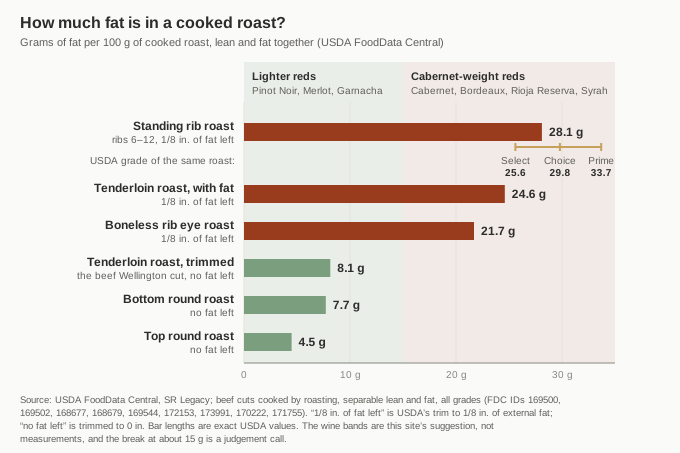
Three things stand out. The standing rib is the fattiest roast at 28.1 g per 100 g, about 3.5 times a trimmed tenderloin (8.1 g) and over six times a top round roast (4.5 g). The cut counts for more than the grade: going from Select to Prime adds 8.1 g to a rib roast, while going from rib to top round removes 23.6 g. And trimming matters: the same tenderloin roast measures 8.1 g with its outer fat trimmed off and 24.6 g with a thin layer left on, a gap of 16.5 g.
One Joint, Every Doneness
Doneness is where a roast stops behaving like a steak. It cooks from the outside in, so when the middle is ready the outer slices have been hot for longer, and a carved joint runs from a pink centre to well-done end cuts. Whoever asks for the end piece is choosing a doneness, and the bottle has to live with it.
First settle the middle. Wine Spectator’s guide to roast beef, quoting Sam Gugino, takes a standing rib roast out of the oven at 125°F (52°C) for medium-rare and says the meat keeps climbing by up to 10°F (about 5.6°C) while it rests for at least 20 minutes. That rest is your window to pour.
Does doneness push the wine up or down? Advisers disagree. Decanter’s guide says a medium-to-well-done steak might stand up to a wine with more tannic structure; our steak guide argues the opposite, that a well-done cut is drier, with less fat and juice to buffer a young red, so it wants softer fruit. I found no study that measured either.
For one roast and one table, pour for the pink slices most guests will take, with tannin that is firm rather than fierce, and let the jus or gravy buffer the end cut. If you have a second bottle open for a well-done fan, make it a Merlot. Age is the next check: Decanter’s Hawksmoor source says beef dry-aged for 35 or even 45 days has such intense flavour that the wine must match it, so a long-aged roast can take a bolder bottle.
Au Jus, Gravy, Horseradish and Yorkshire Pudding
Decanter’s guide lists four things to weigh with beef: the cut, the age of the meat, the cooking time and the accompaniments, sauces included. The first three are settled once the roast is out of the oven.
Au jus means “with juice”: the roast’s own juices, thin and salty. Salt softens tannin, which makes a jus the easy sauce for a tannic red (see our wine pairing principles guide). Gravy is the bigger decision. Gugino’s simple pan gravy reduces a cup each of red wine and beef broth in the roasting pan for about 10 minutes, and for a really rich gravy Hawksmoor’s wine manager told Decanter you want a wine with “a bit of muscle to stand up to it”: New World Cabernet or Malbec.
Horseradish is the one trimming that can work against a tannic red. I found no study of horseradish with wine, so this is reasoning, not measurement: our principles guide notes that tannin clashes badly with bitter or very spicy food, and horseradish is the sharpest thing on the plate. Use a dab, and lean towards the softer end of the choices above if the bowl goes round.
Yorkshire pudding began as a way to use the roast’s own fat: “a dripping pudding” appeared in print in 1737, and Hannah Glasse’s The Art of Cookery Made Plain and Easy named it Yorkshire pudding in 1747. Wikipedia adds that it was first served as a course of its own, with thick gravy, to dull the appetite so that diners ate less of the expensive meat. For wine it is a neutral sponge for gravy with a little extra beef fat, so it asks nothing of the bottle.
Beef Wellington and Leaner Roasts
A beef Wellington changes the question because the roast inside it is a different cut. The fillet is tenderloin, and USDA’s cooked figure for a trimmed tenderloin roast is only 8.1 g of fat per 100 g, so a big Cabernet has little to work against. Our steak guide pairs fillet with Pinot Noir or Merlot, and Decanter’s Hawksmoor source reaches for Grenache or Garnacha with a lightly dry-aged Chateaubriand, another fillet cut, for their fine tannins and red fruit.
For the lean roasts many tables call roast beef, a bottom round carries 7.7 g of fat per 100 g and a top round 4.5 g, so a Merlot, a Garnacha or a younger Rioja will sit better than a Cabernet.
Wine with Prime Rib for 8 to 12 Guests
For a standing rib roast on the bone, Gugino says to buy about 1¼ lb (raw weight) per person, so 8 guests need roughly 10 lb (4.5 kg) and 12 guests about 15 lb (6.8 kg). For a boneless roast he suggests 10 to 12 oz (about 280 to 340 g) per person.
For the wine, a 750 ml bottle pours five 150 ml glasses, so the number of bottles is guests × glasses each ÷ 5, rounded up. Three glasses each is my assumption for a long dinner, not a rule, so here is the range:
- 8 guests: 4 bottles at two glasses each, 5 at three, 7 at four.
- 10 guests: 4 bottles at two glasses each, 6 at three, 8 at four.
- 12 guests: 5 bottles at two glasses each, 8 at three, 10 at four.
Large bottles suit a roast: a magnum holds 1.5 litres, which is two bottles, so four magnums cover the eight bottles that 12 guests need at three glasses each (our bottle sizes guide lists every format). Open and decant a young Cabernet-based wine an hour or two before the roast comes out; our decanting guide gives 30 minutes to a few hours for aeration.
If you can open only one kind of bottle for a mixed table, choose the middle of the road: a Merlot-led Right Bank Bordeaux, a Cabernet-Merlot blend or a Rioja Reserva, which has enough delicacy for the meat and still enough tannin to cleanse the palate. Our ham guide makes the same case for any holiday table with many dishes: put flexibility ahead of a theoretically perfect single-dish match. If turkey shares the table, our turkey guide has the bird’s bottle.
Where the Evidence Stops and the Advice Splits
The fat rule is the best-supported idea here, and it still has limits. I could not open the full paper, because the publisher blocks automated requests, so I read its abstract and two news reports. The test used oil, not beef, and a tannin solution, not wine, and I found no study that put a roast, a doneness or a sauce up against a wine.
Pinot Noir is where the advice splits. Wine Folly says prime rib’s intensity calls for an equally bold wine and that “Pinot Noir won’t cut it”; Decanter’s Hawksmoor source suggests a mature, earthy Pinot Noir for long dry-aged beef; our steak guide chooses it for fillet. They are talking about three different pieces of beef, and the chart suggests why they disagree: Pinot has little to offer against the fattiest roast and comes into its own as the fat falls away (my synthesis, not a finding).
Cabernet itself is a tradition more than a result. The three authorities I read (Decanter, Wine Folly and Wine Spectator) all name it first or close to it, and none cites a tasting of prime rib against rival wines. Treat the picks here as well-reasoned advice, not a ranking.
The USDA numbers have limits too: they are averages for cooked cuts in the SR Legacy dataset, so they describe the cut, not your roast, and the fat you eat depends on how much you trim. To check them, search USDA FoodData Central for “beef, rib, whole (ribs 6-12)”.
Wine with Prime Rib: Your Questions Answered
What is the best wine with prime rib?
A structured red with firm tannin. Cabernet Sauvignon or a Cabernet-based blend such as red Bordeaux is the classic choice, and Rioja Reserva, Syrah and aged Barolo are the usual alternatives. A cooked standing rib roast is about 28% fat by weight in USDA figures, and that fat softens the grip of a tannic red.
Does Pinot Noir go with prime rib?
It can, but it is not the first choice. Wine Folly says Pinot Noir will not cut it against a roast this intense, while Decanter’s Hawksmoor source suggests a mature, earthy Pinot Noir for long dry-aged beef. Pinot suits leaner cuts better, such as the fillet in a beef Wellington (8.1 g of fat per 100 g once trimmed).
Can you drink white wine with prime rib?
Yes, with care. Decanter says fuller whites can work with beef and names barrel-aged Chardonnay, Viognier and white Rioja. A white has little tannin to meet the fat, so choose a rich, textured style with some oak or lees ageing rather than a crisp one.
What wine goes with beef Wellington?
A lighter red: Pinot Noir, Merlot or Garnacha. The fillet inside a Wellington is lean, at 8.1 g of fat per 100 g once trimmed in USDA figures, so a big Cabernet has little fat to work against. If the fillet keeps a layer of fat the figure is 24.6 g, and a Cabernet-based blend becomes a fair choice.
How many bottles of wine do you need for prime rib for 10 people?
A 750 ml bottle pours five 150 ml glasses. For 10 guests, plan 4 bottles at two glasses each, 6 at three or 8 at four. Three glasses each is an assumption for a long dinner, not a rule, so round up if the table is thirsty.
What wine goes with roast beef and Yorkshire pudding?
The same reds as prime rib if the roast is a fatty cut, and softer ones if it is lean. Cabernet or Bordeaux suits a rib roast; Merlot or Garnacha suits a round roast, which carries 4.5 to 7.7 g of fat per 100 g in USDA figures. The pudding asks little of the wine; the gravy matters more.