A good mulled wine recipe for one 750 ml bottle takes about 20 minutes: boil a syrup of orange, cinnamon, cloves and sugar in a fifth of the wine, add the rest of a fruity red, and warm it until it steams at about 65–75°C (150–170°F), never to a simmer. Plenty of the alcohol stays in the pot. In the US government’s measurements, 85% of the alcohol was left when an alcoholic drink was stirred into a hot liquid, and 40% was still there after 15 minutes of simmering. This guide gives the recipe in ml and US cups, picks the wine and tests the famous rule that boiling burns off the alcohol. Its organising idea is an old one, found in a Roman cookbook: make a small, hot base first and add most of the wine last.
In this article
- 1 Mulled Wine Recipe: One Bottle, Five or Six Small Mugs
- 2 Which Wine to Use in a Mulled Wine Recipe
- 3 How Much Alcohol Is Left in Mulled Wine?
- 4 Why a Mulled Wine Recipe Starts With a Syrup
- 5 Does the Never-Boil Rule for Mulled Wine Hold Up?
- 6 From Hippocras to Glühwein: A Short History
- 7 Glühwein, Glögg and Vin Chaud: What Counts as What
- 8 Mulled Wine: Your Questions Answered
Mulled Wine Recipe: One Bottle, Five or Six Small Mugs
Makes about 800 ml. Takes 20 minutes. Use a medium saucepan, and a cooking thermometer if you have one.
Ingredients
- 1 bottle (750 ml, about 3¼ US cups) fruity, unoaked red wine
- 60 g (about 5 tbsp) caster or granulated sugar
- 1 orange: 3 wide strips of zest, then the juice
- 1 cinnamon stick (about 7 cm / 3 in)
- 3 whole cloves
- 1 star anise (optional)
- 30–50 ml (2–3 tbsp) brandy or orange liqueur (optional)
- A few thin slices of a second orange, to serve
Method
- Put the sugar, orange zest and juice, cinnamon, cloves and star anise in a medium saucepan with 150 ml (⅔ cup) of the wine, just enough to cover the sugar. Warm over a medium heat, stirring, until the sugar dissolves.
- Bring to the boil and cook for 5 minutes, until syrupy.
- Turn the heat to low and add the other 600 ml (2½ cups) of wine. Warm for about 10 minutes, until the pan steams and a thermometer reads 65–75°C (150–170°F). Do not let it simmer.
- Take the pan off the heat and stir in the brandy or liqueur if you are using it. Taste, and add a little more sugar if you want it. Strain into heatproof mugs, add an orange slice and let it cool for a minute before sipping.
These amounts sit among the recipes I compared. Fiona Beckett’s recipe in Decanter uses 100 g of sugar and 100 ml of orange liqueur for two bottles. Felicity Cloake in the Guardian uses 150 g of sugar for two and says to add “enough wine to just cover the sugar” for the syrup. Beckett keeps her spices whole because ground ones can “taste powdery”, and Cloake notes that the syrup can be bottled and kept, so you can make it ahead and add the wine on the day.
Which Wine to Use in a Mulled Wine Recipe
Price is the easy part: spend little, but not nothing. Beckett says to make sure you are not “mulling one of the finest bottles in your cellar” but wants “a drinkable if inexpensive wine for a base – something like an own-label Corbières”. Cloake says mulling is no excuse to serve “laughably cheap wine”, and Wine Folly is the outlier, calling even cheap box wine a great base. An open bottle from earlier in the week will do: our guide to how long wine lasts once opened says slightly oxidised wine still works in cooking.
The sources agree on a style too: fruity, with little or no oak and not too much tannin. Cloake calls for “fruity, unoaked red wine”. Wine Folly says any red will do but to “avoid heavily oaked or very tannic styles”, and picks Zinfandel for its “ripe fruit and moderate tannins”, with Italian Primitivo (the same grape), Sangiovese or Garnacha as alternatives. Tannin is the dry, gripping feel on your gums that our guide to what tannin is explains; a drink that already has sugar, spice and heat has no use for extra grip.
They part ways on body. Beckett recommends a medium-bodied red, and Christophe Lechavlier of Borough Wines says a Syrah “will bulk up the mulled wine”. Wine Folly’s older mulled-wine article went bolder, naming Syrah and Malbec and warning off delicate Pinot Noir and Gamay because “mulling wine disguises a lot of the nuances of taste”. A short list, from grapes this site has profiled:
- Garnacha (Grenache): naturally low in tannin and high in ripe red fruit, as our guide to low tannin wines puts it.
- Merlot: a medium-tannin wine with soft, round tannins; see what Merlot tastes like.
- Zinfandel, Primitivo or Sangiovese: Wine Folly’s picks.
- Skip: young Cabernet and other very tannic reds, Reserva and Riserva bottles (more tannin from long oak ageing), and fine wines whose subtlety the spices will hide.
How Much Alcohol Is Left in Mulled Wine?
Most of it, unless you simmer the pot for a long time. The best numbers come from the US Department of Agriculture’s Table of Nutrient Retention Factors, Release 6 (2007), which draws its alcohol rows from a 1992 laboratory study by Augustin and colleagues. They used gas chromatography to measure how much alcohol stayed in foods prepared several ways. An alcoholic drink stirred into a hot liquid kept 85% of its alcohol. Stirred into a dish that was then simmered or baked, it kept 40% after 15 minutes, 35% after 30 minutes and 25% after an hour. It took two and a half hours to get down to 5%.
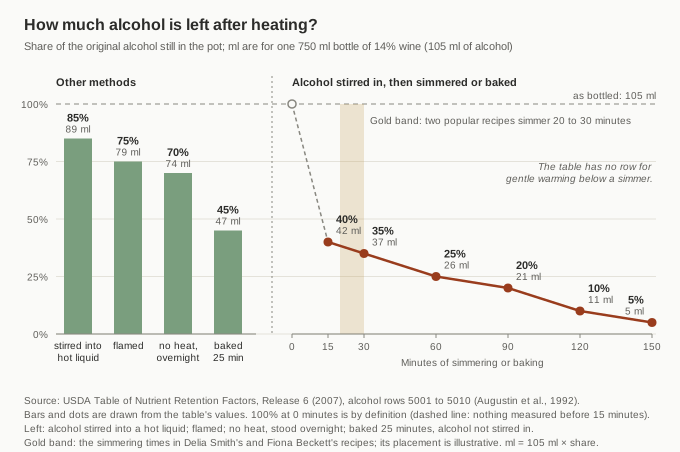
The chart converts the percentages to millilitres for a 750 ml bottle of 14% wine, which holds 105 ml of alcohol (750 ml × 14%). The wines above sit around there: our red wine ABV guide puts Garnacha at 13.5–15%, Merlot and Sangiovese at 13–14.5% and Californian Zinfandel at 14.5–16.5%.
Gentle warming has no row in the table, so the honest answer is a bracket. A pot brought just to steaming should sit nearer the 85% row than the simmered rows, though the table cannot say how much nearer. The syrup step helps: it uses a fifth of the wine, so even if that fifth lost 60% of its alcohol (the 15-minute simmer figure), the syrup step alone would cost the bottle 12%. A recipe that simmers for 20 or 30 minutes, as Delia Smith’s (described by Cloake) and Beckett’s do, falls between the 40% and 35% points, if the table carries over to a pot of wine. Our guide to cooking with wine gives the same picture for sauces and braises.
Real cups point the same way. In a Slovenian television test, the Biotechnical Faculty’s laboratory in Ljubljana analysed mulled wine from Christmas stalls and found 4 to 8% alcohol by volume; only one sample reached the 7% that the German standard sets for mulled wine, and some stalls had added water.
Two cautions. The table measured foods, not mulled wine, and pan shape, a lid and stirring are all likely to change the rate; I found no controlled measurement of a pot of mulled wine before and after heating. And the lowest point is not zero: even two and a half hours of simmering left 5%. For a drink with no alcohol, use grape or apple juice in place of the wine, as Wine Folly suggests for a kid-friendly version.
Why a Mulled Wine Recipe Starts With a Syrup
The oldest spiced-wine recipe in this story already starts with a syrup. In Joseph Dommers Vehling’s 1936 English translation of the Roman cookbook credited to Apicius, “Fine Spiced Wine” (conditum paradoxum) starts with 6 sextarii of honey and 2 of wine heated on a slow fire in a copper bowl. “At the boiling point add a dash of cold wine, retire from stove and skim,” it says, and the cook repeats this two or three times. The pepper, mastic, nard or laurel leaves, saffron and date stones go in the next day, and last of all “18 sextarii of light wine”. Nine-tenths of the wine never meets the fire. The recipe does not say how to serve it.
Mrs Beeton’s recipe of 1861 starts with the spice too: “Boil the spice in the water until the flavour is extracted, then add the wine and sugar, and bring the whole to the boiling-point.” Jamie Oliver’s version, as Cloake describes it in the Guardian, boils sugar, citrus peel and spices with “enough red wine to just cover it all” until thick, then adds the rest of the wine. His reason: the base “needs to be quite hot, and if you do this with both bottles of wine in there you’ll burn off the alcohol”. Cloake’s own recipe follows the same order.
The modern version of the trick has three payoffs: the sugar dissolves before the wine arrives, the spices get strong heat in a small, concentrated liquid, and most of the wine is only warmed. The first two are what cooks say; the third is the arithmetic above.
Does the Never-Boil Rule for Mulled Wine Hold Up?
The usual advice is never to boil mulled wine, and the alcohol is a favourite reason. Beckett’s advice is: “Remember not to boil the liquid at any point, otherwise you’ll burn off the alcohol and make your mulled wine taste bitter.” Wine Folly says to heat the wine until it steams, at about 65–75°C, “never boiling”.
Test the rule against the evidence. On alcohol it is half right: a long simmer does strip most of it, but the USDA’s 85% for stirring into a hot liquid says brief contact costs little. And even careful cooks bend it: Cloake boils her syrup for 5 to 8 minutes, and Beckett, who wrote the rule above, simmers her own pot for about 30 minutes at a heat where the liquid “should barely tremble”. On bitterness I found no measurement, only cooks’ experience.
History sits on the other side. Mrs Beeton’s cook boiled the lot, then served it with “strips of crisp dry toast, or with biscuits”. Her recipe also adds water, which Cloake says “has no place in a wine-based punch”; the EU agrees for Glühwein and forbids it.
A fair verdict: never boil is sound advice for flavour, on the authority of cooks, and for alcohol it is a rule that matters mainly for long simmers. The 65–75°C target comes from Wine Folly; Wikipedia’s mulled wine entry gives 60–70°C for Nordic glögg. Warmth also releases a wine’s aromas faster and makes its alcohol more noticeable, as our serving-temperature guide explains, so mulled wine is the one wine where more heat is the point, up to a limit.
From Hippocras to Glühwein: A Short History
The medieval word for spiced wine was hippocras: wine mixed with spices and sugar and strained through woollen cloths. The 1911 Britannica says the name came not from any recipe of the Greek physician but from an apothecary’s word for a strainer, the “Hippocrates’ sleeve”. The Forme of Cury, an English cookery book from about 1390, opens its recipe “Pur fait Ypocras” and lists ten spices and herbs, among them cinnamon, ginger, galangal, cloves, long pepper and grains of paradise. Cloake tried it with cheap French red and found the spice “overpowering”.
Why spice wine at all? Two stories circulate. Wine Folly says that “back in the day, adding spices helped cover up the wine’s flaws”, because wine shipped over long distances often spoiled. Cloake calls mulled wine “a tipple originally designed to show off the wealth and generosity of a medieval household”. I found no source that settles it, and both can be true.
Glühwein, Glögg and Vin Chaud: What Counts as What
Glühwein, German for glowing wine, is the only version with a legal definition. Annex II of EU Regulation 251/2014 defines it as an aromatised wine-based drink “obtained exclusively from red or white wine” and “flavoured mainly with cinnamon and/or cloves”, with an actual alcoholic strength of at least 7% by volume. Adding water is forbidden, and a version made from white wine must say so in its name.
The regulation also says an aromatised wine-based drink may have no added alcohol “except where Annex II provides otherwise”, and the Glühwein entry makes no exception, so on a plain reading a cup served mit Schuss, with rum or another spirit added, falls outside the definition. The same annex gives Nordic glögg (vinglögg, viiniglögi) the same rules. In France the drink is vin chaud, hot wine; Wine Folly describes a French version with lemon and eau de vie as “wonderful, particularly with a white wine”.
Mulled Wine: Your Questions Answered
Does mulled wine have alcohol?
Yes, and how much depends on the heat. In the USDA table, an alcoholic drink stirred into a hot liquid kept 85% of its alcohol, and a dish simmered for 15 minutes kept 40%. It took two and a half hours of simmering to reach 5%. A Slovenian laboratory test of mulled wine from Christmas stalls found 4 to 8% alcohol by volume. For a version with no alcohol, use grape or apple juice instead of the wine.
What is the best wine for mulled wine?
A fruity, inexpensive red with little oak and moderate tannin. Wine Folly picks Zinfandel, with Primitivo, Sangiovese or Garnacha as alternatives. Decanter recommends a medium-bodied red such as an own-label Corbières, or a Syrah for a chunkier result. Avoid heavily oaked or very tannic reds, and fine bottles whose subtlety the spices will hide.
Can you boil mulled wine?
You can, but the usual advice is not to. Fiona Beckett, writing in Decanter, warns that boiling will burn off the alcohol and make the drink taste bitter. The USDA data show that brief contact with a hot liquid costs little alcohol while a long simmer costs most of it. The safer method is to boil a syrup of sugar, orange and spices in a fifth of the wine, then add the rest and warm it until it steams.
How hot should mulled wine be?
Wine Folly says to heat it until it steams, at about 65–75°C (150–170°F), and never to boil it. Wikipedia gives 60–70°C for Nordic glögg. At that temperature the drink can burn your mouth, so let the mug stand for a minute before you sip.
What is the difference between mulled wine and Glühwein?
Glühwein is the German name, and in the EU it is a legally defined drink: made only from red or white wine, flavoured mainly with cinnamon and/or cloves, with no added water and at least 7% alcohol by volume. The English words mulled wine do not appear in the regulation, so a homemade pot can use any spices, fruit or spirit.
Can you make mulled wine with white wine?
Yes. EU rules allow white Glühwein if the name says white, and Wine Folly suggests aromatic whites such as Riesling, Muscat or Chenin Blanc for white versions. The method is the same: boil the syrup first, then warm the wine without simmering.