
Walk into a wine shop and ask for a dry wine, and the staff know exactly what you mean. But ask what “dry” actually means and the answers get murkier. Does it mean the wine is less fruity? Does it mean it has more tannin? Does it mean it tastes bitter? None of those. Dry wine means wine with no perceptible sweetness — specifically, wine in which the yeast has consumed most or all of the grape’s natural sugar during fermentation, leaving very little residual sugar in the finished wine.
This sounds simple, and in principle it is. But wine’s relationship with sweetness is genuinely complicated by one important fact: fruity-tasting wine is not necessarily sweet wine, and sweet-smelling wine is not necessarily sweet wine. Understanding that distinction is the key to navigating wine lists, buying the right bottles, and understanding why some wines taste drier than they technically are.
In this article
What Dry Actually Means: The Science in Plain English
Wine is made by fermenting grape juice. Grapes contain natural sugar — primarily glucose and fructose — and when yeast is added to crushed grapes, it consumes those sugars and converts them into alcohol and carbon dioxide. This is fermentation, and it is the fundamental process behind all wine.
When fermentation runs to completion — when the yeast has consumed essentially all the available sugar — the resulting wine is dry. No sugar left, no sweetness in the glass. When a winemaker stops fermentation early — by chilling the wine, filtering out the yeast, or adding alcohol to kill the yeast — some sugar remains unconsumed. This residual sugar is what makes wine taste sweet. The more residual sugar, the sweeter the wine.
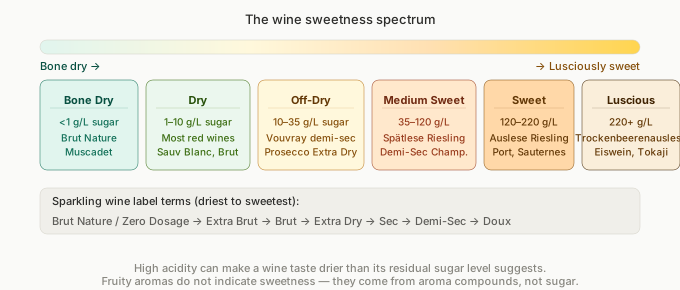
Technically, a wine is considered dry when its residual sugar is below 10 grams per litre (g/L). A bone-dry wine might have under 1 g/L. A wine with 10–35 g/L is off-dry (noticeably but not overwhelmingly sweet). A dessert wine might have 120–220 g/L or more. To put that in context, a can of Coca-Cola contains about 108 g/L of sugar — most dry wines have less than a tenth of that.
One important nuance: EU regulations define dry wine as containing no more than 9 g/L residual sugar (or up to 18 g/L if the acidity is high enough, because acidity masks the perception of sweetness). In practice, you will rarely taste sweetness in a wine below 10 g/L — but a wine at exactly 9 g/L with low acidity might feel slightly rounder and richer than one at 2 g/L.
The Most Common Confusion: Fruity Does Not Mean Sweet
This is the single most important thing to understand about dry wine, and the source of more confusion at wine shops and dinner tables than almost anything else.
When a wine smells strongly of ripe strawberry, peach, or tropical fruit, your brain instinctively expects it to taste sweet — because in almost every other context, fruity things are sweet. Wine breaks that rule. The fruity aromas in wine come from aromatic compounds in the grape — esters, terpenes, and other volatile molecules that evolved in the grape to attract birds and animals. These compounds give wine its characteristic scent of cherry, blackcurrant, citrus, or peach without contributing any sugar whatsoever.
A Sauvignon Blanc that smells intensely of passionfruit and grapefruit is completely dry — below 4 g/L residual sugar. A Pinot Noir that smells of fresh red cherries and violets is bone dry. A New Zealand Sauvignon Blanc that smells almost aggressively tropical is dry. The fruit is in the nose, not in the sugar.
This confusion runs the other way too. A wine with high acidity can taste drier than it technically is, because the acidity counteracts your perception of sweetness. A Riesling with 12 g/L of residual sugar but high, mouth-watering acidity can taste barely off-dry. The same 12 g/L in a low-acid Viognier would taste noticeably sweet. The acid and sugar are in a balancing act, and perceived sweetness often differs from technical sweetness.
The practical upshot: when you call a wine “too sweet,” you might mean the residual sugar is high — or you might mean the wine’s acidity is too low to balance the fruit, even if the sugar is minimal. These are different problems with different solutions.
Which Wines Are Dry? A Practical Guide by Style
Dry Red Wines
The vast majority of red wines are dry. Fermentation in red wine typically runs to near-completion, leaving almost no residual sugar. Additionally, tannin — the compound extracted from grape skins and seeds that gives red wine its drying sensation on your gums — creates a perception of dryness that has nothing to do with sugar. A grippy young Cabernet Sauvignon can feel very “dry” in your mouth even though that dryness is entirely from tannin, not from an absence of sweetness.
Reliably dry reds: Cabernet Sauvignon, Merlot, Pinot Noir, Syrah/Shiraz, Malbec, Sangiovese (Chianti, Brunello), Tempranillo (Rioja), Nebbiolo (Barolo, Barbaresco), Grenache, Mencía. In fact, it is far easier to list the notable exceptions: some Zinfandels from California contain residual sugar and taste off-dry to noticeably sweet; some cheap supermarket reds add sugar for roundness and palatability.
Dry White Wines
Most white wines are also dry, but this is where confusion is most common, because white wines’ aromatic intensity and fruit-forward character can easily be mistaken for sweetness. The following are reliably dry:
- Sauvignon Blanc — almost always bone dry despite its intensely fruity, tropical aromas. Sancerre, Pouilly-Fumé, and Marlborough examples are all dry.
- Chablis and unoaked Chardonnay — bone dry, often mineral and lean.
- Pinot Grigio (Italian style) — dry, light, neutral.
- Albariño (Rias Baixas) — dry, high acidity, saline.
- Assyrtiko (Santorini) — bone dry and intensely mineral.
- Grüner Veltliner (Austrian, unless labelled otherwise) — dry, herbal, peppery.
- Dry Riesling (labelled “trocken” in German, or from Alsace) — bone dry despite Riesling’s reputation for sweetness.
White wines that can be either dry or off-dry depending on the label: Vouvray (Chenin Blanc from Loire; check for “sec”, “demi-sec”, or “moelleux” on the label), Gewurztraminer (Alsatian versions are usually dry; German versions vary), Pinot Gris (Alsatian can be fully dry or slightly off-dry), Viognier (usually dry but can taste richer than its sugar level suggests).
The Riesling Problem: Notoriously Confusing
Riesling deserves special attention because it is the grape most likely to catch people out. In Germany, the sweetness level is often not clearly stated on the front label, and the same producer, from the same vineyard, may make completely dry (trocken), off-dry (halbtrocken), and fully sweet (“Prädikat” wines: Spätlese, Auslese, Beerenauslese) versions. Meanwhile, the wine’s naturally high acidity and intense fruit aromas mean that even an off-dry Riesling can taste deceptively fresh and lean.
The rule: if a German Riesling label says trocken, it is dry. If it says Spätlese, Auslese, or any of the higher Prädikat levels, it is almost certainly sweet (though some producers make dry Spätlesen — welcome to Germany). If it says nothing about sweetness on the front, check the back label or the retailer’s description. Alsatian Riesling from France is generally dry unless specifically labelled as vendange tardive or sélection de grains nobles.
Dry Sparkling Wine: The Counterintuitive Labels
Sparkling wine uses a completely different and deeply counterintuitive set of sweetness terms that confuse almost everyone the first time they encounter them. The key thing to know is that Extra Dry is actually slightly sweeter than Brut — the terminology was established centuries ago and reflects historical usage rather than modern logic.
From driest to sweetest:
- Brut Nature / Zero Dosage — bone dry, 0–3 g/L. The driest style. Common in premium Champagne and natural wine.
- Extra Brut — very dry, 0–6 g/L.
- Brut — dry, up to 12 g/L. The most common and default sparkling wine style. Most Champagne, Cava, and Prosecco Brut sits here.
- Extra Dry / Extra Sec — confusingly, this is slightly sweeter than Brut. 12–17 g/L. Common in Italian Prosecco and some Cava.
- Sec / Dry — off-dry to noticeably sweet. 17–32 g/L. “Dry” on a sparkling label means something quite different to “dry” on a still wine label.
- Demi-Sec — sweet. 32–50 g/L. The traditional pairing with dessert.
- Doux — lusciously sweet. Over 50 g/L. Rarely seen outside historic Champagne traditions.
The practical rule: if you want a dry sparkling wine, look for Brut or drier. If you see “Extra Dry” or “Dry” on a sparkling wine, it will taste noticeably sweet.
How to Tell If a Wine Is Dry
There are a few reliable methods, in increasing order of reliability.
- Check the label for explicit sweetness terms — trocken/sec/secco (dry), demi-sec/halbtrocken (off-dry), moelleux/doux/dolce (sweet). These regional terms appear on Old World wines where sweetness varies significantly within the same grape variety or appellation.
- Look up the technical sheet — most producers list residual sugar in grams per litre on their websites. Under 4 g/L: bone dry. 4–10 g/L: dry. 10–35 g/L: off-dry.
- Ask the wine merchant — the most reliable method for unusual wines where the label tells you nothing. A good merchant knows the style of every wine on their shelves.
- Taste it — sweetness is felt at the tip of the tongue. If the very first contact produces a sugary sensation, the wine has detectable residual sugar. If the initial impression is acidic or neutral rather than sweet, it is dry. Note that tannin can mimic dryness in red wines — the drying sensation on your gums is astringency from tannin, not the absence of sweetness.
Why Dryness Matters for Food Pairing
Matching sweetness level to food is one of the most important — and most commonly violated — principles of food and wine pairing. The rule: a wine should always be at least as sweet as the dish it accompanies. If the food is sweeter than the wine, the wine will taste harsh, acidic, or thin by comparison.
Dry wines with food: dry wines pair best with savoury dishes where there is no sweetness in the food to compete with them. A bone-dry Chablis with oysters, a dry Sangiovese with pasta al pomodoro, a dry Riesling trocken with roast pork — the wine’s acidity and structure enhance the food without any sweetness getting in the way.
Where dry wines struggle: spicy food (capsaicin amplifies the perception of alcohol and tannin, making a dry red taste harsher), very sweet sauces (the food’s sweetness makes the dry wine taste sour), and sweet desserts (a dry wine alongside a chocolate cake will taste almost unpleasantly acidic and thin). For spice, reach for off-dry styles — an off-dry Riesling or Gewurztraminer handles heat much better than a bone-dry Sauvignon Blanc. For dessert, match the sweetness: a sweet wine with a sweet dish. For wine basics explained simply, see our wine basics section. For a broader look at pairing principles, our food and wine pairing guide covers the full framework.
Frequently Asked Questions
What does dry wine mean?
Dry wine means wine with no perceptible sweetness — specifically, wine in which fermentation has consumed most or all of the grape’s natural sugar, leaving very little residual sugar in the finished wine. Technically, a wine is considered dry when it contains fewer than 10 grams of residual sugar per litre. Most still red wines and the majority of still white wines are dry. The term has nothing to do with how the wine tastes in terms of bitterness, astringency, or fruit intensity — it refers only to the absence of sweetness.
Can dry wine still taste fruity?
Yes — and this is the most common source of confusion about dry wine. Fruity aromas and flavours come from aromatic compounds in the grape (esters, terpenes, and other volatile molecules), not from residual sugar. A Sauvignon Blanc that smells intensely of passionfruit and grapefruit is completely dry. A Pinot Noir that tastes of fresh red cherry is bone dry. The fruit is in the grape’s aroma compounds, not in its sugar. Dry wine can be bursting with fruit character and still contain less than 2 g/L of residual sugar.
Is all red wine dry?
The vast majority of red wine is dry, but not all of it. Most quality red wines from Bordeaux, Burgundy, Italy, Spain, and the New World are fully dry. Notable exceptions: some California Zinfandels and cheap supermarket red blends contain residual sugar and taste off-dry. Dessert red wines (like Recioto della Valpolicella, Banyuls, and some late-harvest reds) are intentionally sweet. Port is a fortified sweet red wine. In general, if you are buying a red wine from a serious wine region for under £40, it will almost certainly be dry.
Why does “Extra Dry” Prosecco taste sweeter than Brut?
Because the sparkling wine sweetness scale uses terms that were established centuries ago and are counterintuitive by modern standards. Extra Dry on a sparkling wine label means 12–17 grams of residual sugar per litre, while Brut means up to 12 grams. The word “dry” in “Extra Dry” was originally used to distinguish it from the very sweet Doux and Demi-Sec styles popular in the 19th century — by that comparison, 17 g/L was considered dry. Today, Extra Dry is perceptibly sweeter than Brut. If you want the driest Prosecco, look for Brut or Brut Nature on the label.
What is the difference between dry and off-dry wine?
Dry wine has less than 10 grams of residual sugar per litre and no perceptible sweetness. Off-dry wine has between 10 and 35 grams per litre and a noticeable but not dominant sweetness — you can taste a hint of sugar, but the wine is not what most people would call sweet. Off-dry wines include Vouvray demi-sec, Prosecco Extra Dry, German Halbtrocken Riesling, and many Gewurztraminers. They pair well with spicy food, because the slight sweetness tempers the heat where a fully dry wine would clash.
Does dry wine have less sugar than sweet wine?
Yes, significantly less. A dry wine typically has fewer than 10 grams of residual sugar per litre. A dessert wine like Sauternes or a German Trockenbeerenauslese can have 200–400 grams per litre or more. For comparison, a can of Coca-Cola contains about 108 grams per litre. Most dry table wines have between 1 and 9 grams per litre — a small fraction of the sugar in any commercial soft drink. High acidity in wine can make even these small amounts of sugar undetectable, which is why many people are surprised to learn that Champagne contains any sugar at all.