For roughly three hundred years, nobody knew where Cabernet Sauvignon actually came from. Ampelographers, the specialists whose entire job is tracing grape lineage, assumed it had to be ancient — surely a variety this structured, this capable of producing wines that age for decades, must trace back to Roman vine cuttings or some equally venerable pedigree. Then, in 1996, a team at UC Davis ran DNA analysis on the grape and discovered something nobody had guessed: Cabernet Sauvignon is barely a few centuries old, and it was created entirely by accident, in a single vineyard, by two parent vines that most wine drinkers would never have paired in their imagination. This guide covers the full story of the world’s most planted wine grape: where it genuinely came from, how it conquered nearly every wine region on Earth, what it actually tastes like and why, and how to choose, serve, and enjoy it once you understand what is actually in the glass.
In this article
- 1 Cabernet Sauvignon, at a Glance
- 2 The Grape That Was Born by Accident
- 3 From an Obscure Bordeaux Vine to the World’s Most Planted Grape
- 4 The Judgment of Paris: The Blind Tasting That Shook the Wine World
- 5 What Cabernet Sauvignon Actually Tastes Like
- 6 Where Cabernet Sauvignon Grows: Five Regions, Five Personalities
- 7 How to Serve, Age, and Pair Cabernet Sauvignon
- 8 Cabernet Sauvignon vs Other Bordeaux Grapes
- 9 Cabernet Sauvignon by the Numbers
- 10 Frequently Asked Questions About Cabernet Sauvignon
- 10.1 What is Cabernet Sauvignon, in simple terms?
- 10.2 Is Cabernet Sauvignon a cross between two other grapes?
- 10.3 Why does Cabernet Sauvignon sometimes taste like green bell pepper?
- 10.4 What was the Judgment of Paris, and why does it matter for Cabernet Sauvignon?
- 10.5 What food goes best with Cabernet Sauvignon?
- 10.6 How long can Cabernet Sauvignon age?
Cabernet Sauvignon, at a Glance
- Origin: Bordeaux, France, roughly the 17th century — a natural, accidental crossing, not a deliberate breeding programme.
- Parents: Cabernet Franc (red) and Sauvignon Blanc (white), confirmed by DNA testing only in 1996.
- Body & tannin: full-bodied, high tannin, typically 13.5–15.5% ABV.
- Signature flavours: blackcurrant (cassis), blackberry, black cherry, green bell pepper, cedar, graphite.
- Where it’s grown: literally every major wine-producing country — the single most planted wine grape variety on the planet.
- Key regions: Bordeaux’s Left Bank, Napa Valley, Chile’s Maipo and Colchagua valleys, Coonawarra (Australia), Tuscany’s Super Tuscans.
- Ageing potential: among the best of any red grape — serious examples can improve for 15 to 30 years or more.
- Has its own holiday: International Cabernet Sauvignon Day, celebrated every August 30th.
The Grape That Was Born by Accident
The full story only came to light in 1996, when Carole Meredith, a geneticist at UC Davis, and her colleague John Bowers ran microsatellite DNA analysis on Cabernet Sauvignon in an attempt to finally settle its ancestry. Their result, published the following year in the journal Nature Genetics, was genuinely startling to the wine world: Cabernet Sauvignon is the natural offspring of Cabernet Franc, a red grape, and Sauvignon Blanc, a white one. Nobody had bred this cross deliberately. Sometime in the 17th century, in a Bordeaux vineyard where both varieties happened to be planted near one another, pollen crossed between the two vines, a seed from that cross germinated, and the resulting seedling turned out to combine traits from both parents in a way that happened to make exceptional wine — pure horticultural chance, discovered by a curious grower, propagated by cuttings, and never intentionally engineered by anyone. The original Nature Genetics paper by Bowers and Meredith is the primary source for this discovery, for anyone who wants the underlying science rather than a summary.
What makes the discovery genuinely surprising, even to experienced wine professionals, is which traits came from which side of the family. From Cabernet Franc, the new grape inherited its small, thick-skinned berries — the direct source of Cabernet Sauvignon’s famously high tannin and deep colour, since thicker skins mean more tannin and pigment available to extract during fermentation. From Sauvignon Blanc, a grape most drinkers associate purely with crisp, aromatic white wine, Cabernet Sauvignon inherited its bright acidity and, more surprisingly still, the herbaceous, green bell pepper character that shows up in cooler vintages and less-ripe fruit — a trait almost nobody would have guessed came from the white side of the family tree before the DNA evidence made it undeniable. For three centuries, wine experts had constructed elaborate theories about Cabernet Sauvignon’s noble, ancient lineage; the actual answer was a chance accident between two grapes with almost nothing in common except a shared corner of a French vineyard.
From an Obscure Bordeaux Vine to the World’s Most Planted Grape
Cabernet Sauvignon’s practical advantages mattered as much as its flavour in explaining its eventual global takeover. Those same thick, tightly-clustered skins inherited from Cabernet Franc also happen to make the grape unusually resistant to rot in damp conditions — a genuinely useful trait in Bordeaux’s often wet, maritime climate, and one that let Cabernet Sauvignon succeed where more delicate varieties struggled. Records place the grape as a known planting in Bordeaux’s Médoc region by the 18th century, where early adopting estates — including the property that would eventually become Château Mouton Rothschild, one of Bordeaux’s five First Growths — began building reputations specifically around it.
The grape’s rise was not entirely smooth. A devastating outbreak of powdery mildew in 1852 hit Bordeaux hard, and in the replanting that followed, many growers turned toward Merlot, which proved more resistant to the specific pressures of the era and ripens earlier and more reliably in Bordeaux’s marginal climate. That single agricultural crisis is a large part of why Merlot, not Cabernet Sauvignon, is actually the most widely planted grape across Bordeaux as a whole today — a fact that surprises people who assume Cabernet must dominate a region so strongly associated with its name. Cabernet Sauvignon nonetheless kept its position as the prestige backbone of the Left Bank specifically, where the gravelly, well-draining soil of the Médoc suits it better than almost anywhere else on Earth, and where it remains the senior partner in the great Bordeaux blends to this day. Our guide to Bordeaux versus Burgundy covers how this blending tradition compares with Burgundy’s single-varietal philosophy in much more depth.
What eventually turned Cabernet Sauvignon into a truly global phenomenon, rather than simply a prestigious French one, was a combination of exactly the traits that had already served it well at home: thick skins that travel and transplant well, a long ripening window that tolerates a wide range of climates, and a flavour profile assertive enough to shine even when farmed less carefully than Bordeaux’s most meticulous estates. By the mid-20th century it had reached essentially every wine-producing country capable of ripening a late-season red grape, and today it holds the title of the world’s single most planted wine grape variety — popular enough to have its own unofficial holiday, International Cabernet Sauvignon Day, celebrated every August 30th by producers and drinkers alike.
The Judgment of Paris: The Blind Tasting That Shook the Wine World
No single event did more to establish Cabernet Sauvignon’s credibility outside France than the Judgment of Paris, a blind tasting organised almost as an afterthought in May 1976 by British wine merchant Steven Spurrier to mark the American bicentennial. The format was simple and, at the time, assumed to be a formality: a panel of nine respected French wine judges — sommeliers, critics, and Michelin-starred restaurateurs among them — tasted a lineup of top Bordeaux reds alongside a handful of upstart Californian Cabernet Sauvignons, with all bottles served blind so no judge knew which wine was which as they scored it.
The result stunned everyone in the room, including the organiser. Stag’s Leap Wine Cellars’ 1973 Cabernet Sauvignon, made by Warren Winiarski on a modest plot in Napa Valley’s Stag’s Leap District, took first place — ahead of Château Mouton Rothschild, Château Montrose, Château Haut-Brion, and Château Léoville-Las-Cases, four of Bordeaux’s most storied names, all judged by French experts who had no idea they were ranking a California wine above their own country’s finest. The news reached the wider public through a single Time magazine article, and its effect was disproportionate to its size: for the first time, the wine establishment had public, undeniable proof that world-class Cabernet Sauvignon could come from somewhere other than Bordeaux, and Napa Valley’s reputation, along with the reputation of New World wine generally, changed almost overnight. Nearly fifty years later, the Judgment of Paris remains the reference point every conversation about New World versus Old World Cabernet eventually circles back to.
What Cabernet Sauvignon Actually Tastes Like
Cabernet Sauvignon’s core flavour signature is dark fruit: blackcurrant, known in wine circles by its French name cassis, is the grape’s calling card, joined by blackberry and black cherry in varying proportions depending on ripeness and climate. In cooler vintages or from cooler sites, the wine often shows black cherry and plum alongside a more restrained, savoury character; in warmer regions, the fruit turns riper and more concentrated, sometimes verging on jammy in the most sun-drenched examples. Oak ageing, standard practice for any serious Cabernet Sauvignon, layers in vanilla, cedar, tobacco, and baking spice, while bottle age gradually adds leather, dried fruit, and a softer, more integrated structure as the wine’s famously firm tannin polymerises and mellows over years in the cellar.
The grape’s most distinctive, and most divisive, character is its green bell pepper note, caused by aromatic compounds called pyrazines — the same family of compounds responsible for green pepper’s flavour in the vegetable itself. Pyrazines are most present in under-ripe grapes and cooler growing conditions, and for much of the 20th century this greenness was considered an outright flaw in Bordeaux wine, something winemakers actively worked to minimise through canopy management and careful picking decisions. Tastes have shifted since: many drinkers today genuinely enjoy a touch of this herbaceous, savoury edge, and it remains a reliable fingerprint of cooler-climate Cabernet Sauvignon from Bordeaux, coastal California regions like Monterey, and parts of Chile, while warmer regions such as most of Napa Valley ripen the grape fully enough that sunlight breaks pyrazines down before harvest, leaving little to none in the finished wine. For a deeper look at the tannin structure that defines Cabernet Sauvignon’s ageing potential specifically, see our guide to tannin in wine.
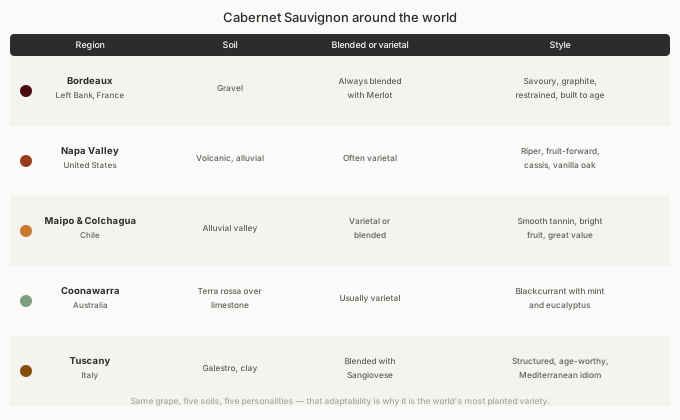
Where Cabernet Sauvignon Grows: Five Regions, Five Personalities
Bordeaux’s Left Bank (Médoc, Pauillac, Saint-Julien, Margaux) is where Cabernet Sauvignon still commands the most prestige, grown on well-draining gravel soils and, per centuries of local tradition, always blended with Merlot, Cabernet Franc, and small amounts of Petit Verdot rather than bottled alone. Left Bank Cabernet is built for the long haul: savoury, restrained, marked by graphite and cedar alongside its dark fruit, and often genuinely difficult to enjoy in its first decade, since the tannin needs real time to soften into something approachable. Three of Bordeaux’s five First Growth châteaux sit in Pauillac alone, a testament to how completely this specific patch of gravel came to define the grape’s most classic expression.
Napa Valley, thanks in large part to the Judgment of Paris, became Cabernet Sauvignon’s most celebrated New World home. Volcanic soils on the valley’s hillsides and rich alluvial soils on its floor both support the grape well, and Napa Cabernet is typically bottled as a single varietal rather than blended, in a noticeably riper, more fruit-forward style than Bordeaux: think ripe cassis, blackberry, and generous vanilla-and-toast oak character. Napa’s reputation now supports some of the most expensive Cabernet Sauvignon on Earth, with cult producers like Screaming Eagle commanding four-figure prices per bottle for a wine that, historically, only exists because of what a French tasting panel accidentally proved about California in 1976.
Chile‘s Maipo, Colchagua, and Aconcagua valleys have become one of the world’s best sources of genuinely excellent, accessibly priced Cabernet Sauvignon, helped by alluvial soils and a long, dry, disease-free growing season that lets the grape ripen fully and consistently almost every vintage. Chilean Cabernet typically shows smooth, well-integrated tannin and bright, fresh fruit, without the premium price tag that Napa or top Bordeaux commands — a large part of why Chile has become the go-to recommendation for genuinely good Cabernet Sauvignon on a modest budget. Wine Folly’s Cabernet Sauvignon deep dive has detailed tasting notes for these and several other regions not covered here.
Coonawarra, in South Australia, grows Cabernet Sauvignon on one of the most distinctive soils in the wine world: terra rossa, a thin strip of red clay barely 27 kilometres long, formed over millennia from wind-blown desert dust settling onto an ancient limestone bed. Wynns Coonawarra Estate’s 1954 “Black Label” Cabernet Sauvignon helped establish the region’s reputation and remains an Australian icon today. Coonawarra Cabernet has a genuinely recognisable regional signature: pure, focused blackcurrant fruit, fine-grained but persistent tannin, and a distinctive streak of mint and eucalyptus that rarely appears anywhere else, a byproduct of eucalyptus trees growing near many of the region’s vineyards and their aromatic oils finding their way, subtly, into the finished wine.
Tuscany‘s relationship with Cabernet Sauvignon produced one of the most rebellious stories in modern wine. In the years after the Second World War, Marchese Mario Incisa della Rocchetta planted Cabernet Sauvignon on his Bolgheri estate purely for his own family’s drinking, in open defiance of Italian wine law, which at the time permitted only local grapes like Sangiovese in the region’s classified wines. The resulting wine, eventually released commercially and named Sassicaia, became so acclaimed that it helped force Italy to create an entirely new legal category, the Indicazione Geografica Tipica (IGT), specifically to accommodate wines that broke traditional varietal rules but were unmistakably world-class. Sassicaia and its fellow “Super Tuscans” like Ornellaia now rank among Italy’s most sought-after and expensive wines, built from Cabernet Sauvignon blended with Sangiovese in a distinctly Mediterranean idiom, structured enough to age for decades.
How to Serve, Age, and Pair Cabernet Sauvignon
Serve Cabernet Sauvignon at 64–68°F (18–20°C), cooler than most people assume and cooler than a typical centrally-heated room — our guide to wine serving temperature covers exactly why full-bodied reds need this specific range to avoid tasting hot or alcoholic. A young, tannic bottle, particularly from Bordeaux, Napa, or Coonawarra, generally benefits from 30 minutes to a few hours of aeration in a decanter before serving; our guide to decanting wine walks through exactly how to do this, and why the technique for a young wine differs from decanting an older one for sediment.
Cabernet Sauvignon’s firm tannin and full body make it one of the most classically reliable food pairings in all of wine: a well-marbled ribeye or New York strip steak is the definitive match, since the fat in the meat binds with the wine’s tannin, softening both sides of the pairing at once, exactly the mechanism covered in our guide to wine pairing principles. Beyond steak, Cabernet Sauvignon pairs well with lamb, hard aged cheeses like a mature cheddar or Manchego, and, for a genuinely indulgent match, dark chocolate, whose own bitterness and richness echo the wine’s structure rather than clashing with it. Given its structure and tannin, it is generally the wrong choice alongside delicate fish, very spicy food, or ham — our guide to wine and ham explains exactly why big tannic reds clash with salty, cured meat specifically.
Cabernet Sauvignon vs Other Bordeaux Grapes
Within its own Bordeaux blend, Cabernet Sauvignon is generally the most structured and tannic of the permitted varieties, with Merlot contributing softness and earlier approachability, and Cabernet Franc — its own parent grape, remarkably — contributing a lighter body and a more overtly aromatic, sometimes floral character. We cover the specific differences between Cabernet Sauvignon and one of its most common New World rivals in detail in our Malbec vs Cabernet Sauvignon guide, and for the broader question of how Cabernet Sauvignon compares with the world’s other major full-bodied reds, see our guide to full-bodied red wine.
Cabernet Sauvignon by the Numbers
The scale of Cabernet Sauvignon’s expansion is easy to understate. In 1990, roughly 100,000 hectares of Cabernet Sauvignon were planted worldwide; today that figure has grown many times over, with France alone accounting for more than 55,000 hectares, and global plantings now covering an area comparable to a small country. France remains the historic leader in raw acreage, but Cabernet Sauvignon has become a genuine agricultural export in the truest sense: it is now the single most planted wine grape on every continent capable of growing it, a distinction no other variety, including its own parent Cabernet Franc, comes close to matching. Part of what makes this expansion remarkable is how little the grape itself has changed to achieve it. Unlike crops that get re-engineered or selectively bred for new markets, every Cabernet Sauvignon vine on Earth is, genetically, a clone descended from that same accidental 17th-century Bordeaux seedling — the grape did not adapt to conquer the world; growers simply kept finding new soils willing to let it thrive.
That single origin point is also why Cabernet Sauvignon tastes recognisably like itself in Bordeaux, Napa, Chile, Australia, and Tuscany all at once, even as each region bends its character in a different direction. No other grape has managed quite this combination of consistency and adaptability at this scale, which is a large part of why it functions as a kind of universal reference point in wine education: once you know what Cabernet Sauvignon tastes like, you have a genuine baseline for understanding tannin, oak, and full-bodied structure that applies almost everywhere else in red wine.
Frequently Asked Questions About Cabernet Sauvignon
What is Cabernet Sauvignon, in simple terms?
Cabernet Sauvignon is a full-bodied red wine grape, originally from Bordeaux, France, and now the most widely planted wine grape in the world. It is known for high tannin, dark fruit flavours like blackcurrant and blackberry, and exceptional ageing potential, and it is the natural offspring of two other grapes, Cabernet Franc and Sauvignon Blanc, confirmed by DNA testing only in 1996.
Is Cabernet Sauvignon a cross between two other grapes?
Yes. DNA analysis conducted at UC Davis in 1996 confirmed that Cabernet Sauvignon is a natural crossing between Cabernet Franc, a red grape, and Sauvignon Blanc, a white grape, that occurred accidentally in a Bordeaux vineyard sometime in the 17th century. It inherited its thick skins and high tannin from Cabernet Franc, and its acidity and herbaceous character from Sauvignon Blanc.
Why does Cabernet Sauvignon sometimes taste like green bell pepper?
The green bell pepper note comes from aromatic compounds called pyrazines, which are more concentrated in under-ripe grapes and cooler growing conditions. It was historically considered a flaw in Bordeaux wine, though many drinkers now enjoy it as a genuine stylistic marker of cooler-climate Cabernet Sauvignon. Warmer regions like Napa Valley typically ripen the grape enough that sunlight breaks these compounds down before harvest.
What was the Judgment of Paris, and why does it matter for Cabernet Sauvignon?
The Judgment of Paris was a blind tasting held in 1976, in which French wine judges rated Californian Cabernet Sauvignon above top Bordeaux wines, including Château Mouton Rothschild, without knowing which wines were which. Stag’s Leap Wine Cellars’ 1973 vintage took first place, and the result dramatically raised the international reputation of Napa Valley and New World wine generally.
What food goes best with Cabernet Sauvignon?
A well-marbled steak is the classic pairing, since the wine’s firm tannin binds with the meat’s fat and protein, softening both. Cabernet Sauvignon also pairs well with lamb, hard aged cheeses, and dark chocolate. It is generally a poor match for delicate fish, very spicy food, or salty cured meats like ham, since its tannin can clash with salt and overwhelm lighter dishes.
How long can Cabernet Sauvignon age?
Serious Cabernet Sauvignon, particularly from Bordeaux’s Left Bank, Napa Valley, or Coonawarra, can improve in the bottle for 15 to 30 years or more, thanks to its firm tannin and full body. Everyday, less structured examples are generally built for drinking within a few years of release rather than long-term cellaring.