Our last grape profile covered Cabernet Sauvignon, a wine grape that conquered nearly every wine-producing country on Earth in barely a century. Nebbiolo is its temperamental opposite. Widely considered one of Italy’s two or three greatest grapes, capable of producing wines that rank among the most collectible on the planet, Nebbiolo has spent centuries refusing to leave a single corner of northwest Italy — and even there, growers plant more of two other, far less prestigious grapes than they do Nebbiolo itself. It also carries the single strangest contradiction in all of red wine: pour a glass, hold it to the light, and you will see something as pale as a rosé. Taste it, and your mouth will pucker as if you had just bitten into a persimmon. This guide explains why Nebbiolo looks nothing like it tastes, why it stubbornly refuses to travel, and everything worth knowing about Barolo, Barbaresco, and the grape behind both.
In this article
- 1 Nebbiolo, at a Glance
- 2 The Paradox: Why the Palest Wine You’ll Ever Drink Has the Fiercest Tannin
- 3 A Name Born From Fog
- 4 Barolo and Barbaresco: King and Queen of Piedmont
- 5 The Grape That Refuses to Leave Home
- 6 Beyond Barolo: Roero, Gattinara, Valtellina, and Nebbiolo’s Other Names
- 7 What Nebbiolo Actually Tastes Like
- 8 How to Serve and Age Nebbiolo
- 9 Food Pairing
- 10 Why Vintage Matters So Much for Nebbiolo
- 11 Choosing Your First Bottle of Nebbiolo
- 12 Is Climate Change Actually Helping Nebbiolo?
- 13 Frequently Asked Questions About Nebbiolo
Nebbiolo, at a Glance
- Origin: Piedmont, northwest Italy — first documented in 1268, making it far older than Cabernet Sauvignon.
- Appearance: pale ruby, often mistaken for Pinot Noir on sight alone.
- Tannin & acidity: both extremely high, despite the pale colour — the grape’s defining paradox.
- Signature aromas: tar and roses, alongside cherry, dried fruit, licorice, and truffle.
- Total plantings: roughly 5,500 hectares worldwide, about 80% of it in Piedmont alone.
- Famous wines: Barolo (“the King”) and Barbaresco (“the Queen”), both 100% Nebbiolo by law.
- Ageing potential: among the longest of any red wine — top examples improve for 20 to 40 years or more.
- Other names: Spanna (Gattinara, Ghemme), Chiavennasca (Valtellina), Picotener (Valle d’Aosta).
The Paradox: Why the Palest Wine You’ll Ever Drink Has the Fiercest Tannin
Colour and tannin usually travel together in red wine. Thicker skins generally mean more anthocyanins (the pigments responsible for colour) and more tannin at once, which is why a deeply opaque wine like Cabernet Sauvignon is reliably also a tannic one. Nebbiolo breaks that pattern almost entirely. Its skin is relatively thin and, crucially, low in anthocyanins, which is why the finished wine stays a translucent pale ruby even at full ripeness and often develops a distinct brick-orange rim within just a few years in bottle — a colour profile closer to a delicate Pinot Noir than to anything resembling a “big” red. And yet that same thin skin carries an unusually dense concentration of tannin, extracted over the long macerations traditional Barolo producers still favour, sometimes thirty days or more on the skins. The result is a wine that looks delicate and drinks like a fortress: ferocious, drying tannin and racing acidity hidden behind a colour that gives away nothing about what is actually in the glass.
This mismatch is rare enough among major grapes that it is worth seeing plotted directly rather than just described. The chart below places seven well-known red grapes by how pale or deep they typically look against how tannic they typically taste, using characteristics drawn from published tasting profiles across each variety.
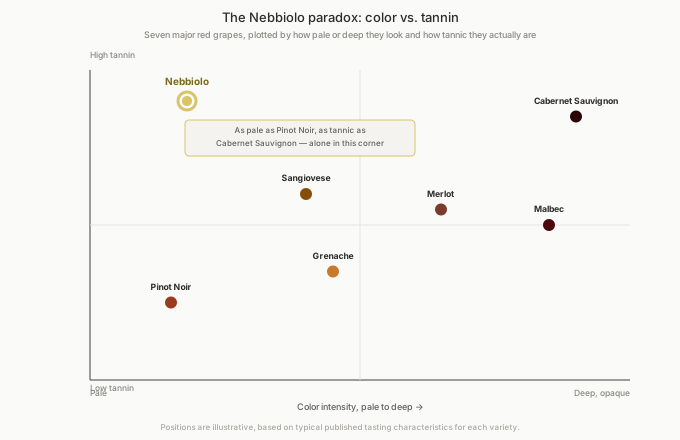
Notice that Cabernet Sauvignon and Nebbiolo sit at almost the same height on the tannin axis — genuinely comparable structure and grip — while occupying opposite ends of the colour axis entirely. Malbec tells a smaller version of the same story in reverse: dark in the glass, but with tannin soft enough that it rarely intimidates a new drinker the way its colour might suggest, a point covered in more depth in our guide to Malbec. Nebbiolo, though, is the one true outlier on this chart — no other major grape sits anywhere near its combination of pale colour and forceful structure, which is exactly why blind-tasting Nebbiolo by colour alone is one of the more reliable ways to be fooled at a wine table.
A Name Born From Fog
Nebbiolo’s name comes from nebbia, the Italian word for fog, and there are two competing explanations for why. The more common one points to the weather itself: Nebbiolo is one of the last grapes harvested each year in Piedmont, often not until well into October or even November, by which point the Langhe hills are frequently blanketed in the thick autumn fog the region is known for. The second theory points to the grape rather than the climate: ripe Nebbiolo berries develop a natural powdery bloom, or pruina, on their skins, giving each cluster a faintly foggy, dusted appearance even before any weather is involved. Either explanation places the name’s origin centuries back — the grape’s first specific documented mention, under the name “nibiol,” comes from Rivoli, near Turin, in 1268, according to Oz Clarke’s Encyclopedia of Grapes. That makes Nebbiolo a genuinely ancient variety, in sharp contrast to Cabernet Sauvignon’s comparatively recent 17th-century origin as an accidental crossing.
Barolo and Barbaresco: King and Queen of Piedmont
Barolo, grown across roughly 2,100 hectares in the communes of Barolo, La Morra, Castiglione Falletto, Serralunga d’Alba, and Monforte d’Alba, has earned the nickname “the King of Wines, and the Wine of Kings” — a reputation that owes a great deal to Camillo Benso, Count of Cavour, the 19th-century Piedmontese statesman who helped organise and professionalise Nebbiolo production in the region in the mid-1800s, giving the wine aristocratic backing at a pivotal moment in its history. Italian law is exact about what Barolo requires: a “normale” bottling needs 38 months of total ageing, including 18 months in wood, while a Riserva demands 62 months total, still with a minimum of 18 months in wood. Both must be made from 100% Nebbiolo, and both are built to reward genuine patience — a young Barolo, still gripped by unresolved tannin, can taste almost punishingly austere, which is exactly why serious collectors buy it years, sometimes decades, before they intend to open it.
Barbaresco, grown in a smaller zone just northeast of Barolo along the Tanaro river, is traditionally called “the Queen” to Barolo’s King, and Italian law reflects its generally softer, earlier-drinking character with shorter minimum ageing: 26 months total for a normale bottling, including 9 months in wood, and 50 months total for a Riserva, again with at least 9 months in wood. The gentler requirement is not arbitrary — Barbaresco’s slightly warmer microclimate and typically lighter soils produce wines with somewhat softer tannin and quicker development than Barolo’s, without sacrificing the region’s signature rose, tar, and cherry aromatics. The two appellations effectively compete for the title of Nebbiolo’s finest expression, and serious drinkers tend to keep bottles of both rather than choosing a side.
The Grape That Refuses to Leave Home
Here is where Nebbiolo’s story diverges most sharply from Cabernet Sauvignon’s. Global Nebbiolo plantings total only around 5,500 hectares, with roughly 80% of that concentrated in Piedmont and most of the remainder in the neighbouring regions of Lombardy and Valle d’Aosta. Outside Italy entirely, plantings are almost a rounding error: Australia, the largest foreign grower, accounts for only around 200 hectares, alongside small experimental plots in California, Washington, Oregon, Chile, Argentina, and South Africa — collectively a tiny fraction of what a single mid-sized Napa Valley Cabernet Sauvignon producer might farm alone. Even more striking, Nebbiolo is not even the dominant grape within its own home region: despite being Piedmont’s most famous and prestigious variety by far, it occupies only about 10% of the region’s total vineyard area, comfortably outplanted at home by both Barbera and Dolcetto.
The reason comes down to a genuinely narrow set of demands. Nebbiolo buds early, which exposes it to spring frost risk, yet ripens exceptionally late, often not until the very end of the growing season, which means it needs a long, mild autumn to reach full ripeness without succumbing to rot along the way — a combination of timing that few places outside Piedmont’s specific hills manage to offer. It is also notoriously particular about soil, favouring calcareous marl, and about aspect, generally requiring precise south or southwest-facing slopes to capture enough sun over its long season. Winemakers who have tried planting it elsewhere, including a small but growing experimental plot at Mari Vineyards in northern Michigan, describe a grape that takes noticeably longer to ripen than almost anything else in the vineyard and rewards only the most careful, patient site selection. Nebbiolo’s stubbornness is, in its own way, the flip side of Cabernet Sauvignon’s global success: one grape thrives almost anywhere it is planted, while the other insists on almost nowhere at all. Jancis Robinson’s profile of Nebbiolo covers this same reluctance to travel from a working critic’s perspective.
Beyond Barolo: Roero, Gattinara, Valtellina, and Nebbiolo’s Other Names
Barolo and Barbaresco understandably dominate the conversation, but Nebbiolo has a genuine life beyond them, often under an entirely different regional name. Roero DOCG, just across the Tanaro river from Barbaresco, produces a lighter, more approachable style, requiring a minimum of 95% Nebbiolo and just 20 months of ageing (32 for Riserva) — a useful, more affordable entry point into serious Nebbiolo. Further north, in what is often called Alto Piemonte, the grape goes by the alias Spanna in the appellations of Gattinara and Ghemme, producing notably lighter, higher-acid wines that some tasters compare stylistically to red Burgundy rather than to Barolo. Carema, a tiny Alpine appellation, requires at least three years of ageing (four for Riserva) and produces some of the most fragrant, floral Nebbiolo made anywhere. Across the regional border in Lombardy, the grape is grown under the name Chiavennasca on the impossibly steep, hand-farmed terraced vineyards of Valtellina, a genuinely dramatic, high-altitude expression of the variety. Learning these synonyms is, in practice, one of the most useful things a newcomer to Nebbiolo can do, since a bottle labelled Spanna or Chiavennasca is unmistakably Nebbiolo underneath, at a fraction of Barolo’s price. Wine Folly’s full guide to Nebbiolo has detailed notes on several more of these lesser-known appellations.
What Nebbiolo Actually Tastes Like
The classic descriptor for Nebbiolo, repeated by wine writers for generations, is “tar and roses” — an evocative shorthand for a wine that pairs something dark, savoury, and almost medicinal with something delicate and floral, often literally rose petal and violet, in the same glass. Beneath that headline sit layers of red cherry, dried cranberry, and pomegranate in youth, moving toward dried fruit, leather, tobacco, and forest floor with real bottle age; licorice, dried herbs, and a distinct truffle note — fitting, given Piedmont’s other great culinary export — round out a well-aged bottle. Structurally, expect racing acidity and firm, sometimes downright austere tannin in youth, gradually resolving into something silkier and more integrated over the long ageing this guide has already covered. For the broader vocabulary to describe sensations like these, see our guide to describing wine taste, and for more on how tannin itself behaves and softens with age, our guide to tannin in wine covers the underlying chemistry in depth.
How to Serve and Age Nebbiolo
Serve Nebbiolo at 64–68°F (18–20°C), the same range recommended for other full-bodied reds in our guide to wine serving temperature, since its high tannin and alcohol both become more aggressive if served too warm. A young Barolo or Barbaresco genuinely benefits from real time in a decanter, often an hour or more, to soften its considerable structure before drinking — our guide to decanting wine covers exactly how to do this for a wine this firm. As a rough drinking-window guide: entry-level Langhe Nebbiolo is generally at its best within three to seven years of the vintage; standard Barolo and Barbaresco typically hit their stride between eight and twenty years; and the finest cru bottlings from top traditionalist producers can continue developing for thirty or even forty years, a timeline matched by very few other wines anywhere in the world.
Food Pairing
Piedmont’s own kitchen offers the truest map for pairing Nebbiolo, since the wine and the region’s classic dishes developed side by side. Braised beef in Barolo (brasato al Barolo), slow-cooked until tender enough for the wine’s firm tannin to bind comfortably with the meat’s fat, is the definitive local pairing, following the same tannin-and-fat logic covered in our guide to wine pairing principles. Tajarin, Piedmont’s delicate egg-yolk-rich pasta, often served simply with butter and shaved white truffle, is a more delicate but equally traditional match, echoing the truffle notes many aged Nebbiolo wines develop naturally. Hard, aged cheeses — a well-aged Parmigiano or a Piedmontese Castelmagno — and rich, slow-braised game dishes both stand up well to the wine’s acid and tannin without being overwhelmed by either.
Why Vintage Matters So Much for Nebbiolo
Vintage matters more for Nebbiolo than for almost any other major red grape, a direct consequence of how narrow its ripening window really is. A cool, wet autumn can leave Nebbiolo’s notoriously late harvest unripe and aggressively tannic even by its own demanding standards, while a warm, dry, extended autumn allows the grape’s full aromatic and structural potential to show. Among recent vintages, 2016, 2019, and 2020 have been widely praised across both Barolo and Barbaresco for a genuinely rare combination: full ripeness alongside the freshness and acidity that keeps a serious Nebbiolo balanced rather than jammy. Producers themselves talk about vintage variation with unusual candour for this reason, since even a well-regarded estate can turn out a genuinely difficult wine in a poor year, regardless of reputation.
Choosing Your First Bottle of Nebbiolo
For newcomers wary of Barolo’s price and patience requirements, three practical entry points are worth knowing. Langhe Nebbiolo, made from grapes grown in the same broader region but declassified below Barolo or Barbaresco status, typically costs a fraction of either while sharing real family resemblance in aroma and structure, and is built to drink within a few years rather than decades. Nebbiolo d’Alba, a step up from Langhe Nebbiolo, offers slightly more depth and concentration at a still-approachable price. And Roero, covered above, gives a genuinely serious, DOCG-level Nebbiolo experience with a noticeably shorter wait than Barolo demands. Buying a bottle or two of each tier side by side, from the same vintage where possible, is one of the more instructive ways to actually taste what the extra ageing requirements and stricter zoning of Barolo and Barbaresco are buying you.
Is Climate Change Actually Helping Nebbiolo?
A warming climate has quietly started to work in Nebbiolo’s favour, in a way that runs against the usual narrative about climate change and wine. Because the grape’s biggest historical obstacle has always been ripening fully before autumn’s cold and rain arrive, a longer, warmer growing season gives marginal, cooler sites, particularly in Alto Piemonte appellations like Gattinara, Ghemme, and Boca, a genuinely better shot at reliably ripening Nebbiolo than they had a generation ago. Several of these once-overlooked northern zones are seeing real renewed investment and critical attention as a direct result, alongside small but growing experimental plantings even further afield, including in cooler pockets of North America. It remains to be seen whether this shifts Nebbiolo’s stubborn geography in any meaningful way, but for a grape this tied to one narrow set of conditions, even a modest change to those conditions is worth watching closely.
Frequently Asked Questions About Nebbiolo
What is Nebbiolo wine?
Nebbiolo is a red wine grape native to Piedmont in northwest Italy, best known as the sole grape behind Barolo and Barbaresco. It is famous for a striking contradiction: a pale, almost translucent colour paired with very high tannin and acidity, and for exceptional ageing potential, with top examples improving in the bottle for twenty to forty years or more.
Why is Nebbiolo wine so pale if it has such strong tannin?
Nebbiolo’s skin is relatively thin and low in anthocyanins, the pigments responsible for a wine’s colour, which keeps the finished wine pale even at full ripeness. However, that same skin carries an unusually high concentration of tannin, extracted through long maceration, so colour and tannin, which usually rise together in red wine, become disconnected in Nebbiolo specifically.
What is the difference between Barolo and Barbaresco?
Both are made from 100% Nebbiolo in Piedmont, but Barolo requires longer legal ageing (38 months, 62 for Riserva) and is generally more powerful, tannic, and slow to mature, earning the nickname “the King.” Barbaresco requires shorter ageing (26 months, 50 for Riserva) and typically produces softer, earlier-drinking wines, earning it the nickname “the Queen.”
Why isn’t Nebbiolo grown outside Italy very much?
Nebbiolo buds early but ripens very late, requiring a long, mild autumn and precise south-facing slopes with calcareous soil to ripen fully. Few regions outside Piedmont offer this exact combination, which is why global plantings remain small, roughly 5,500 hectares total, with about 80% concentrated in Piedmont and only scattered experimental plots elsewhere in the world.
What does Nebbiolo taste like?
Nebbiolo is classically described as tasting of “tar and roses,” combining dark, savoury, almost medicinal notes with delicate rose and violet aromatics. Expect red cherry, dried fruit, and licorice in youth, developing leather, truffle, and forest floor notes with age, all wrapped in firm tannin and racing acidity.
Is Nebbiolo the same grape as Chiavennasca or Spanna?
Yes. Chiavennasca is the local name for Nebbiolo in Valtellina, Lombardy, and Spanna is the name used in the Alto Piemonte appellations of Gattinara and Ghemme. Both produce genuine Nebbiolo wine, often in a lighter, more approachable style than Barolo, typically at a significantly lower price.