
Most wine is sold in the familiar 750ml bottle, but that is only one entry in a surprisingly elaborate naming system that runs from a 187ml single serving up to an 18-litre giant that holds two dozen standard bottles. Many of the larger sizes are named after biblical kings — Jeroboam, Methuselah, Nebuchadnezzar — a 19th-century marketing flourish from the Champagne trade that stuck. What most guides leave out is the genuinely useful part: the same name can mean a different volume depending on whether you are buying still wine or Champagne, and knowing this saves you from a confusing and occasionally expensive mistake.
In this article
Why 750ml Is the Standard
The 750ml bottle became the international standard largely through 19th-century trade between France and England. English merchants, who dominated the wine trade, worked in imperial gallons; French producers worked in litres. A bottle size needed to convert cleanly between the two systems for trade to run smoothly. 750ml achieves that: it divides evenly into the imperial gallon (which holds exactly six 750ml bottles) and works conveniently within the metric system. The standard became formalised through trade practice long before any single regulatory body mandated it, and it has remained essentially unchanged for over 150 years.
Smaller Than Standard
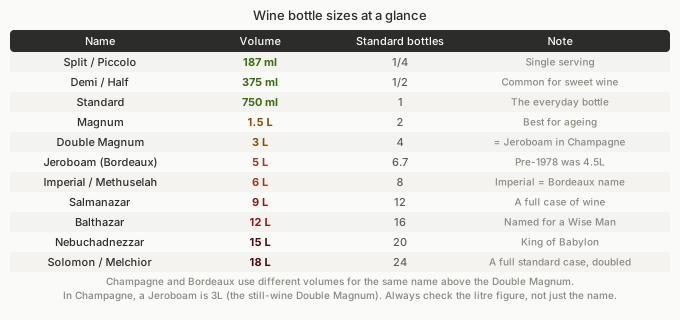
- Split / Piccolo — 187ml (1/4 bottle): A single serving, roughly one generous glass. Common for airline service, individual Champagne servings, and gift sets. Piccolo is the term most used for Champagne; Split for still wine.
- Demi / Half — 375ml (1/2 bottle): Two glasses. The most common small format, widely used for dessert and fortified wines (Sauternes, Port) where a full bottle would go to waste before being finished, since these wines are typically served in smaller pours and last longer once opened.
- Jennie / Half-litre — 500ml: An uncommon size, used occasionally for sweet wines from Tokaji and similar regions. Sits between the Demi and the full litre.
- Clavelin — 620ml: A unique bottle size used exclusively for Vin Jaune, the unusual oxidative yellow wine of the Jura region in France. The volume reflects the traditional yield after extended barrel ageing under a flor yeast layer, during which the wine evaporates significantly.
- Litre — 1,000ml: A less common format that sits between standard and Magnum. Popularised in California by certain premium Cabernet producers; otherwise relatively rare in the fine wine trade.
Larger Than Standard: The Biblical Names
Above the standard bottle, names shift from descriptive (“Double Magnum”) to historical. The grand large-format names — Jeroboam, Rehoboam, Methuselah, Salmanazar, Balthazar, Nebuchadnezzar, Solomon — come from the Hebrew Bible, adopted by the 19th-century Champagne trade for marketing impact. A bottle called a Nebuchadnezzar carries more weight at auction and at the table than one simply labelled “15 litres.”
- Magnum — 1.5 litres (2 bottles): The most common and most useful large format. Widely produced, reasonably easy to store, and considered by many wine professionals the ideal format for ageing serious wine — the lower ratio of air to wine relative to bottle volume slows oxidation, letting the wine develop more gracefully over decades. Master of Wine Serena Sutcliffe has called the Magnum the perfect size for sharing a bottle between two people across an evening.
- Double Magnum — 3 litres (4 bottles): Equivalent to two Magnums. This is where the naming starts to diverge by region (see below) — in Champagne, this exact volume is called a Jeroboam.
- Jeroboam (Bordeaux) — 5 litres (6.7 bottles): Named after the first king of the Northern Kingdom of Israel. Before 1978, the Bordeaux Jeroboam was 4.5 litres (now called a Rehoboam by some producers); the modern standard is 5 litres.
- Rehoboam — 4.5 litres (6 bottles): Used primarily for Champagne. Named after King Rehoboam, son of Solomon.
- Imperial (Bordeaux) / Methuselah (Burgundy & Champagne) — 6 litres (8 bottles): The same volume carries two different names depending on the wine region. Methuselah is the largest format typically produced for Burgundy. Named after the biblical figure famous for living 969 years.
- Salmanazar — 9 litres (12 bottles): A full case of wine in a single bottle. Named after the Assyrian king Shalmaneser.
- Balthazar — 12 litres (16 bottles): Named after one of the Three Wise Men. Equivalent to two Imperials/Methuselahs.
- Nebuchadnezzar — 15 litres (20 bottles): Named after the King of Babylon. A substantial, ceremonial format usually seen at major celebrations rather than everyday cellars.
- Solomon / Melchior — 18 litres (24 bottles): A full standard case of wine, doubled, in one bottle. Named after King Solomon. One of the largest formats commercially produced.
- Melchizedek — 30 litres (40 bottles): An extremely rare format, occasionally produced by Champagne houses for promotional or collector purposes. Named after a biblical priest-king figure.
The Naming Conflict: Why the Same Word Means Different Things
Here is the detail that catches out even experienced wine buyers: the same bottle name can refer to different volumes depending on whether you are buying still wine or Champagne, and depending on which region’s tradition is being used.
The clearest example: in Champagne, a Jeroboam is 3 litres — the same volume that Bordeaux calls a Double Magnum. Bordeaux’s own Jeroboam is a completely different volume: 5 litres (4.5 litres before 1978). If you order “a Jeroboam” without specifying still wine or Champagne, you could receive a bottle anywhere from 3 to 5 litres.
The same pattern repeats at 6 litres: Bordeaux calls it an Imperial; Burgundy and Champagne call it a Methuselah. Both refer to exactly 6 litres, but the name you will see depends entirely on which wine you are buying.
The reason this inconsistency has never been resolved comes down to history and production method. The Champagne naming tradition developed somewhat more rigorously because of a genuine technical constraint: Champagne undergoes its secondary, bubble-creating fermentation inside the bottle, a process that works reliably up to Magnum size. Beyond 1.5 litres, the bottles become too heavy and unwieldy for the riddling process (the rotation that moves sediment to the neck), so larger-format Champagne is typically fermented in standard bottles or Magnums and then carefully transferred — a process called transvasage. Still wine has no such constraint; a 6-litre Imperial of Bordeaux or Barolo can be filled directly and aged undisturbed for decades, which gave Bordeaux’s naming tradition more freedom to develop independently.
The practical lesson: when buying or discussing a large-format bottle, always confirm the litre figure rather than relying on the name alone, particularly above the Double Magnum. A reputable retailer or auction house will always state the volume explicitly.
Why Bottle Size Actually Matters
Bottle size is not purely about quantity — it has a genuine effect on how wine ages, and that is the primary reason collectors seek out large formats for serious wine.
- Ageing speed: a larger bottle has a smaller ratio of the small headspace of air (between the cork and the wine) relative to its total volume. Since the slow oxidation that drives ageing happens primarily through that small amount of trapped oxygen and gradual exchange through the cork, a Magnum ages more slowly and more gracefully than a standard bottle of the identical wine. This is why serious collectors often purchase Magnums of wines intended for very long-term cellaring — 10, 20, even 50 years.
- Practicality and occasion: a standard bottle suits 2–4 people; a Magnum suits 5–8; a Double Magnum or Jeroboam suits a larger party or special celebration. Larger formats are chosen as much for the visual statement and shared experience as for practical serving.
- Value and collectability: large-format bottles of celebrated wines (a Methuselah of Burgundy, a Salmanazar of Champagne) often command significant premiums at auction, both because production runs are limited and because the format itself has become a collector’s object.
- Practical drawbacks: an Imperial (6L) weighs around 12kg full; a Solomon (18L) weighs over 35kg. These formats are genuinely difficult to lift, pour, and store, which is part of why they remain rare despite their prestige.
Choosing the Right Size for Your Occasion
- Solo drinking or sampling: a Split (187ml) or Demi (375ml) avoids waste and lets you try more wines.
- Dinner for two to four: a Standard bottle (750ml) gives 4–6 glasses.
- Dinner party of five to eight: a Magnum (1.5L) ensures everyone gets a generous pour from the same bottle, which also looks better on the table than two standard bottles.
- A wedding or large celebration: a Double Magnum, Jeroboam, or Rehoboam makes a genuine statement and serves 16–20+ guests from one bottle.
- Cellaring for the long term: a Magnum of a wine you intend to age for a decade or more will develop more gracefully than the same wine in a standard bottle — see our guide to which wines age well for more on long-term cellaring. If a producer offers Magnum bottling of a wine you love, it is worth the modest premium for anything you plan to keep.
For guidance on how long any of these formats will keep once opened, our guide to how long wine lasts covers the practical side of working through a large-format bottle once it is opened.
Frequently Asked Questions
What are the different wine bottle sizes?
From smallest to largest: Split/Piccolo (187ml, a single serving), Demi/Half (375ml, two glasses), Standard (750ml, the everyday bottle), Magnum (1.5L, two bottles), Double Magnum (3L, four bottles), Jeroboam (5L in Bordeaux or 3L in Champagne), Rehoboam (4.5L), Imperial/Methuselah (6L, eight bottles), Salmanazar (9L, a full case), Balthazar (12L, sixteen bottles), Nebuchadnezzar (15L, twenty bottles), and Solomon/Melchior (18L, twenty-four bottles). Most of the larger formats are named after biblical kings, a 19th-century Champagne marketing tradition that has persisted ever since.
How many bottles is a Magnum?
A Magnum holds 1.5 litres, equivalent to two standard 750ml bottles. It is the most widely produced large-format bottle and is considered by many wine professionals to be the ideal size for ageing serious wine, because its lower ratio of air to wine relative to volume slows oxidation and allows the wine to develop more gracefully over long cellaring periods. A Magnum typically pours 10 to 12 glasses, making it a practical choice for dinner parties of 5 to 8 people.
Why is a Jeroboam different sizes for wine and Champagne?
In Champagne, a Jeroboam is 3 litres — the same volume that Bordeaux still wine calls a Double Magnum. In the Bordeaux tradition, a Jeroboam is 5 litres (4.5 litres before 1978). This naming inconsistency developed historically and has never been resolved by any international standard. The most likely explanation is that the large-format naming traditions in Champagne and Bordeaux developed somewhat independently in the 19th century, and by the time the inconsistency was widely recognised, both traditions were too established to change. Always confirm the exact litre figure rather than relying on the name when buying a large-format bottle.
Why are large wine bottles named after biblical kings?
The naming tradition originated with the French Champagne trade in the 19th century, who drew on names from the Hebrew Bible — Jeroboam, Rehoboam, Methuselah, Salmanazar, Balthazar, Nebuchadnezzar, Solomon, Melchizedek — to give their grandest large-format bottles a sense of prestige and grandeur. In an era before standardised labelling, the names were also easier for buyers and merchants to remember and order by than precise volume figures. The names were applied with more attention to drama than historical accuracy: Balthazar is sometimes confused with Belshazzar, a different biblical figure, but the naming has simply stuck through over a century of use.
Does wine age better in larger bottles?
Yes, generally. Larger bottles have a smaller ratio of headspace air to wine volume, which slows the gradual oxidation that drives wine ageing. A Magnum (1.5L) of a given wine typically ages more slowly and develops more gracefully than the same wine in a standard 750ml bottle, which is why serious collectors often seek out Magnums specifically for long-term cellaring. The effect continues at larger formats, though the practical difficulties of storing, handling, and pouring bottles above 6 litres often outweigh the marginal ageing benefit for most collectors.
Why are wine bottles 750ml?
The 750ml standard developed through 19th-century trade between England and France. English merchants, who dominated the international wine trade at the time, measured in imperial gallons, while French producers worked in litres. A 750ml bottle divides evenly into the imperial gallon (exactly six bottles per gallon) while also working cleanly within the metric system, making it a practical compromise between the two measurement systems. The size became standard through trade practice rather than formal regulation, and has remained essentially unchanged for over 150 years.