Ask a room full of wine lovers whether they’re “a Bordeaux person or a Burgundy person” and you will get a surprisingly heated answer, because the question is really about something bigger than taste: it is a genuine philosophical split, argued out in French vineyards for centuries, over what wine is actually supposed to express. Bordeaux believes in the blend — in the winemaker’s skill at combining several grape varieties into something more balanced and consistent than any one grape could achieve alone. Burgundy believes in the single grape and the single plot — in stripping everything back until the wine speaks for exactly one small patch of ground and nothing else. Both regions sit less than four hours apart by train, and both are unambiguously world-class, but the differences between them run through nearly every decision each makes, from grape variety down to the shape of the bottle. Here is what actually separates Bordeaux and Burgundy, and why.
In this article
- 1 Bordeaux vs Burgundy, at a Glance
- 2 The Core Difference: Blends vs Single Varietals
- 3 Climate and Geography
- 4 The Grapes: Bordeaux’s Blending Cast vs Burgundy’s Purists
- 5 Left Bank vs Right Bank: Bordeaux’s Own Internal Divide
- 6 Classification Systems: Ranking Producers vs Ranking Land
- 7 Scale and Ownership: Château vs Domaine
- 8 How the Wines Actually Taste and Feel
- 9 Even the Bottles Are Different
- 10 Which Should You Try First?
- 11 Price and Value: Why Top Burgundy Can Cost More Than First Growth Bordeaux
- 12 Food Pairing: Structure vs Elegance at the Table
- 13 Frequently Asked Questions About Bordeaux and Burgundy
- 13.1 What is the main difference between Bordeaux and Burgundy wine?
- 13.2 Is Bordeaux or Burgundy wine better?
- 13.3 What grapes are used in Bordeaux versus Burgundy?
- 13.4 How do Bordeaux and Burgundy’s classification systems differ?
- 13.5 What is the difference between Bordeaux’s Left Bank and Right Bank?
- 13.6 Why is Burgundy wine so fragmented among different producers?
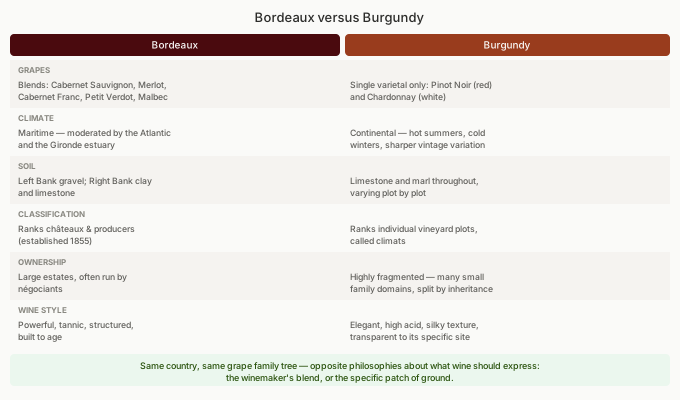
Bordeaux vs Burgundy, at a Glance
- Grapes: Bordeaux blends several varieties; Burgundy uses one grape per wine, no exceptions.
- Climate: Bordeaux is maritime and moderate; Burgundy is continental with sharper seasonal swings.
- Classification: Bordeaux ranks producers (1855); Burgundy ranks specific vineyard plots.
- Ownership: Bordeaux favours large estates; Burgundy is famously fragmented among small domains.
- Style: Bordeaux is powerful and built to age; Burgundy is elegant and site-transparent.
- Bottle shape: Bordeaux’s is high-shouldered and narrow; Burgundy’s has sloping shoulders and a wider base.
- Scale: Bordeaux produces far more wine overall, from much bigger individual estates.
The Core Difference: Blends vs Single Varietals
Nearly every other difference between these two regions flows from one decision made centuries ago. Bordeaux built its entire winemaking tradition around blending: a red Bordeaux is typically a combination of Cabernet Sauvignon, Merlot, Cabernet Franc, Petit Verdot, and occasionally Malbec, with the exact proportions varying château by château and vintage by vintage depending on how each grape performed that year. The underlying logic is that different grapes bring different strengths — Cabernet Sauvignon’s structure and ageing potential, Merlot’s softness and immediate charm — and a skilled winemaker’s job is to combine them into something more balanced and more consistent from year to year than any single variety could achieve alone.
Burgundy rejects that premise almost entirely. Red Burgundy is essentially always 100% Pinot Noir; white Burgundy is essentially always 100% Chardonnay. There is no blending cushion to smooth out a difficult vintage or an underperforming plot — the wine is simply an unfiltered expression of one grape grown on one specific piece of land in one specific year, for better or worse. This is not a lesser or more limited approach; it is a deliberate bet that a single grape, grown with total attention to a single site, reveals more about that site than any blend ever could. Wine Enthusiast frames this succinctly, noting that Bordeaux’s grapes “come together under the firm guidance of the winemaker” — where Burgundy instead hands that authorship over to the vineyard itself. Wine Enthusiast’s full comparison of the two regions covers this grape-by-grape breakdown in more detail.
Climate and Geography
Bordeaux sits in southwestern France, its vineyards spread around the Gironde estuary where the Dordogne and Garonne rivers meet before reaching the Atlantic. That coastal position gives it a maritime climate: the ocean moderates temperature swings between seasons, extending the growing season long into autumn and generally protecting against the sharpest frosts and heat spikes. This relative climatic stability suits Cabernet Sauvignon and Merlot well, both late-ripening grapes that need a long, even season to develop fully.
Burgundy, in east-central France, has no such ocean nearby to smooth things out. Its continental climate brings genuinely hot summers and cold winters, and considerably more year-to-year variation than Bordeaux experiences — which is exactly why vintage variation matters so much more in Burgundy conversation than in Bordeaux conversation. Pinot Noir and Chardonnay both suit this pattern: they are comparatively early-ripening, thin-skinned grapes that thrive on Burgundy’s warm days and cool nights, but they are also unusually sensitive to a difficult season, which is part of why a poor Burgundy vintage can differ so dramatically from a great one in the same village.
The Grapes: Bordeaux’s Blending Cast vs Burgundy’s Purists
Bordeaux’s red blend draws on five permitted grapes, each contributing something distinct: Cabernet Sauvignon brings structure, dark fruit, and serious ageing potential; Merlot brings softness, plumpness, and earlier approachability; Cabernet Franc adds aromatic lift and a touch of herbal complexity; Petit Verdot contributes colour, spice, and firm tannin in small amounts; and Malbec, once more widely planted, still appears in smaller proportions today (our guide to Malbec covers how the grape found its true fame elsewhere, in Argentina). Bordeaux’s white wines follow the same blending logic on a smaller scale, typically combining Sauvignon Blanc and Sémillon, sometimes with a touch of Muscadelle, to produce everything from crisp dry whites to the botrytis-affected sweet wines of Sauternes.
Burgundy allows itself no such combination. Pinot Noir is responsible for every red Burgundy worth the name, prized specifically because it is thin-skinned and famously reactive to exactly where and how it is grown — the trait that makes it such a precise messenger for Burgundy’s fragmented patchwork of vineyard plots. Chardonnay plays the same singular role for white Burgundy, from the lean, mineral-driven wines of Chablis in the north to the richer, more structured examples of the Côte de Beaune further south. Both grapes are, not coincidentally, considered two of the most “transparent” varieties in winemaking — relatively neutral on their own, and therefore unusually good at showing off differences in soil and climate rather than masking them with their own strong grape character. For more on how Pinot Noir and other lighter reds compare with Bordeaux’s bolder style, see our guide to full-bodied red wine.
Left Bank vs Right Bank: Bordeaux’s Own Internal Divide
Bordeaux itself is split by the Gironde estuary into two zones with genuinely different characters, a distinction serious Bordeaux drinkers track as closely as the difference between Bordeaux and Burgundy overall. The Left Bank, including the famous Haut-Médoc appellations of Pauillac, Margaux, and Saint-Julien, has gravelly, well-draining soil that suits Cabernet Sauvignon particularly well, stressing the vines just enough to concentrate flavour in the fruit; wines here lean toward power, firm tannin, and genuinely long ageing potential. The Right Bank, home to Pomerol and Saint-Émilion, has more clay and limestone, which retains water more readily and suits Merlot’s needs better than Cabernet Sauvignon’s — wines here are typically softer, plusher, and more approachable earlier, without necessarily sacrificing complexity.
Both banks still grow the same broad cast of grapes and blend them the same way; what shifts is simply which grape leads. A useful shorthand: if you enjoy structured, age-worthy Cabernet Sauvignon, look to the Left Bank; if you prefer a softer, more immediately generous red, the Right Bank’s Merlot-led wines are the better starting point.
Classification Systems: Ranking Producers vs Ranking Land
Bordeaux’s defining classification dates to 1855, when Napoleon III wanted a showcase ranking of the region’s best wines for the Paris Exposition Universelle. Local wine brokers ranked roughly sixty Left Bank châteaux into five tiers, from First Growth down to Fifth Growth, based largely on the prices their wines commanded at the time. Remarkably, that ranking has barely changed since — only one château has ever been promoted, Mouton Rothschild, elevated to First Growth status in 1973 after decades of lobbying. The system ranks producers, meaning the classification travels with the château’s name and reputation rather than with any specific parcel of vines, and a château can, in principle, expand or change its vineyard holdings while keeping its classified status. Decanter Tours’ guide to both regions is a useful reference for the classification systems side by side.
Burgundy’s classification works on an entirely different unit of analysis: the land itself, not the producer who happens to farm it. Vineyards are ranked into four tiers — Grand Cru at the top, then Premier Cru, then Village-level wines, then broader Regional appellations — based on centuries of accumulated observation about which specific plots, or climats, consistently produce the finest wine. Because the ranking belongs to the land rather than the owner, a single Grand Cru vineyard is very often split among several different small producers, each making their own wine from their own few rows of vines within that same plot, all entitled to the same Grand Cru status. Our dedicated guide to Burgundy covers this classification pyramid, and its most famous villages, in considerably more depth.
Scale and Ownership: Château vs Domaine
Bordeaux and Burgundy also differ sharply in how their vineyard land is actually owned and organised. Bordeaux favours large, often single-owner estates: a classified château can farm anywhere from dozens to well over a hundred contiguous hectares under one label, and much of the region’s production, especially at the everyday end, moves through négociants, merchant houses that buy grapes or finished wine from multiple growers and blend or bottle it under their own name. This structure supports consistency and scale — a classified Bordeaux château can produce tens of thousands of cases in a good vintage.
Burgundy is, by contrast, famously fragmented. Centuries of French inheritance law, which requires an estate to be divided equally among all heirs rather than passed intact to a single successor, has splintered many of Burgundy’s best vineyards into dozens of tiny individual holdings, sometimes just a few rows of vines apiece, owned by different families who may have no relation to one another beyond sharing the same hillside. A single Grand Cru vineyard like Clos de Vougeot, for instance, is divided among more than 80 separate owners. This is precisely why a bottle of Burgundy lists both the specific vineyard and the individual producer so prominently — two wines from the exact same Grand Cru plot, made by different neighbouring domaines in the same vintage, can genuinely taste quite different depending on each producer’s own choices in the vineyard and cellar.
How the Wines Actually Taste and Feel
Red Bordeaux tends toward genuine power: dark fruit like blackcurrant and blackberry, layered with cedar, tobacco, and graphite in wines with real bottle age, backed by firm tannin and a structure built explicitly for the long haul — a serious classified Bordeaux is often at its best a decade or more after release, not on the day it is bought. Left Bank wines lean toward austerity and brooding power; Right Bank wines show a softer, plummier, more immediately generous character, though both are still built with genuine ageing potential in mind.
Red Burgundy occupies almost the opposite end of the sensory spectrum: lighter in body, higher in acid, with red fruit — cherry, raspberry, cranberry — layered over an often haunting, earthy complexity that seasoned drinkers describe as almost impossible to pin down precisely, which is a large part of Pinot Noir’s appeal to serious collectors. White Burgundy runs from lean, saline, and citrus-driven in Chablis to rounder, more textured, and sometimes butter-and-hazelnut-inflected further south in the Côte de Beaune, while Bordeaux’s dry whites bring a herbaceous, citrus-and-tropical-fruit brightness from Sauvignon Blanc balanced by Sémillon’s weightier texture. For the fuller vocabulary to describe differences like these in your own glass, see our guide to describing wine taste.
Even the Bottles Are Different
The regional rivalry runs down to the glass itself. The Bordeaux bottle has high, straight shoulders and a relatively narrow base, a shape that conveniently stacks well in a cellar and, according to long-standing tradition, helps catch sediment as an older wine is poured, keeping it from sliding down into the glass. The Burgundy bottle has gently sloping shoulders and a wider base, a design with less to do with function and more with the practical limitations of early glassmaking techniques in the region. Producers elsewhere in the world signal which grape or style tradition they are following partly through which bottle shape they choose — a Pinot Noir from Oregon or New Zealand will almost always ship in a Burgundy-shaped bottle, regardless of where it was actually grown.
Which Should You Try First?
If you already know you enjoy powerful, structured reds that reward patience — or you simply want a wine built to pair with a rich, fatty meal — Bordeaux is the more forgiving entry point, since its blending tradition smooths out vintage variation and its classification system gives newcomers a reasonably reliable quality signal to follow. If you are drawn to lighter-bodied, higher-acid reds, or you find the idea of tasting the same grape express wildly different personalities from one hillside to the next genuinely fascinating, Burgundy rewards that curiosity, though it demands more homework: producer reputation matters enormously, since two neighbouring domaines on the same slope can turn out meaningfully different wines. Neither region is objectively the better choice — they are simply answering a different question about what wine is for, and the honest answer to “which is better” is that it depends entirely on which of those two questions you find more interesting.
Price and Value: Why Top Burgundy Can Cost More Than First Growth Bordeaux
Price behaves differently across the two regions, and understanding why helps explain some of the sticker shock newcomers feel when they first shop for Burgundy. Bordeaux’s larger estates and blending tradition allow for real economies of scale: a classified chateau producing tens of thousands of cases a year can charge less per bottle than its prestige would otherwise suggest, and Bordeaux offers a genuinely deep range of everyday, mid-tier, and prestige wine at every price point. Burgundy’s fragmentation works against this: a Grand Cru vineyard split among a dozen tiny producers means each individual domaine might make only a few hundred cases of any single wine in a given year, and that scarcity, combined with intense global demand for the most sought-after producers, pushes prices for top Burgundy to levels that can exceed even First Growth Bordeaux, bottle for bottle.
This scarcity dynamic means Burgundy shopping requires more homework than Bordeaux shopping. Because the vineyard name alone does not guarantee quality the way a classified chateau’s name does, buying good Burgundy means learning to trust specific producers as much as specific vineyards — two wines labelled with the exact same Premier Cru vineyard, made by different neighbouring domaines, can vary enormously in both price and quality. Bordeaux, particularly its classified growths, offers a more legible starting point for a newcomer with a wine budget, precisely because the 1855 Classification does much of that producer-vetting work in advance.
Food Pairing: Structure vs Elegance at the Table
Food pairing reflects each region’s core personality just as clearly as anything else. Bordeaux’s firm tannin and structure make it a natural partner for rich, fatty, well-marbled red meat — a classic Left Bank Cabernet blend alongside a proper steak or leg of lamb is one of the most reliable pairings in French wine, following the same tannin-meets-fat logic covered in our guide to wine pairing principles. Burgundy’s lighter body and brighter acidity suit more delicate fare: roast chicken, duck, mushroom-based dishes, and salmon all flatter red Burgundy’s earthy, red-fruited character without overwhelming it, while white Burgundy’s richer, buttery style pairs naturally with cream sauces, lobster, and other classic French bistro fare.
Frequently Asked Questions About Bordeaux and Burgundy
What is the main difference between Bordeaux and Burgundy wine?
Bordeaux wines are blends of several grape varieties, typically Cabernet Sauvignon and Merlot for reds, chosen and combined by the winemaker for balance and consistency. Burgundy wines are made from a single grape variety, Pinot Noir for red and Chardonnay for white, with no blending, designed to express one specific vineyard plot as purely as possible.
Is Bordeaux or Burgundy wine better?
Neither is objectively better; they represent different philosophies and styles rather than different quality tiers. Bordeaux offers powerful, structured, age-worthy blends with a relatively reliable classification system, while Burgundy offers lighter, more elegant, site-specific wines that reward deeper knowledge of individual producers. The better choice depends on personal taste rather than any inherent superiority of one region.
What grapes are used in Bordeaux versus Burgundy?
Bordeaux reds blend Cabernet Sauvignon, Merlot, Cabernet Franc, Petit Verdot, and occasionally Malbec, while Bordeaux whites blend Sauvignon Blanc and Sémillon. Burgundy uses only Pinot Noir for red wine and only Chardonnay for white wine, never blended with any other variety.
How do Bordeaux and Burgundy’s classification systems differ?
Bordeaux’s 1855 Classification ranks specific châteaux and producers, and that ranking has barely changed in over 150 years. Burgundy’s classification ranks individual vineyard plots, called climats, into Grand Cru, Premier Cru, Village, and Regional tiers, regardless of which producer farms them, meaning a single top-ranked vineyard can be divided among many different owners.
What is the difference between Bordeaux’s Left Bank and Right Bank?
The Left Bank, including Pauillac and Margaux, has gravelly soil suited to Cabernet Sauvignon, producing powerful, tannic, long-ageing wines. The Right Bank, including Pomerol and Saint-Émilion, has clay and limestone soil suited to Merlot, producing softer, plusher, more approachable wines. Both banks still blend the same core grapes; the difference is which grape dominates.
Why is Burgundy wine so fragmented among different producers?
French inheritance law requires an estate to be divided equally among all heirs rather than passed to a single successor, which over generations has split many of Burgundy’s best vineyards into small individual holdings owned by different families. A single Grand Cru vineyard can have dozens of separate owners, each making their own wine from their own few rows of vines within that same plot.