
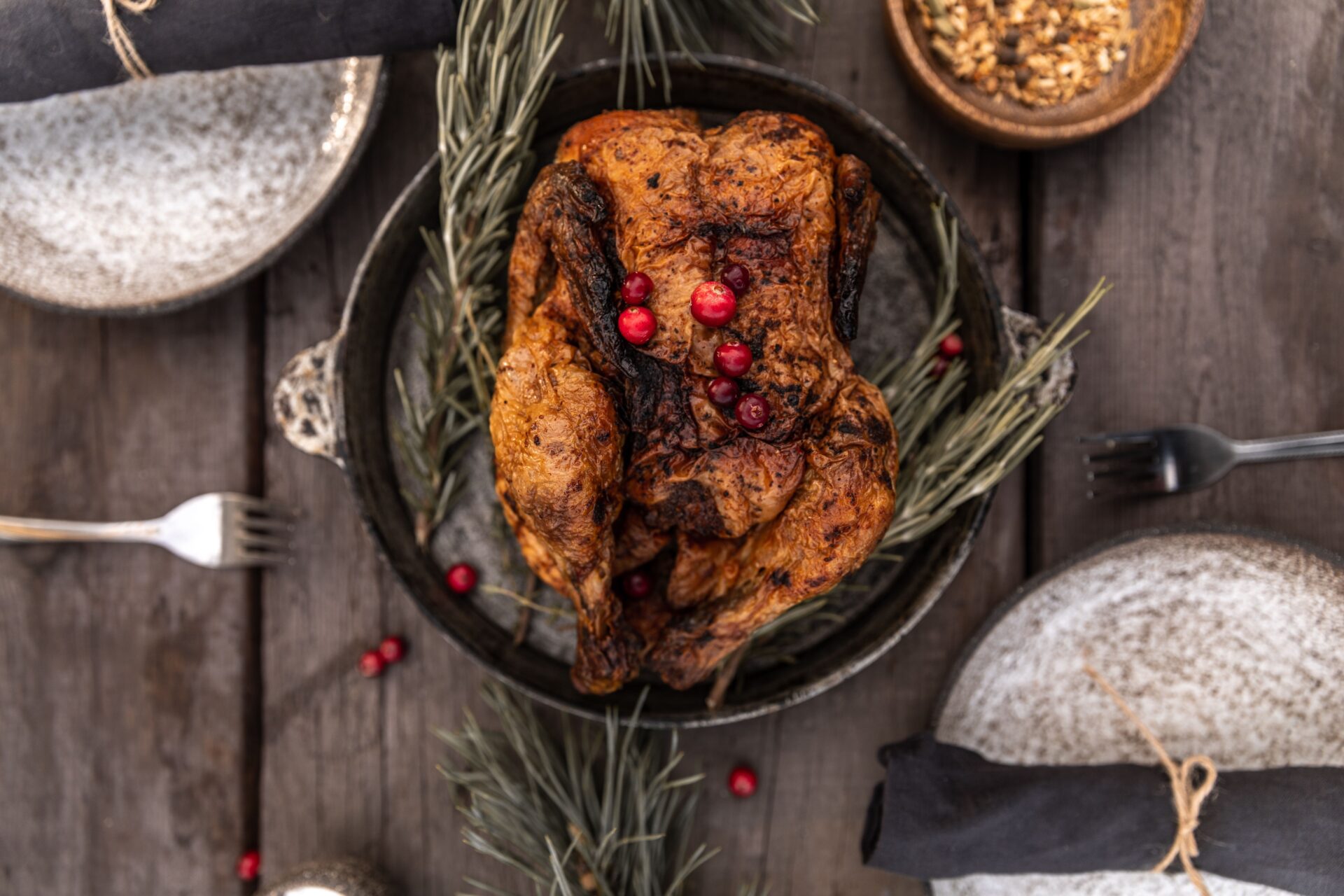
Ask a sommelier what wine to pair with turkey and the honest answer is a shrug: turkey itself is one of the mildest, leanest meats on the table, and on its own it will get along with almost anything. The real problem sits next to it. A Christmas or Thanksgiving plate routinely stacks savoury gravy, herby stuffing, sweet-tart cranberry sauce and a sweet roasted side into a single meal — four or five directions of flavour at once, which is not a problem any other protein on this site has to solve. There is also no inherited wine tradition to fall back on, the way there is for beef or lamb, because turkey only became the default festive roast surprisingly recently on both sides of the Atlantic. This guide covers the wine that actually works with turkey and its trimmings, why sweetness on the plate fights a dry red, and the one big, oaky bottle people reach for out of habit that quietly ruins half the table.
In this article
- 1 The Best Wine for Turkey, at a Glance
- 2 Why Turkey Never Inherited a Wine Tradition
- 3 The Real Problem Isn’t the Turkey — It’s the Table
- 4 Mapping the Plate
- 5 Red Wine for Turkey
- 6 White, Off-Dry and Sparkling: The Versatile Picks
- 7 The One Wine to Avoid
- 8 Frequently Asked Questions About Wine and Turkey
- 8.1 What wine goes best with turkey?
- 8.2 Is red or white wine better with turkey?
- 8.3 What wine goes with cranberry sauce?
- 8.4 Why does turkey pair badly with big red wines like Cabernet Sauvignon?
- 8.5 What is the best wine for a whole Thanksgiving or Christmas dinner, not just the turkey?
- 8.6 Does turkey traditionally have a classic wine pairing?
The Best Wine for Turkey, at a Glance
- Plain roast turkey breast: Beaujolais, a light Pinot Noir, or a dry rosé.
- Turkey with gravy: Pinot Noir — the classic answer, and for good reason.
- Dark meat, stuffing or pigs in blankets: Zinfandel, Grenache, or a Côtes du Rhône blend.
- Mashed potatoes, bread sauce or a creamy side: a lightly oaked Chardonnay.
- Cranberry sauce or a sweet side: off-dry Riesling or Gewürztraminer.
- Bringing only one bottle for the whole table: an off-dry Riesling, a dry rosé, or a good Cava — see why below.
- What to avoid: a big, young, heavily oaked Cabernet Sauvignon or Bordeaux blend.
Why Turkey Never Inherited a Wine Tradition
Part of the reason there’s no settled answer is that turkey never had centuries to build one. Beef has Bordeaux; lamb has the Rhône; a whole roast goose has centuries of English, German and Alsatian tradition behind it. Turkey has none of that, because it is a genuinely New World bird — domesticated by the Aztecs in Mexico and carried back to Spain by conquistadors only in 1523. From there it spread fast: English merchant William Strickland is credited with bringing the first turkeys home in the 16th century, and by the time Pilgrim and Wampanoag families shared the 1621 Plymouth harvest feast, turkey was already a known bird on English tables, not a new discovery — which makes the popular “Pilgrims discovered the turkey” story backwards.
Even its name is an accident of trade routes, not geography. English merchants already imported African guinea fowl via Ottoman “Turkey merchants” and called that bird a turkey-cock; when settlers met the similar-looking American bird, they reused the name out of habit, even though the two are barely related and neither has much to do with the country of Turkey. The French made the same kind of mix-up with a different country: dinde is short for poule d’Inde, “hen of India.”
On both sides of the Atlantic, turkey took a surprisingly long time to become the default roast. In Britain, goose was Christmas dinner for centuries — the Cratchit family eats one in Charles Dickens’s 1843 A Christmas Carol — and turkey was the expensive, semi-exotic bird a reformed Scrooge sends round instead, specifically to look extravagant. Turkey did not overtake goose as Britain’s standard Christmas bird until the 20th century, once cheaper farming and refrigeration made it affordable for everyone. In America, turkey did not become Thanksgiving’s fixed centrepiece until Sarah Josepha Hale’s decades-long campaign helped persuade Abraham Lincoln to declare a national Thanksgiving in 1863 — and turkeys were simply practical for a big table: one bird feeds a crowd, and unlike a cow or a hen, it isn’t already earning its keep producing milk or eggs.
None of that history handed anyone a wine pairing. It handed cooks a large, mild, relatively modern centrepiece and left the wine question wide open — which is exactly why so much conflicting advice about it exists today.
The Real Problem Isn’t the Turkey — It’s the Table
Turkey breast is about as lean as meat gets — skinless, it runs close to a single gram of fat per 100 grams, in the same range as chicken breast and nowhere near a marbled steak. That matters for the same reason it matters with a lean cut of beef: tannin in red wine works by binding to proteins in your saliva, and it needs fat and protein in the food to grab onto instead, or the grip stays in your mouth and the wine tastes harsh. It’s the same logic that sends a lean fillet toward Pinot Noir rather than a young Cabernet in our steak guide — plain turkey breast is lean enough to want a similarly gentle red, or no red at all, which is exactly the principle our wine pairing principles guide sets out for every protein.
Gravy, dark meat and stuffing change the equation, because they add back exactly what the breast is missing — fat, salt, umami. That’s why the classic advice to “just drink Pinot Noir with everything” only half-works: it’s a fine match for the bird, and a slightly thin one once gravy and stuffing are on the fork.
The bigger complication is sugar. Cranberry sauce, a glazed sweet potato casserole, sometimes a fruit-studded stuffing — a Christmas or Thanksgiving plate carries more sweetness than almost any other savoury meal of the year, and sweetness changes how wine tastes. Sweet and umami-rich food make a dry wine taste more bitter, more astringent and more sour by contrast, a principle Master of Wine Tim Hanni has spent much of his career researching and explaining to the wine trade; salty, acidic food does the opposite and makes wine taste softer. That’s the real reason a bone-dry, high-tannin red can taste unexpectedly harsh at this particular meal even though it’s perfectly balanced on its own — and why a wine with a little residual sugar of its own, like an off-dry Riesling, tends to survive contact with the sweeter side dishes so much better.
Mapping the Plate
Because the plate has two things going on at once — richness and sweetness — it helps to plot them separately rather than asking “what wine goes with turkey” as if it were a single dish. The chart below places the turkey itself and five common sides by how rich and how sweet each one is, against the wine that suits that particular combination.
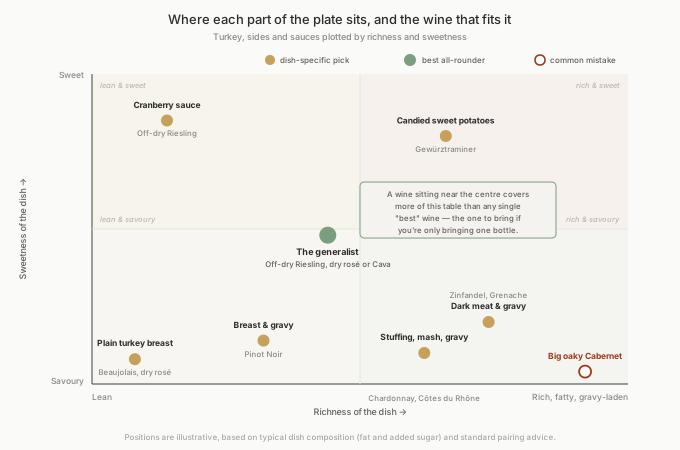
Two things stand out. First, there is no dish that is both very sweet and very rich except the glazed sweet potato casserole, and that’s exactly the dish most red wines handle worst — which is why an aromatic, slightly sweet white earns its reputation as the specialist for this meal. Second, the point sitting nearest the centre of the chart — an off-dry Riesling, a dry rosé, or a good Cava — never scores a perfect match against any single dish, but it never fights anything badly either. That’s the practical case for bringing a generalist instead of a specialist to a table this varied, especially if you’re only bringing one bottle for a crowd with very different plates.
Red Wine for Turkey
If you’re committed to red, match it to what’s actually on the fork rather than to the turkey label in the abstract. Plain roasted turkey breast, especially white meat without much gravy, wants something in the same weight class as a lean cut of beef or veal: a chilled Beaujolais or another light Gamay, a simple Pinot Noir, or a dry rosé of Pinot Noir if you want something in between.
Once gravy, stuffing and dark meat are involved, move up in weight without necessarily moving up in tannin. A West Coast Zinfandel or a Grenache-led Côtes du Rhône has the fruit and savoury depth to stand up to gravy and stuffing without the drying grip of a young Cabernet or Bordeaux blend, because turkey meat never gets as fatty as a well-marbled steak no matter how much gravy is involved. A slightly cooler-climate Syrah, with its peppery edge, also works well against a sausage-heavy stuffing or a peppery gravy.
White, Off-Dry and Sparkling: The Versatile Picks
White wine is arguably the safer default, and not just for the sweet sides. A lightly oaked Chardonnay — something with real texture but not a wall of vanilla and butter — has enough body for gravy, mashed potatoes and bread sauce without fighting the bird; our Chardonnay guide covers the styles worth seeking out if you want something more textured than a basic unoaked bottle. Viognier and a richer style of Chenin Blanc do a similar job, with a floral, honeyed edge that flatters roasted skin and herbs.
The wines that earn their reputation as specialists for this particular meal, though, are the ones with a little residual sugar: an off-dry Riesling — a German Kabinett or a similar style, not a bone-dry one — or Gewürztraminer, whose lychee-and-rose perfume and soft acidity were practically built for cranberry sauce and a marshmallow-topped sweet potato casserole. Neither is a fully sweet dessert wine; see our guide to what dry wine actually means if the sweetness spectrum is unfamiliar territory. It just takes enough sugar to stop the sweeter dishes from making the wine taste stripped and sour.
Sparkling wine is the wildcard that quietly wins more often than it gets credit for, which is why Decanter’s own Christmas turkey pairing panel keeps landing on it too. Dry Champagne, Cava or a good Crémant has the acidity to cut through gravy and buttery sides, the bubbles reset your palate between bites of very different food, and a fuller, slightly richer style — a blanc de noirs, or a wine with a few years of age — has enough presence to stand up to dark meat. It’s one of the few wines on this list that works from the first course through to dessert without a single weak link.
The One Wine to Avoid
The most common mistake at this meal isn’t a wrong grape — it’s reaching for the biggest, most expensive bottle in the rack because the occasion feels formal. A young, heavily oaked Cabernet Sauvignon or a structured Bordeaux blend is built for fat and protein it will never actually meet at this table: turkey is too lean to soften its tannin the way a ribeye would, and the moment it sits next to cranberry sauce or a glazed sweet potato, the sweetness makes the wine taste even more astringent and bitter than it does on its own. It isn’t a disaster — nobody’s dinner is ruined by a glass of good Cabernet — but it is the pairing most likely to make an expensive bottle taste worse than it is, at the one meal of the year with the least fat and the most sugar on the table. Save it for a leftover turkey sandwich the next day, eaten without the cranberry sauce anywhere nearby, if you want to actually taste why it’s a good bottle.
Turkey isn’t the only bird on the holiday table. Our wine with chicken guide runs through the same logic by cooking method, and if ham is your centrepiece instead, our wine and ham guide covers that in full.
Frequently Asked Questions About Wine and Turkey
What wine goes best with turkey?
There isn’t one single best wine, because turkey itself is mild and the rest of the plate does most of the work. Pinot Noir is the most reliable all-purpose red, with enough acidity and low enough tannin to handle both the bird and gravy. An off-dry Riesling, a dry rosé or a good sparkling wine covers an even wider range of dishes, including cranberry sauce and sweet potato casserole, which is why they’re the better choice if you’re bringing only one bottle for a whole table.
Is red or white wine better with turkey?
Neither is objectively better — it depends on the plate, not just the bird. A light, low-tannin red like Pinot Noir or Beaujolais suits turkey and gravy well. White wine, especially a textured Chardonnay or an off-dry Riesling, tends to have the edge once cranberry sauce, stuffing and sweet side dishes are involved, because white wines generally carry more acidity and, in off-dry styles, the residual sugar that a festive plate’s sweetness needs.
What wine goes with cranberry sauce?
An off-dry wine with its own fruit and a little residual sugar, such as an off-dry Riesling, Gewürztraminer or a fruity rosé. Cranberry sauce is sharply tart and often quite sweet, and a bone-dry red or white next to it tends to taste thinner and more sour than it should. A wine with some sweetness of its own holds its shape against the sauce instead of being flattened by it.
Why does turkey pair badly with big red wines like Cabernet Sauvignon?
Turkey breast is very lean — about as lean as chicken breast — and red wine tannin needs fat and protein in the food to bind to, or it stays in your mouth and tastes harsh. A young, heavily oaked Cabernet Sauvignon or Bordeaux blend has little to grab onto with plain turkey, and it gets worse next to sweet sides like cranberry sauce or candied sweet potatoes, since sweetness in food makes dry, tannic wine taste more bitter and astringent by contrast.
What is the best wine for a whole Thanksgiving or Christmas dinner, not just the turkey?
An off-dry Riesling, a dry rosé, or a good Cava or Crémant is the safest single choice for a table carrying turkey, gravy, stuffing, cranberry sauce and a sweet side all at once. None of them is the single best match for any one dish, but none of them clashes badly with anything either, which matters more than a perfect pairing once a table has this many different flavours on it at the same time.
Does turkey traditionally have a classic wine pairing?
No, and that’s part of why the question feels unsettled. Turkey is a New World bird, domesticated in Mexico and brought to Europe only in the 16th century, and it didn’t become the fixed centrepiece of Christmas or Thanksgiving until surprisingly recently — too modern to have inherited a centuries-old European wine pairing the way beef has Bordeaux or lamb has the Rhône. The pairing advice in circulation today is modern trial and error, not old tradition.