Our last grape profile covered Nebbiolo, a grape so bound to one corner of Piedmont that it has never really grown well anywhere else. Chardonnay is its exact opposite: it grows on every continent that makes wine, it is the most planted white wine grape on the planet, and it is astonishingly indifferent to where it lands. That indifference is the whole story. Chardonnay has less flavour of its own than almost any other major grape — no muscat perfume, no Sauvignon Blanc bite — so what you taste in the glass is mostly the climate it was grown in and the decisions the winemaker made afterward. The same grape gives you flinty Chablis, tropical Australian bottlings, the backbone of Champagne, and Le Montrachet, the most expensive dry white wine in the world. It also spent about fifteen years as the most mocked wine on the shelf. This guide explains why one grape can be all of those things at once, and how to read a Chardonnay label so you actually know what you are about to drink.
In this article
- 1 Chardonnay, at a Glance
- 2 The Grape That Barely Tastes of Itself
- 3 A Grape Named After Thistles
- 4 From Chablis to Napa: One Grape, Two Different Drinks
- 5 The Part People Get Wrong: Butter Is Not Oak
- 6 Chardonnay in Champagne
- 7 Anything But Chardonnay: How a Grape Became a Punchline
- 8 The World’s Most Expensive Dry White
- 9 Chardonnay ABV: What to Expect in the Glass
- 10 How to Serve and Age Chardonnay
- 11 Food Pairing
- 12 Frequently Asked Questions About Chardonnay
Chardonnay, at a Glance
- Origin: Burgundy, France — a natural cross of Pinot and the near-extinct Gouais Blanc, confirmed by DNA testing in 1999.
- Colour: ranges from pale straw with a green tint (cool climate, no oak) to deep gold (warm climate, barrel-aged).
- Style: almost always dry; body runs from light and mineral to broad and creamy depending on where and how it is made.
- Alcohol: roughly 12% to 14.5% ABV — nearer 12.5% in Chablis, 14% and up in California and Australia.
- Signature flavours: green apple, lemon and wet stone when cool; yellow peach, pineapple and mango when warm; vanilla, toast and butter when oak and malolactic fermentation are involved.
- Plantings: around 210,000 hectares worldwide, making it the most widely planted white wine grape on Earth.
- Great regions: Chablis, the Côte de Beaune and the Mâconnais in Burgundy; Champagne; Sonoma and the Central Coast; Margaret River and the Adelaide Hills in Australia.
- Ageing: most Chardonnay is built to drink within three years; top white Burgundy and vintage Blanc de Blancs Champagne can improve for a decade or more.
The Grape That Barely Tastes of Itself
Most famous grapes announce themselves. Sauvignon Blanc smells of cut grass and gooseberry no matter where it grows. Gewürztraminer smells of lychee and rose in Alsace, New Zealand or Chile alike. Chardonnay does not do this. On its own, ripe Chardonnay juice tastes of not much more than apple, lemon and a vague sense of “white wine” — pleasant, but close to a blank page. Winemakers sometimes call it a neutral grape, and they do not mean it as an insult.
That neutrality is exactly why Chardonnay took over the world. A grape with a loud personality resists being shaped; a quiet one takes instruction. Chardonnay will faithfully record the coolness of a limestone slope in northern France or the warmth of a Californian afternoon, and it will absorb whatever a cellar does to it — fermentation in oak, months resting on its spent yeast, a secondary fermentation that trades sharp acidity for a buttery softness. Every one of those choices leaves a fingerprint, and because the grape itself contributes so little noise, the fingerprints are easy to read once you know what they are. The rest of this guide is really a list of those fingerprints.
A Grape Named After Thistles
There is a real village called Chardonnay, in the Mâconnais in southern Burgundy. It has existed under that name since at least the 1400s, and its name comes from the medieval Latin Cardonnacum, meaning “place of thistles.” The grape, oddly, got the name much later. Through the 1800s it went by a scatter of local names — Chardenet, Chaudenet, Chardonnet, Beaunois — and the spelling we now use was only fixed in 1896, at a national wine congress in Chalon-sur-Saône, a short drive from the village it borrowed the name from. Chardonnay has been the world’s trendiest grape for roughly fifty years, and it has only officially been called Chardonnay for about a hundred and thirty.
Its parentage stayed a mystery until 1999, when John Bowers and Carole Meredith at the University of California, Davis, ran DNA tests on dozens of French grape varieties and published the results in the journal Science. Chardonnay, it turned out, is a natural cross of Pinot — the noble red grape of Burgundy — and Gouais Blanc, a grape so ordinary that medieval authorities had repeatedly tried to ban it as unworthy of good vineyard land. Gouais Blanc is barely grown anywhere today, but before it faded it crossed with Pinot again and again in the fields of northeastern France, producing at least sixteen varieties still in use — Chardonnay, Gamay, Aligoté and Melon de Bourgogne among them. The researchers put their confidence in the Pinot and Gouais parentage at more than 99.99 percent. The world’s most prestigious white grape is, genetically, half peasant stock.
One inheritance from that lineage matters every spring: like Pinot, Chardonnay buds early, which leaves the young shoots exposed when late frosts arrive. It is why growers in Chablis spend April nights lighting paraffin heaters and running sprinklers over the vines to encase the buds in protective ice, and why a single cold week can cut a year’s crop in half.
From Chablis to Napa: One Grape, Two Different Drinks
Climate sets the outer limits of what a Chardonnay can be. In a cool region, the grapes hold on to their acidity and never build much sugar, so the wine finishes lean, tight and low in alcohol, with flavours in the green-apple, lemon, pear and wet-stone range. Chablis, at the cold northern edge of Burgundy, is the reference point: bone-dry, sharp, often with a chalky or flinty note that drinkers describe as “mineral.” Cool parts of Sonoma, Tasmania, Chile’s Casablanca Valley and the Adelaide Hills work in the same register.
In a warm region, the same grape ripens further. Sugar climbs, acidity falls, alcohol rises, and the fruit flavours shift toward yellow peach, melon, pineapple and even banana. Warm-climate Chardonnay feels rounder and fuller in the mouth, and can taste faintly sweet even when it is technically dry, simply because very ripe fruit reads that way. Much of California, inland Australia and South Africa’s warmer sites sit here.
The chart below plots eight well-known Chardonnay regions by how cool or warm the growing climate is, and how lean or rich the typical cellar style is. The point is not the exact placement of any one dot — those are broad-brush — but the spread. There is no tidy line. A single grape fills nearly the whole space.
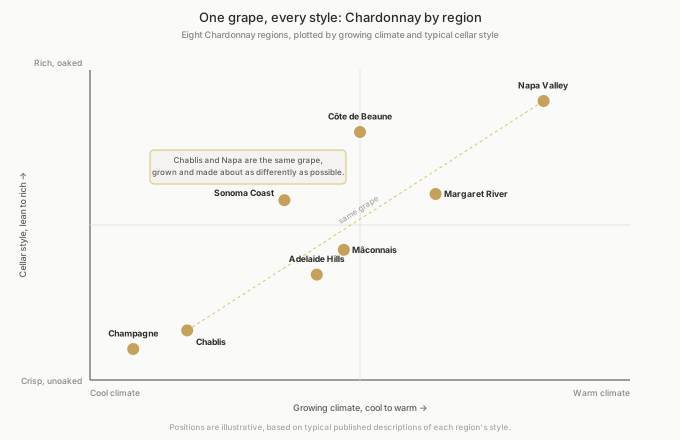
Notice that climate does not settle the question by itself. Sonoma Coast is genuinely cool, yet its Chardonnay is often made in a rich, oak-influenced style. The Adelaide Hills is warmer, yet many producers there aim for something lean and taut. The vertical axis — what happens in the cellar — is largely a decision, which is where the next section comes in.
The Part People Get Wrong: Butter Is Not Oak
Ask a room of casual wine drinkers what makes a Chardonnay taste “buttery” and most will say oak. It is a reasonable guess, and it is wrong. The butter comes from malolactic fermentation, a second fermentation that nearly all red wines and many Chardonnays go through after the alcoholic one. Bacteria convert the grape’s sharp malic acid — the acid of green apples — into softer lactic acid, the acid of milk. A by-product of that conversion is a compound called diacetyl, which is the exact molecule the food industry uses for artificial butter flavour. Block malolactic fermentation, as Chablis producers often do, and even a heavily oaked Chardonnay will not taste buttery.
Oak does something different. A new oak barrel gives vanilla, baking spice, toast, and sometimes a coconut or hazelnut note, plus a rounder texture and a slow trickle of oxygen that ages the wine faster. A third thing, lees stirring — leaving the wine on its spent yeast for months and periodically stirring it, called bâtonnage in French — adds a creamy weight and flavours of bread dough or brioche. Producers mix and match all three. That is why “oaked Chardonnay” is a crude label: a Meursault aged in old barrels with full malolactic is a completely different wine from a Chablis Grand Cru aged in old barrels without it, even though both saw wood. Wine Folly’s guide to Chardonnay lays out the main style camps in more detail. The honest summary is that when you taste a Chardonnay, you are mostly tasting a set of choices — and once you can name them, the grape stops being confusing.
Chardonnay in Champagne
Chardonnay is one of the three main grapes of Champagne, alongside the red-skinned Pinot Noir and Meunier, and it accounts for about 31% of the region’s vineyard area. In a blend it contributes acidity, precision and the capacity to age; tasters often describe its role as the “spine” of a Champagne. On the Côte des Blancs, a strip of pure chalk south of Épernay, growers plant almost nothing else — roughly 97% of the vineyard there is Chardonnay — and the wines made entirely from it are labelled Blanc de Blancs, literally “white from whites.” A young Blanc de Blancs is all lemon, green apple and crushed shell; with ten or more years on the cork it turns toward toast, hazelnut and baked pastry while staying tight. If you have only met Chardonnay as a still wine, a good grower Blanc de Blancs is worth seeking out. Our guide to non-vintage Champagne covers how these bottles are assembled and why most carry no year.
Anything But Chardonnay: How a Grape Became a Punchline
Chardonnay’s modern boom has a start date. On 24 May 1976, at a blind tasting in Paris now known as the Judgment of Paris, a panel of French judges ranked a 1973 Chardonnay from Château Montelena in Napa Valley above four white Burgundies — and it scored higher than any wine in the room, red or white. The result made headlines, and demand for California Chardonnay went vertical. The state had a few hundred acres of it in the mid-1960s; by 2000 it had nearly 90,000.
Scale did what scale usually does. To feed the demand, a lot of ambitious, heavily oaked, high-alcohol Chardonnay went out the door, and a lot of cheap imitation followed it — wines so thick with vanilla and butter that the fruit disappeared. By the late 1980s the backlash had a slogan: ABC, “Anything But Chardonnay,” popularised by the California winemaker Randall Grahm and repeated for two decades by drinkers who had been worn down by the “butter bomb” style. Chardonnay became shorthand for unadventurous. It kept selling in enormous volume the entire time, which tells you the mockery was mostly a fashion among people who talk about wine rather than a real collapse in what people drank.
The fashion has since turned again. Since the 2010s, producers almost everywhere have pulled back on new oak, picked earlier for freshness, and released unoaked or lightly oaked bottlings fermented in steel — closer in spirit to Chablis than to old Napa. If you decided years ago that you disliked Chardonnay, there is a fair chance you disliked one narrow style of it that is now out of favour.
The World’s Most Expensive Dry White
At the other end of the price range from a supermarket own-label sits Le Montrachet, a single Grand Cru vineyard straddling the villages of Puligny-Montrachet and Chassagne-Montrachet in Burgundy’s Côte de Beaune. It is tiny — exactly 8 hectares, about the size of eight rugby pitches — and split among roughly eighteen owners, each farming a strip. The Domaine de la Romanée-Conti works just 0.67 of a hectare of it and makes around 3,000 bottles a year, which change hands for something like £8,000 to £10,000 each. Wine-Searcher’s ranking of the most expensive Chardonnays on Earth is, for the top two dozen entries, an unbroken list of white Burgundy.
What makes this worth a paragraph is that it is the same grape as the £6 bottle. The gap is site — a particular limestone slope with a particular exposure — plus low yields, old vines, and decades of accumulated reputation. Burgundy labels its wines by place rather than by grape for exactly this reason, which our guide to French wine labels unpacks, and the full hierarchy from regional Bourgogne up to Grand Cru is covered in our Burgundy region guide. Chardonnay is the vehicle; in Burgundy, the address is the price.
Chardonnay ABV: What to Expect in the Glass
Most Chardonnay falls between 12% and 14.5% ABV. Cool regions sit at the bottom of that band — a Chablis or a Blanc de Blancs base wine is often around 12% to 12.5% — because the grapes are picked before they build much sugar, and sugar is what yeast turns into alcohol. Warm regions sit at the top: California and inland Australian Chardonnay frequently lands at 14% or more, and a few reach 15%. Neither oak nor malolactic fermentation changes the alcohol figure, but both change how the alcohol feels: a broad, creamy, oaky wine at 14.5% can taste less hot than a lean one at 13% because the texture cushions it. If you want the number for a specific bottle it is on the back label, and our guide to wine alcohol content by type puts Chardonnay in context against other wines.
How to Serve and Age Chardonnay
Serving temperature does more for Chardonnay than almost any other adjustment. A crisp, unoaked style wants to be properly cold, around 7–10°C (45–50°F), which keeps it snappy. A rich, oaked style is better a little warmer, around 10–13°C (50–55°F); too cold and its texture and aromatics shut down, so take it out of the fridge twenty minutes before pouring. Our wine serving temperature guide has the full range. A large white-wine glass helps with the oaked styles; the fridge door is fine for the everyday ones.
On ageing, be realistic: the large majority of Chardonnay — anything inexpensive, anything sold as bright and fruity — is made to drink now and gains nothing from years in a cupboard. The exceptions are real but specific: village and Premier Cru white Burgundy, Grand Cru Chablis, vintage Blanc de Blancs Champagne, and a handful of top bottlings from California and Australia can all develop for ten to twenty years, trading primary fruit for notes of hazelnut, honey and toast. White Burgundy has been dogged since the late 1990s by “premature oxidation,” bottles turning flat and sherried years earlier than they should, so even here ageing is not a guarantee. Our guide to which white wines age well goes deeper on what separates a keeper from a drink-now bottle.
Food Pairing
Chardonnay is one of the most food-friendly white wines precisely because it comes in so many weights. The trick is to match the style to the dish rather than reaching for “Chardonnay” as a single thing.
- Crisp and unoaked (Chablis, steel-fermented bottlings): oysters and raw shellfish, sushi and sashimi, goat cheese, fried fish, green salads with a sharp dressing. The classic pairing of Chablis and oysters is not a cliché by accident — the wine’s saline edge and high acidity are built for it.
- Medium-bodied, lightly oaked (Mâconnais, cooler New World): roast chicken — the textbook Chardonnay pairing — plus turkey, pork loin, and creamy soups.
- Rich, oaked, full malolactic (Meursault, warm-climate California): lobster and crab with butter, creamy pasta and risotto, roast squash and pumpkin, corn, and mushroom dishes, where the wine’s weight and nutty notes meet the richness head-on.
Our companion piece on what to eat with Chardonnay works through more dishes by style, from raw bar to roast dinner.
Frequently Asked Questions About Chardonnay
What does Chardonnay taste like?
It depends heavily on where it is grown and how it is made. Cool-climate Chardonnay such as Chablis tastes of green apple, lemon, pear and wet stone, with sharp acidity. Warm-climate Chardonnay tastes of yellow peach, pineapple and melon, and feels fuller and rounder. Oak barrels and malolactic fermentation add vanilla, toast and a buttery note on top of the fruit.
Is Chardonnay a sweet or dry wine?
Almost all Chardonnay is fully dry, meaning it has little or no residual sugar. Warm-climate and heavily oaked versions can give an impression of sweetness because of ripe fruit flavours and vanilla from the oak, but that is not actual sugar. Sweet Chardonnay does exist as a rare dessert style, but it is not what the word normally refers to.
What is the difference between Chablis and Chardonnay?
There is no difference in grape: Chablis is a wine region in northern Burgundy, and its wine is made entirely from Chardonnay. “Chablis” on a label tells you the style — dry, lean, high-acid, usually unoaked or subtly oaked, with a mineral character — because that is what the cool climate and limestone soils there produce.
Why do so many people say they hate Chardonnay?
The dislike usually traces back to the heavily oaked, high-alcohol “butter bomb” style that dominated the 1990s and triggered the “Anything But Chardonnay” backlash. That style is now much less common. Most people who think they dislike Chardonnay are fine with a crisp unoaked bottle or a well-made Chablis, which are very different wines.
What is unoaked Chardonnay?
Unoaked Chardonnay is fermented and aged in stainless steel or concrete rather than oak barrels, so it picks up no vanilla, toast or spice from wood. The result is a fresher, more fruit-driven wine that shows the grape and the climate directly. Chablis is the most famous example; many producers worldwide now make a deliberately unoaked bottling.
What foods go best with Chardonnay?
Match the food to the style. Crisp unoaked Chardonnay suits oysters, sushi, goat cheese and fried fish. Lightly oaked, medium-bodied Chardonnay is the classic partner for roast chicken and pork. Rich, oaked Chardonnay stands up to lobster and crab with butter, creamy pasta, risotto and roasted squash.