In July 1395, Philip the Bold, Duke of Burgundy, issued an edict against a single grape. In Wine Spectator’s translation, he called Gamay an “evil and disloyal plant”, all to protect the reputation of Burgundy’s Pinot Noir. In 1999, DNA tests at the University of California, Davis, showed that Pinot was one of Gamay’s parents. This guide to Gamay vs Pinot Noir explains how two close relatives ended up so different: what each tastes like, why one thrives on granite and the other on limestone, how long they keep, whether Gamay really has no tannin, and what to pour with dinner. The thread running through it is abundance against scarcity, with Gamay the generous grape and Pinot Noir the fussy, scarce one, and the vineyard statistics show which of the two the world has been planting: since 2000 the parent has almost doubled its vineyards and the child has lost almost two-fifths of its own.
In this article
- 1 Gamay vs Pinot Noir at a Glance
- 2 A Duke, a Ban and a DNA Test
- 3 Did the Ban Really Send Gamay to Beaujolais?
- 4 Six Centuries Later, the Duke Is Winning
- 5 Gamay vs Pinot Noir in the Vineyard
- 6 Gamay vs Pinot Noir in the Glass
- 7 How Long They Keep
- 8 When They Share a Bottle
- 9 Gamay vs Pinot Noir at the Table
- 10 Which One Should You Choose?
- 11 Gamay and Pinot Noir: Your Questions Answered
Gamay vs Pinot Noir at a Glance
- Family: Pinot, most probably Pinot Noir, is a parent of Gamay, which makes the two close kin. Chardonnay is another of the same parents’ offspring.
- Home ground: Pinot Noir is the red grape of Burgundy’s Côte d’Or and a mainstay of Champagne. Gamay is the grape of Beaujolais, where it covers about 98% of the vineyards.
- Vineyards worldwide: about 132,000 hectares of Pinot Noir against about 23,000 of Gamay in 2023, with 92% of the Gamay in France.
- Soil and ripening: Gamay favours granite and ripens about two weeks earlier. Pinot Noir favours chalky clay and limestone and is the fussier, lower-yielding vine.
- Colour: Pinot Noir is often pale garnet, while young Beaujolais can be a deep purple-red.
- Tannin and acidity: both are usually described as low in tannin and medium-high in acidity, though sources disagree on which is softer.
- Alcohol: Wine Folly gives Gamay 10–11.5% ABV and Pinot Noir 12–14%.
- Flavour: Gamay is bright and floral, with raspberry, wild strawberry, blackberry and violet. Pinot Noir adds cherry and savoury earth, with mushroom and forest floor as it ages.
- Keeps: most Gamay is best drunk young, and Wine Folly allows 3 to 5 years. Pinot Noir usually evolves over 5 to 10 years, and the best can last up to 20.
- Serve: both cool, at about 12–15°C (55–60°F).
A Duke, a Ban and a DNA Test
Gamay had plenty of friends among the growers of 14th-century Burgundy. Wikipedia places its first appearance in the village of Gamay, south of Beaune, in the 1360s, and says it ripened about two weeks earlier than Pinot Noir and was easier to cultivate. Wine Spectator’s account of the edict describes it as “easygoing and generous in yield”, “a godsend in hard times”, and says many growers were “quick to bid Pinot Noir adieu”.
Philip the Bold took the opposite view. His July 1395 edict, which Wine Spectator calls “perhaps the most famous critical savaging in wine history”, complained of the wine’s “very great and terrible bitterness”, called it “injurious to the human creature”, and ordered the vine “extirpated, destroyed and reduced to nothing”.
The motive was partly reputation and partly land. Wikipedia says Gamay occupied ground that could grow the more “elegant” Pinot Noir, and when Philip the Good issued a second edict about sixty years later, his stated reasoning was: “The Dukes of Burgundy are known as the lords of the best wines in Christendom. We will maintain our reputation”. Wine Spectator adds that Burgundy was locked in a rivalry with Paris over which had the better wine, and the historians John Winthrop Haeger and Roger Dion, according to Wikipedia’s Pinot Noir entry, believe that tying Pinot to Burgundy was the explicit strategy of the Valois dukes. Read that way, the ban was brand protection as much as quality control.
As a ban, it worked. Wine Spectator notes that virtually all red wine from the Côte d’Or is still made from Pinot Noir, and that Saint-Aubin has a premier cru called Sur Gamay, outside the hamlet of Gamay, where the bottle cannot contain any Gamay. As policy, Wine Spectator’s verdict is harsher: the ban “was disastrous as a policy move but, it must be said, effective as a ban on Gamay”.
Then came the twist. In 1999 a team at the University of California, Davis, led by Carole Meredith, reported in the journal Science that Chardonnay is the offspring of Pinot and an obscure white grape called Gouais Blanc, and that the same two parents had produced 15 other varieties, Gamay among them. “This one was a huge surprise,” Meredith told Wine Spectator. “None of us had even heard of Gouais. Our French colleagues were skeptical at first, but the DNA evidence is conclusive.” So the grape a duke banned to protect Pinot Noir was Pinot’s own child, and a sibling of Chardonnay, the grape behind the great white Burgundies. Our Chardonnay guide tells the same discovery from the other side.
One caution on the family tree. The tests could not say which Pinot. Wine Spectator’s 1999 report explained that current DNA technology “cannot differentiate between Pinot Noir, Pinot Gris and Pinot Blanc”, which are mutations of one variety and genetically identical for testing purposes, and that “Pinot Noir seems the most likely candidate, according to Meredith, because it has always been the most common in France.” Inter Beaujolais, the region’s trade body, simply calls Gamay “a natural cross between pinot noir and gouais blanc”. Pinot Noir as the parent is a very safe bet, but it is not something the 1999 test could strictly prove. The other parent had its own troubles: authorities tried to ban Gouais Blanc in the 16th and 18th centuries, which makes Gamay the child of one scorned grape and one protected one.
Did the Ban Really Send Gamay to Beaujolais?
You will often read that the edicts drove Gamay south, out of Burgundy and into the granite of Beaujolais, where it thrived. Wikipedia’s Beaujolais entry says just that: the edicts “had the effect of pushing Gamay plantings southward”. It is a neat story, but the sources do not fit it neatly. Inter Beaujolais says the variety has been planted in its territory “since the early 17th century”, more than two hundred years after the first edict. Wine Spectator’s version is that Beaujolais, a medieval backwater at the extreme south of Philip’s territory, saw the edict go unenforced, and that by the 17th century vintners had discovered that its hilly terroir “suited the grape uniquely”.
The fairest summary is that the ban cleared Gamay out of the Côte d’Or, but its great career in Beaujolais began later and by a less dramatic route. Granite, too, is a preference rather than a rule. SwissWine says Gamay in Switzerland “thrives particularly well in limestone and granite soils”, and Inter Beaujolais itself says that although granite seems to be its soil of choice, the variety “is good at adapting”.
Six Centuries Later, the Duke Is Winning
If the duke could see today’s vineyard statistics, he might feel vindicated. A widely used global dataset is the University of Adelaide’s database of winegrape plantings, compiled by Kym Anderson, Signe Nelgen and Germán Puga. In 2000 the world had 69,187 hectares of bearing Pinot Noir and 37,762 of Gamay Noir, which is 1.8 hectares of Pinot for every hectare of Gamay. By 2023 Pinot Noir had grown to 131,983 hectares, up 91%, while Gamay had shrunk to 23,127, down 39%. The chart puts the four data points on one page.
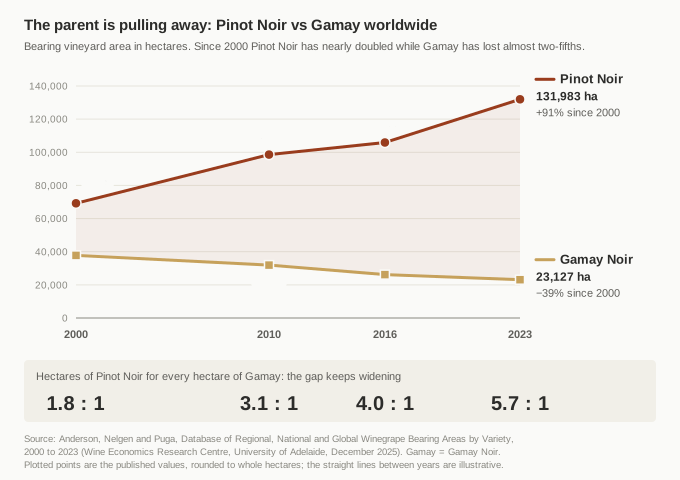
Look at the gap rather than the lines: 1.8 hectares of Pinot for each hectare of Gamay in 2000, 3.1 in 2010, 4.0 in 2016 and 5.7 in 2023. France shows the turn most clearly. In 2000 it had more Gamay than Pinot Noir, 34,537 hectares against 26,526. By 2010 Pinot had edged ahead, 30,086 to 29,698, and by 2023 it led by 43,895 hectares to 21,326. Gamay is now overwhelmingly a French grape: France holds 92% of the world’s Gamay, with Switzerland next at 1,086 hectares and Canada at 307.
The database does not say why. For Pinot Noir, Anderson and Puga’s 2025 working paper points to rising demand for both sparkling wine, where Pinot is commonly blended with Chardonnay, and fine still wine, which has encouraged plantings even in regions less suited to the grape. It also notes that Pinot Noir’s average price is typically well above that of other varieties. For Gamay, the timing fits the hangover from Beaujolais Nouveau: Wikipedia reports that at the 1992 peak more than half of all Beaujolais was sold as Nouveau, that a consumer backlash followed, and that over 1.1 million cases were destroyed or distilled after the 2001 vintage. Linking those events to the vineyard figures is my inference, not something the dataset states.
Gamay vs Pinot Noir in the Vineyard
The organising idea of this guide is that Gamay and Pinot Noir are a study in abundance and scarcity, and the vineyard is where it starts. Gamay is generous. Inter Beaujolais says that the more vine stocks there are on a plot, the more prolific it becomes, so it “has to be tamed” to rebalance quantity and quality. WSET’s Diploma guidance notes that Gamay is naturally resistant to rot and that on fertile plains yields of 60 hectolitres per hectare are possible for bulk wine. SwissWine puts the consequence plainly: Gamay “produces higher yields, which often makes it a cheaper alternative to the more elegant and complex Pinot Noir”.
Pinot Noir is the opposite. Wikipedia says it must be low-yielding to make quality wine and is sensitive to wind, frost, soil and pruning. Wine Folly says it buds early, has thin skin and tight clusters, and can be “notoriously temperamental”, which is why growers call it the “heartbreak grape”. Anderson and Puga open their paper by calling it “famous for being very difficult to produce well”.
Soil is the second split. Wikipedia describes the northern half of Beaujolais, where most of the crus sit, as hills of schist and granite with some limestone, giving “more structured, complex wines”, while the flatter, clay-and-sandstone south gives “lighter, fruitier wines”. It also says Gamay roots shallowly on alkaline soils, which stresses the vine and raises acidity, and lists chalky clay as Pinot Noir’s ideal soil. Wine Folly ties the great villages of the Côte de Nuits to limestone and clay. Soil, slope and climate working together is what the word terroir means, and our guide to terroir explains how.
Gamay also ripens early, in a warmer place. Wikipedia says Beaujolais has a climate closer to the Rhône’s than to Burgundy’s and that its vines consistently fully ripen their grapes. The vines are planted tightly, at 9,000 to 13,000 per hectare, among the highest densities of any major wine region, and most are trained in the traditional gobelet style with short pruning.
Pinot Noir, meanwhile, has long outgrown Burgundy. The Côte d’Or is still the benchmark, and our Burgundy guide covers the region, but Anderson and Puga’s tables put more Pinot Noir in Champagne than in Burgundy: 13,144 hectares against 10,282 in 2016. In 2023 the biggest national areas were France with 43,895 hectares, the United States with 29,216, Germany with 11,637 and Italy with 10,568. Wine Folly calls Pinot Noir the “structural backbone” of Champagne.
Gamay vs Pinot Noir in the Glass
Colour is the first trap. Pinot Noir is often likened to garnet and is frequently much lighter than other reds, which Wikipedia puts down to a lower content of skin anthocyanins, the colouring matter, than most classic red varieties. Beaujolais often goes the other way: Wikipedia describes the colour Gamay gives the region’s wines as a deep bluish-red, and WSET’s Diploma exam guidance describes Beaujolais Nouveau as “deep purple in colour”. That comes partly from the method, because WSET says carbonic or semi-carbonic maceration “extracts colour but not tannin”. So a deep-coloured, soft red may well be Gamay and a translucent garnet one is more likely Pinot Noir, though that is a tendency, not a test.
On the nose, Gamay leans floral and crunchy. SwissWine says that “Gamay often has a more floral nose than Pinot Noir. It has a more pronounced minerality and can have slightly higher acidity.” Inter Beaujolais lists raspberry, wild strawberry, blackberry and black cherry, occasionally peppery or floral, and Wine Folly adds violet and peony. Pinot Noir leans savoury and earthy: Wine Folly describes ripe cherry and raspberry, forest floor, tea leaves and sometimes clove, with mushroom and leather as it ages.
In the mouth, Wine Folly rates both as dry with medium-high acidity, Gamay as medium-light in body and Pinot Noir as medium. The clearest number is alcohol: 10–11.5% for Gamay against 12–14% for Pinot Noir. Inter Beaujolais describes the style as “supple, fruity wines that are low in alcohol content”.
Now the tannin question. Gamay is often said to have none at all, and Wine Folly’s profile does list it as “No Tannins” against Pinot Noir’s “Low Tannins”. Other sources are less absolute. SwissWine says Gamay generally has “marked acidity and light tannins”, WSET’s Nouveau answer plan lists “low levels of soft tannins”, and Wikipedia’s Beaujolais entry says the grape adds “moderate tannins” to the region’s wines. What the sources agree on is the role of method. WSET says the carbonic approach extracts colour but not tannin. The same Wikipedia entry says that as the grapes ferment longer they “develop more tannins and a fuller body”, that some oak-aged Moulin-à-Vent gains more tannin and structure than other Beaujolais, and that growers have shifted towards smaller, thicker-skinned clones, which should push tannin up, not down. So treat “no tannin” as shorthand for a style built to avoid it. Our guide to what tannin is explains the grip they are arguing about.
And the banana? That is the Nouveau trick, not the grape. Wikipedia says Nouveau, fermented for only a few days, “can be dominated by estery flavors such as bananas and pear drops”, and WSET credits the carbonic process with “distinctive kirsch/bubblegum aromas”. WSET describes the process as whole bunches in a tank full of carbon dioxide, where the grapes ferment inside their skins and burst under their own weight. The crus, which are allowed longer to ferment, taste different: Wikipedia lists sour cherries, black pepper, dried berry and fresh-cut stone and chalk.
How Long They Keep
Pinot Noir has the higher ceiling. Wine Folly says most bottles evolve gracefully over 5 to 10 years and top-tier ones can last up to 20, and Wikipedia says red Burgundy in good years often peaks 15 or 20 years after the vintage, though Pinot can pass through uneven and unpredictable phases on the way. Gamay is built for earlier drinking. Wine Folly suggests 3 to 5 years in the cellar, and SwissWine says it is generally at its best one to three years after bottling, with top wines keeping for five to ten years or longer.
Beaujolais has its own ladder, according to Wikipedia: basic Beaujolais and Nouveau are meant to be drunk within a year of the harvest, Beaujolais-Villages within two to three years, and Chénas, Juliénas, Morgon and Moulin-à-Vent can develop for up to 10 years. Morgon, it says, can take on a Burgundian character of silky texture after five years. That is the case our guide to underrated wines makes for the crus: serious bottles that get overlooked because of Nouveau.
Burgundy eventually made peace with its banned grape. Bourgogne Passe-Tout-Grains became an appellation on 31 July 1937, and Wikipedia says it must contain more than 30% Pinot Noir and more than 15% Gamay, with the two fermented together, starting with a carbonic maceration. In Switzerland the same pair makes Dôle, which SwissWine describes as Gamay made with Pinot Noir. In the Loire, Gamay turns up with Cabernet Franc and Côt, and Touraine blends can include Pinot Noir as well. Relatives, it turns out, can share a tank. Wine Spectator even notes that Gamay is allowed around the Mâcon village of Chardonnay, where the red is labelled Mâcon-Chardonnay Rouge.
Gamay vs Pinot Noir at the Table
Serve both cooler than you would a heavier red. Wine Folly suggests 55–60°F (12–15°C) for each, and our serving temperature guide gives a similar 12–14°C for light reds. Wikipedia says the lightest Nouveau is served at about 11°C (52°F), while fuller Cru Beaujolais can be treated like red Burgundy, at 16–17°C (60–62°F). Wine Folly suggests a wide-bowled glass and about 30 minutes of decanting for either grape.
Gamay is the more flexible with food. Wine Folly says it “pairs with all manner of dishes, from sweet and sour salmon steaks and beef stroganoff to sesame tempeh”, and SwissWine suggests poultry, cold meats, soft cheeses such as Brie or Tomme, mushroom dishes and quiches. Pinot Noir is, in Wine Folly’s words, a “catch-all food pairing wine”, “light enough for salmon but complex enough to pair with richer meats, such as duck”, and especially good with earthy, fatty mushroom dishes. For salmon in particular, our wine with salmon guide ranks Pinot Noir as the best red and Gamay as a good alternative.
Which One Should You Choose?
Choose Gamay when you want something light, juicy and low in alcohol that is happy with a chill, or when you are pouring for someone who says they only drink white. Choose Pinot Noir when you want more depth, savoury complexity and a bottle that rewards keeping. If you are new to red wine, our guide to the best red wine for beginners includes both. On price, SwissWine calls Gamay often a cheaper alternative to Pinot Noir, which fits Anderson and Puga’s observation that Pinot’s average price is typically well above the average for other varieties, though neither is a rule for any particular bottle.
Two label traps are worth knowing, both noted on Wikipedia. The best Cru Beaujolais do not usually show the word “Beaujolais” at all, to separate themselves from mass-produced Nouveau, so look for names such as Morgon, Fleurie or Moulin-à-Vent. And in California, “Gamay Beaujolais” was not Gamay: it is a misnomer for a series of Pinot Noir clones, while “Napa Gamay” turned out to be a different grape, Valdiguié, and the name has not appeared on labels since 2007.
Gamay and Pinot Noir: Your Questions Answered
What is the difference between Gamay and Pinot Noir?
Gamay is the lighter, more floral and more generous of the two relatives. Wine Folly puts Gamay at 10–11.5% alcohol and medium-light body, against 12–14% and medium body for Pinot Noir, and SwissWine says Gamay often has a more floral nose, more pronounced minerality and slightly higher acidity. Gamay also ripens earlier and crops more heavily, which often makes it cheaper, while Pinot Noir adds savoury, earthy notes and keeps for longer.
Yes. DNA work at the University of California, Davis, published in Science in 1999, showed that Gamay is a cross between Pinot and a white grape called Gouais Blanc, as are Chardonnay and 14 other varieties. The test could not tell Pinot Noir from Pinot Gris or Pinot Blanc, but Pinot Noir was judged the most likely parent, and Inter Beaujolais describes Gamay as a natural cross of Pinot Noir and Gouais Blanc.
Which has more tannin, Gamay or Pinot Noir?
Neither has much, and sources disagree on the order. Wine Folly lists Gamay as having no tannins and Pinot Noir low tannins, SwissWine says Gamay has light tannins, and the Wikipedia entry on Beaujolais says Gamay adds moderate tannins. Winemaking plays a big part: WSET says carbonic or semi-carbonic maceration extracts colour but not tannin, while longer fermentations and oak add structure.
Is Beaujolais made from Gamay or Pinot Noir?
Gamay. It covers about 98% of the vineyards that produce Beaujolais, and red Beaujolais is almost always 100% Gamay. Beaujolais is a place, not a grape. Pinot Noir is the red grape of the heart of Burgundy, further north.
Can Gamay age like Pinot Noir?
Some can, but Pinot Noir has the higher ceiling. Wine Folly gives Gamay 3 to 5 years in the cellar and says most Pinot Noir evolves over 5 to 10 years, with the best lasting up to 20. At the top of Beaujolais, Wikipedia says Chénas, Juliénas, Morgon and Moulin-à-Vent can develop for up to 10 years, and Morgon can take on a Burgundian character after five years.
Which is better for a beginner, Gamay or Pinot Noir?
Both are good first reds, because both are dry, low in tannin and medium-high in acidity. Gamay is the gentler start: lighter, lower in alcohol, juicy, happy slightly chilled and often cheaper. Pinot Noir is the one to grow into, with more savoury depth and a longer life. If you think you only like white wine, try a chilled Gamay first.