Pinot Grigio and Pinot Gris are the same grape. Not cousins, not clones — one variety, with two names that happen to signal two different ideas about what the wine should be. The light, dry, faintly lemony Pinot Grigio that fills wine lists by the glass is one version of it. A rich, spiced, almost oily Alsace Pinot Gris that can sit next to roast pork is another. So is a copper-tinted skin-contact wine from Friuli, and so is a honeyed dessert wine from a single late-picked vineyard. This guide covers what Pinot Grigio actually tastes like, why one grape splits into such different wines, where the good versions come from, and what to put on the table beside each style. It also covers a fact most drinkers never hear: the crisp, easy Pinot Grigio the world now drinks by the tanker-load was, as a global style, essentially built by one importer in 1979.
In this article
- 1 The Grape at a Glance
- 2 One Grape With a Broken Colour Switch
- 3 The Pinot Grigio You Know Was Built in 1979
- 4 What Pinot Grigio Tastes Like
- 5 What Pinot Gris Tastes Like
- 6 Ramato: When a White Grape Goes Orange
- 7 Where It Grows
- 8 Pinot Grigio ABV: What to Expect
- 9 How to Serve and Age It
- 10 Food Pairing
- 11 Frequently Asked Questions About Pinot Grigio and Pinot Gris
The Grape at a Glance
- Grape: a single variety — Pinot Grigio is the Italian name, Pinot Gris the French. Both mean “grey Pinot.”
- Also called: Grauburgunder and Ruländer in Germany, Szürkebarát (“grey monk”) in Hungary, Malvoisie in parts of Switzerland and the Loire.
- Origin: eastern France, as a colour mutation of Pinot Noir. Its skins are greyish-blue to pinkish-copper, not green.
- Body: light in the Italian style; medium to full in Alsace, Oregon and Germany.
- Sweetness: usually dry. Italian Pinot Grigio is reliably bone dry; Alsace Pinot Gris runs dry to off-dry, and in its late-harvest forms, genuinely sweet.
- Acidity: medium to medium-high — highest in cool Italian and German sites, softer in Alsace and the New World.
- Alcohol: roughly 11.5–13% for Italian Pinot Grigio, 13.5–15% for Alsace Pinot Gris.
- Signature flavours: lemon zest, green apple, white pear and a bitter-almond note in the light style; ripe peach, apricot, honey, ginger and wood-smoke in the rich one.
- Plantings: around 50,000 hectares worldwide. Italy grows well over a third of it — more than the United States, Germany and Australia combined.
- Ageing: most versions are built for the first two or three years. Alsace Grand Cru bottlings and late-harvest wines can improve for a decade or more.
One Grape With a Broken Colour Switch
Pinot Gris is not a grape in its own right so much as Pinot Noir with one setting changed. Somewhere in the vineyards of medieval France, a Pinot Noir vine produced a shoot whose berries came out the wrong colour — a greyish, dusty pink instead of black. That change traces to a single point in the grape’s DNA, a one-letter difference that partly disables the machinery a black grape uses to build pigment in its skin. Propagate cuttings from that shoot and you have Pinot Gris. Do the same trick again, further, and you get the green-skinned Pinot Blanc. All three are, genetically, the same variety wearing different coats.
The mutation is unstable enough that it still happens. A block of Pinot Noir can throw a single cane of grey-pink fruit centuries after the first one did, and a few Alsace growers keep old mixed plantings where black, grey and white Pinot berries hang in the same row. The name follows the colour: gris is French for grey, grigio is Italian for grey, Grauburgunder is German for “grey Burgundian.” What none of the names quite admit is that the skin is really closer to pale rose. Those pink skins carry a small amount of the same pigment compounds found in red grapes, which is why Pinot Grigio can pour with a faint coppery or onion-skin tint, and why the grape can be turned into something that looks like rosé without any red grapes involved. Hold on to that point — it comes back later.
The Pinot Grigio You Know Was Built in 1979
It is easy to assume the light Italian Pinot Grigio on every by-the-glass list is an ancient tradition. As a global product, it is younger than most of the people drinking it. The style was formalised in 1961, when the Santa Margherita winery in the Veneto released a Pinot Grigio made deliberately without skin contact — pressed pale, fermented cool, bottled young and crisp — as a modern, clean alternative to the darker, heavier whites Italy was making at the time.
What turned that house style into a worldwide category was one man. In 1979 the American importer Anthony Terlato tasted his way through dozens of Italian whites looking for something to build a brand around, picked Santa Margherita’s Pinot Grigio, and made an unusual bet: he priced it as a premium wine, above ten dollars a bottle at a time when imported Italian white was a cheap-carafe category, and marketed it hard to restaurants. It worked to a degree the trade still talks about. Pinot Grigio went from a wine most Americans had never heard of to the most popular imported wine in America’s leading restaurant poll, a spot it held from the mid-1990s to the late 2000s. Every “Anything But Chardonnay” drinker who reached for Pinot Grigio in the 1990s and 2000s was, knowingly or not, following a path one company cut in one decade. The grape is old; the phenomenon is not.
This matters for a practical reason. Because the light style was designed to be inoffensive and easy to sell in volume, an enormous amount of Pinot Grigio is made to a price rather than to a place — especially the high-yield wine from the flat land of the Veneto. Those bottles are not faulty; they are just quiet to the point of near-silence. The interesting versions of this grape almost all come from somewhere the label will tell you about, which is the rest of this guide.
What Pinot Grigio Tastes Like
The Italian style — the one the word “Pinot Grigio” usually points to — is light-bodied, bone dry and built around acidity. The flavours sit in the citrus-and-orchard range: lemon zest, lime, green apple, under-ripe pear, sometimes white peach or a melon note in a riper year. There is often a faint bitter-almond twist on the finish, which is a genuine varietal signature rather than a flaw, and in the best examples a saline or wet-gravel edge that the trade calls minerality. Alcohol is modest, the wine is unoaked, and it is not asking for your attention — it is built to refresh and to get out of the way of food.
Quality tracks altitude and ambition. The lightest, most neutral wine comes from the warm Venetian plain, where yields are high. Move up into the Alpine foothills and it changes character: Alto Adige (Südtirol), in the far north against the Austrian border, makes a Pinot Grigio with real cut and stony precision, and the more serious producers there give it weight, texture and even a little barrel age. Friuli, to the east, makes a fuller, rounder, more textured version, some of it seriously good. If you have decided you find Pinot Grigio boring, a bottle from either of those two regions is the fastest way to test whether you actually dislike the grape or just dislike the cheap version of it. Wine Folly’s grape profile of Pinot Gris lays out the full flavour spectrum region by region.
What Pinot Gris Tastes Like
Under its French name, the same grape becomes a different wine. Alsace, the strip of vineyard between the Vosges mountains and the Rhine that many consider the grape’s spiritual home, picks Pinot Gris late and ripe and makes something medium to full-bodied, low in obvious acidity, and rich in the mouth — a texture people reach for words like “oily” or “waxy” to describe, and mean as a compliment. The flavours move away from citrus and toward ripe stone fruit (peach, apricot, nectarine), honey, dried ginger, baking spice and a distinctive note of wood-smoke or struck flint that shows up in almost no other white wine. It is a wine with presence, made to be eaten with rather than sipped alone.
The catch is sweetness. Standard Alsace Pinot Gris sits in an ambiguous zone: often technically dry or nearly so, but with enough ripe fruit and glycerol to taste faintly sweet, and some bottlings carry real residual sugar with no clear signal on the label. If you want to know where a given wine sits, our explainer on what “dry” actually means covers how to read the clues. Between the crisp Italian and the rich Alsatian poles sit the New World versions: Oregon, whose Willamette Valley planted the first Pinot Gris in the United States in 1965 and now treats it as a house grape, makes a dry, medium-bodied wine with pear and citrus fruit and a soft texture — the middle path. Germany’s Grauburgunder is drier and firmer, with apple, pear and a squeeze of honey, and its warmest regions, Baden and the Pfalz, sometimes give it oak and turn out something not far from a Chardonnay.
The chart below plots eight of these styles on two axes — how full-bodied the wine is, and how sweet — to show how much ground a single grape covers, and in which direction it travels.
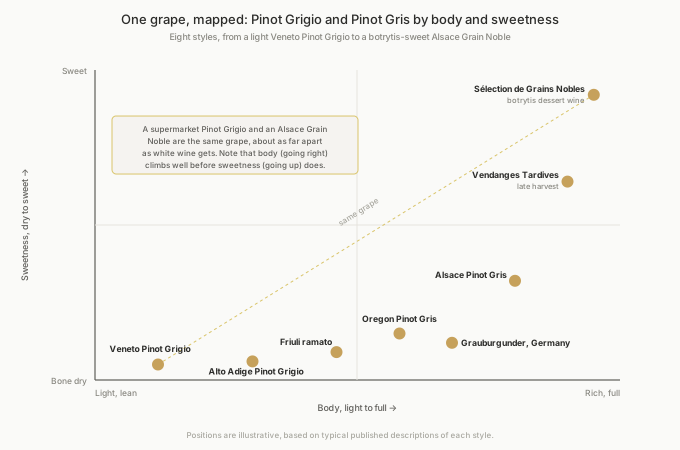
The empty top-left corner is the useful part: you cannot get a light-bodied wine that is also very sweet from this grape, because sweetness here comes from leaving the grapes to hang and concentrate, which builds body at the same time. Everything dry clusters along the bottom, and only Alsace pushes upward into real sweetness.
Ramato: When a White Grape Goes Orange
Here is where those pink skins pay off. Leave the pressed juice of Pinot Grigio in contact with its own skins for a day or two before fermenting — the way you would start a rosé — and the skins tint the wine a pale copper or salmon colour and lend it a light grip of tannin. In Friuli and across the border into Slovenia this is a traditional style with its own name, ramato, from the Italian for “coppered.” It predates the pale industrial style by generations; before stainless steel and the pressure to bottle everything crystal-clear, a good deal of north-eastern Italian Pinot Grigio looked like this.
A ramato tastes like a wine caught between categories: white-wine freshness and citrus underneath, but with notes of white raspberry, dried cranberry, sour cherry and something faintly savoury or leathery, plus a texture closer to a light red than to a crisp white. It is, in effect, an orange wine made from a grape most people file under “inoffensive,” and the modern skin-contact movement has pushed a small revival of the style. Decanter‘s primer on ramato is a good place to read more, and a bottle is worth seeking out if only to see how far one grape can be pushed from its reputation.
Where It Grows
Italy is the giant. It grows well over a third of the world’s Pinot Grigio — more than the United States, Germany and Australia combined — and Italian plantings have multiplied several times over since 1990 as global demand ran ahead of supply. The Veneto and the wider Delle Venezie zone produce the bulk, most of it the light commercial style. Friuli-Venezia Giulia is the quality address for texture and for ramato. Alto Adige, high and cool, makes the most precise and age-worthy Italian examples; its wines are worth paying up for.
Alsace treats Pinot Gris as one of its four noble grapes, alongside Riesling, Gewurztraminer and Muscat, and grants it access to the region’s Grand Cru vineyards. Look for Grand Cru on the label for the serious dry-ish wines, and for Vendanges Tardives (late harvest) or Sélection de Grains Nobles (made from individually selected botrytis-shrivelled berries) for the sweet ones. One quirk of history: Alsace Pinot Gris spent centuries labelled Tokay d’Alsace, a borrowed reference to Hungary’s Tokaj. Hungary objected, the EU agreed, and after a long phase-out the name was banned outright from the 2007 vintage — so older bottles in a cellar may still say “Tokay” where new ones say only Pinot Gris.
Beyond the two heartlands: Germany has more Grauburgunder than France has Pinot Gris, concentrated in Baden and the Pfalz. Oregon is the New World benchmark, with New Zealand not far behind and leaning, whichever name it uses on the label, toward the richer Gris style. Australia splits the difference by spelling: bottles labelled “Grigio” are usually made light and crisp, bottles labelled “Gris” fuller and textured, on the same shelf from the same regions. It is the clearest example anywhere that, with this grape, the name is a style instruction as much as a translation.
Pinot Grigio ABV: What to Expect
Italian Pinot Grigio is one of the lower-alcohol dry whites on the shelf, usually 11.5–13% ABV, and often right at the bottom of that band. The reason is deliberate: the grapes are picked early, before they build much sugar, to lock in acidity and keep the wine crisp, and less sugar going into the fermentation means less alcohol coming out. Alsace Pinot Gris is a different animal, commonly 13.5–15%, because the fruit is left to hang until it is fully ripe and sometimes sugar-rich enough that fermentation stops with a little sweetness left behind. Oregon and German examples land in between, around 13–14%. If a wine says “Pinot Gris” rather than “Pinot Grigio,” expect it to be the bigger drink. Our guide to wine alcohol content by type sets these numbers against other wines.
How to Serve and Age It
Serve the light Italian style properly cold, around 7–10°C (45–50°F) — straight from the fridge is fine — because the cold keeps its acidity snappy and there is little aromatic detail to lose. Give a rich Alsace Pinot Gris or a ramato a little more warmth, around 10–13°C (50–55°F), so its texture and spice open up; twenty minutes out of the fridge does it. A standard white-wine glass suits every version, and none of them need decanting.
On ageing, be realistic. The overwhelming majority of Pinot Grigio — anything light, anything inexpensive, anything sold on freshness — is at its best within two or three years of the vintage and gains nothing from a cellar. The exceptions are specific and worth knowing: top Alto Adige bottlings, serious Friuli, Alsace Grand Cru Pinot Gris, and above all the Vendanges Tardives and Sélection de Grains Nobles sweet wines, which can hold and improve for ten to twenty years, trading fresh fruit for honey, marmalade and toasted nuts. Our guide to which white wines age well goes into what separates a keeper from a drink-now bottle.
Food Pairing
Because the grape comes in so many weights, the reliable move is to match the dish to the style rather than to “Pinot Grigio” as a single idea.
- Light Italian Pinot Grigio — its job is to refresh and cut. Oysters and clams, fried calamari or whitebait, grilled sole or sea bass with lemon, sushi and sashimi, a shaved-fennel or green salad, risotto bianco, fresh goat cheese, and light pasta with olive oil, garlic or seafood. Alto Adige’s mineral versions are especially good with a raw bar.
- Alsace Pinot Gris — rich enough to stand next to meat. Roast pork and pork belly, roast chicken and guinea fowl, choucroute garnie and tarte flambée, smoked fish, and pungent washed-rind cheeses such as Munster. Its ripe fruit and gentle acidity also handle mild to medium spice — Thai green curry, a mild korma, miso-glazed fish — though for serious heat an off-dry Riesling is still the safer call, as our Riesling pairing guide explains.
- Oregon and German Pinot Gris — the versatile middle. Salmon is close to a signature match; our wine with salmon guide covers why the wine’s weight and soft acidity work with an oily fish. Also roast chicken, pork chops, quiche, and creamy soups.
- Ramato — treat it like a light red. Charcuterie and cured ham, roast turkey and duck, mushroom dishes, and hard aged cheeses. It is one of the more useful wines to have open across a mixed table.
Frequently Asked Questions About Pinot Grigio and Pinot Gris
What does Pinot Grigio taste like?
In its common Italian style, Pinot Grigio is light-bodied, bone dry and crisp, with flavours of lemon zest, lime, green apple and under-ripe pear, a faint bitter-almond note on the finish, and sometimes a saline or wet-stone edge in the better examples from Alto Adige and Friuli. It is unoaked and low in alcohol. The lightest, cheapest versions from the Venetian plain can be very neutral, while the same grape labelled Pinot Gris, especially from Alsace, tastes completely different: fuller, richer, and marked by peach, honey, ginger and wood-smoke.
What is the difference between Pinot Grigio and Pinot Gris?
They are the same grape variety — Grigio is Italian for grey, Gris is French for grey — but the two names have come to signal two styles. Pinot Grigio usually means the light, crisp, bone-dry Italian interpretation; Pinot Gris usually means the fuller, richer, sometimes off-dry style associated with Alsace, Oregon and Germany. Producers in the New World often choose the spelling on the label to tell you which style is in the bottle. Our dedicated comparison, Pinot Gris vs Pinot Grigio, goes through the differences in detail.
Is Pinot Grigio a sweet or a dry wine?
Italian Pinot Grigio is almost always fully dry, and its high acidity makes any trace of sugar hard to notice. Alsace Pinot Gris is less predictable: it ranges from dry through distinctly off-dry, often without a clear label indication, and its ripe fruit can give an impression of sweetness even when the sugar is low. The Alsace designations Vendanges Tardives (late harvest) and Sélection de Grains Nobles (botrytis-affected) are genuinely sweet dessert wines. Oregon and New World Pinot Gris is typically dry.
What is ramato or “orange” Pinot Grigio?
Ramato — Italian for “coppered” — is Pinot Grigio made with a day or two of skin contact before fermentation, the way a rosé is started. Because the grape has pinkish-grey skins, that contact stains the wine a pale copper colour and adds a light tannic grip. It is a traditional style in Friuli and neighbouring Slovenia that predates the modern pale style, and it tastes like a cross between a white and a light red, with white raspberry, sour cherry and a savoury, leathery edge. It is effectively an orange wine made from a grape better known for being inoffensive.
How much alcohol is in Pinot Grigio?
Italian Pinot Grigio is usually 11.5–13% ABV and often near the bottom of that range, because the grapes are picked early to preserve acidity and there is less sugar to convert to alcohol. Alsace Pinot Gris is typically 13.5–15% because the fruit is picked much riper. Oregon and German examples generally fall around 13–14%. As a rule of thumb, a bottle labelled “Pinot Gris” will be a stronger drink than one labelled “Pinot Grigio.”
Which foods pair best with Pinot Grigio and Pinot Gris?
Match the food to the style. Light Italian Pinot Grigio suits delicate seafood, oysters, fried fish, sushi, salads, fresh goat cheese and light pasta. Rich Alsace Pinot Gris handles roast pork and chicken, choucroute, smoked fish, washed-rind cheese such as Munster, and mildly spiced dishes. Oregon and German Pinot Gris are the versatile middle and pair especially well with salmon. Ramato behaves like a light red and works with charcuterie, roast poultry and aged cheese.
Pinot Grigio and Pinot Gris earn their place in our wider guide to the major wine grape varieties, which maps how this grape sits alongside the other whites worth knowing. The short version: one grape, one broken colour switch, and about as wide a range of wines as any variety on earth — from a wine designed to disappear to one built to be cellared for twenty years.