In 1986, the New Zealand government was paying farmers to pull up their vines. Meanwhile, a start-up winery in Marlborough called Cloudy Bay had just made its first Sauvignon Blanc, and one of the fastest rises any wine style has ever made was about to begin. Today New Zealand Sauvignon Blanc accounts for about 86% of the country’s wine exports and roughly two-thirds of the vines in the ground. It also smells of passionfruit, grapefruit and cut grass with an intensity almost no other white wine can match, for a reason that surprises most people: the passionfruit isn’t in the grape. This guide covers what actually creates that smell, how the style was born, whether the wine is dry, how it compares with Sancerre and Chardonnay, and why nearly everything about the way it is made comes down to protecting a handful of fragile molecules.
In this article
- 1 New Zealand Sauvignon Blanc at a Glance
- 2 The Passionfruit Isn’t in the Grape
- 3 The Year New Zealand Paid Farmers to Pull Up Its Vines
- 4 Why Marlborough
- 5 Reading a Bottle: The Green-to-Tropical Dial
- 6 Is New Zealand Sauvignon Blanc Dry?
- 7 Screwcaps, Stainless Steel and the Race Against Oxygen
- 8 Against Sancerre and Chardonnay
- 9 What to Eat With It
- 10 Frequently Asked Questions About New Zealand Sauvignon Blanc
- 10.1 Is New Zealand Sauvignon Blanc dry or sweet?
- 10.2 Why does New Zealand Sauvignon Blanc smell like passionfruit?
- 10.3 What is the difference between New Zealand and French Sauvignon Blanc?
- 10.4 Should you age New Zealand Sauvignon Blanc?
- 10.5 What food goes best with New Zealand Sauvignon Blanc?
- 10.6 Which part of New Zealand makes the most Sauvignon Blanc?
New Zealand Sauvignon Blanc at a Glance
- Grape: Sauvignon Blanc, a green-skinned white variety from France and one of the two parents of Cabernet Sauvignon.
- Where it grows: about three-quarters of it in Marlborough, at the top of the South Island, with Hawke’s Bay and Nelson next.
- Smells of: passionfruit, grapefruit, gooseberry and lime, with cut grass, green pepper or tomato leaf on the herbal side.
- Structure: dry, high in acidity, light to medium in body, no tannin, usually 12–13.5% ABV.
- Serve: well chilled, at 7–10°C (45–50°F).
- Drink: young, ideally within two to three years of the vintage.
- Best with: goat cheese, raw and lightly cooked fish, shellfish and anything green and herby.
The Passionfruit Isn’t in the Grape
Crush a ripe Sauvignon Blanc berry and you will not smell passionfruit. The aroma molecules that define the style are not sitting in the fruit waiting to be released. They are built during fermentation, when yeast cuts them free from odourless precursor compounds in the juice. Researchers in Bordeaux identified the key molecules in the 1990s. They belong to a family called thiols, sulfur-containing compounds with astonishingly low detection thresholds.
Three of them do most of the work. 3-mercaptohexyl acetate smells of passionfruit and can be detected at about 4 parts per trillion. 3-mercaptohexanol smells of grapefruit and passionfruit skin, with a threshold of about 60 parts per trillion. 4-mercapto-4-methylpentan-2-one, the tongue-twister, smells of box tree and broom at low levels and, when it piles up, of cat’s pee, the wine trade’s least dignified tasting note and a genuine one. Its threshold is below one part per trillion.
For scale, that is the same parts-per-trillion territory as TCA, the compound behind cork taint. Your nose is a far better chemistry instrument than it has any right to be.
What makes Sauvignon Blanc unusual is how far above those thresholds the wine sits. A survey of commercial Sauvignon Blancs from Australia, New Zealand, France and South Africa, cited in a peer-reviewed paper on measuring thiols in wine, found average 3-mercaptohexanol levels of 1,700 to 7,100 parts per trillion, roughly 30 to 120 times the level at which a nose first notices it. Marlborough wines are known to be especially rich in this compound and its acetate cousin, which is why a poured glass can perfume a whole table.
The green half of the flavour comes from a different family, the methoxypyrazines, which smell of green pepper, tomato leaf and cut grass. Unlike thiols, pyrazines are already in the berry. They peak around véraison, when the grapes begin to ripen, then fall as the fruit ripens and as sunlight reaches the bunches. Cabernet Sauvignon shares them, which is why underripe Cabernet can smell of bell pepper. Sauvignon Blanc is one of its two parents, and our Cabernet Sauvignon guide tells that story.
Hold on to those two families, thiols and pyrazines, because they explain almost everything that follows: where the wine grows, how it is made and why it is best drunk young.
The Year New Zealand Paid Farmers to Pull Up Its Vines
That flavour was not an overnight success. Until the mid-1980s, New Zealand wine was not something anyone abroad was queuing for. The vineyards were heavily planted with Müller-Thurgau, a high-yielding German cross of modest reputation, along with hybrids and other workhorse varieties. A planting boom produced a glut, and by 1986 the government had stepped in with a vine-pull scheme that paid growers to tear vines out. By New Zealand Winegrowers’ figures, the country’s productive vineyard area fell from 5,900 hectares in 1985 to 4,300 hectares in 1986, a drop of 27% in a single year, and did not climb back above 5,900 until 1993.
The twist is that the grape which would replace all of it was already in the ground. Sauvignon Blanc had reached New Zealand in 1969, when Ross Spence of Matua planted the first vines in Waimauku, west of Auckland. Marlborough, a farming district at the top of the South Island that few people thought of as wine country, cottoned on in 1973, when Montana Wines began planting there. A record drought in 1975 killed most of that first planting, and the replacements included Sauvignon Blanc and Pinot Noir. In 1979 Montana picked the first Marlborough Sauvignon Blanc.
Then came Cloudy Bay. In 1983 David Hohnen, the Australian founder of Cape Mentelle in Margaret River, tasted a Marlborough Sauvignon Blanc and was captivated by its intensity. With winemaker Kevin Judd he set up Cloudy Bay, named after the bay Captain Cook named in 1770, and made the first vintage in 1985. The wine was picked up quickly by critics, especially in Britain, and Cloudy Bay is widely credited with putting New Zealand Sauvignon Blanc on the world map.
The vine-pull scheme, meanwhile, had an unintended effect. Many growers used the payments to swap unfashionable varieties for fashionable ones, with Chardonnay and Sauvignon Blanc the main winners, often keeping the old rootstocks. A programme meant to shrink the industry ended up clearing the ground for the grape that would define it.
The chart below shows how that played out. The zoomed panel shows the 1986 collapse at close range; the main chart shows the same years at full scale, alongside Sauvignon Blanc’s share of everything New Zealand grows.
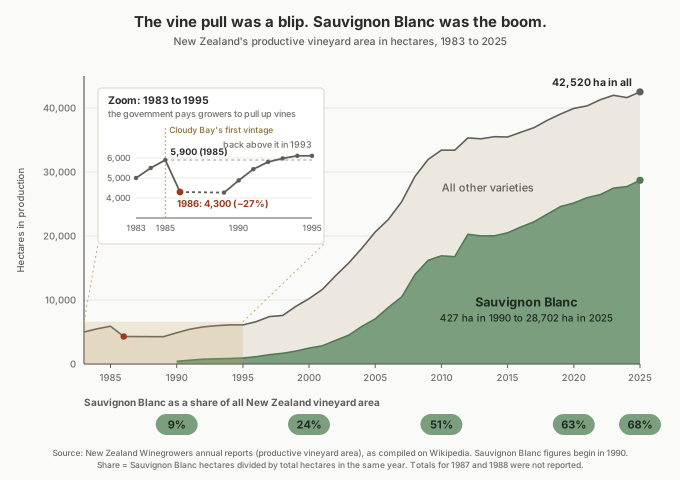
Up close, the vine pull was a real wound: more than a quarter of the country’s productive vines gone in twelve months. Stepping back, it is barely a notch. Sauvignon Blanc went from 427 hectares in 1990 to more than 28,000 today, and from about 9% of New Zealand’s vineyard area to roughly two-thirds. New Zealand Winegrowers now puts Sauvignon Blanc at around 72% of the country’s wine production and 86% of what it exports.
Why Marlborough
Marlborough sits at the north-eastern tip of the South Island, where the Wairau Valley opens onto the sea. It is by far New Zealand’s biggest wine region, producing roughly three-quarters of all the country’s wine. A Māori name for the Wairau area, Kei puta te Wairau, is translated as “the place with the hole in the cloud”, which suits a district that gets around 2,500 hours of sunshine and about 640 mm (25 inches) of rain a year, according to NIWA figures for Blenheim, its main town.
The Richmond Ranges to the north and the Wither Hills to the south shelter the valley from the worst of the weather. Summer afternoons average about 23°C (74°F), but nights fall to around 13°C (55°F), a swing of roughly ten degrees. Sun by day ripens the fruit; cool nights let the vines hold on to acidity and aroma. The soils are mostly free-draining alluvial gravel, and with so little rain, young vines often need irrigation.
Inside Marlborough, three sub-regions give slightly different wines. The Wairau Valley floor around Blenheim, with its deep gravels, tends to produce the ripest, most tropical style. The Southern Valleys climb into the Wither Hills on north-facing slopes of glacial loess. The Awatere Valley, further south and generally cooler, is the youngest of the three and now covers about a third of Marlborough’s planted area.
Reading a Bottle: The Green-to-Tropical Dial
Because the two aroma families pull in opposite directions, every bottle of New Zealand Sauvignon Blanc sits somewhere on a dial that runs from green to tropical. Fruit that is picked earlier, or grown in cooler and shadier conditions, keeps more of its pyrazines and tastes greener. Fruit that is picked riper, with more sun on the bunches, loses them and leaves the thiols in charge. That gives you three broad styles to look for.
- Greener and more herbal: cut grass, gooseberry, lime, green pepper and pea shoot. Cooler sub-regions such as the Awatere Valley tend to lean this way, and the wines often feel sharper and more savoury.
- Riper and more tropical: passionfruit, grapefruit and ripe pear, with a more generous, juicy mid-palate. This is the classic sunny-valley-floor style and the one most people picture.
- Rounder and richer: where winemakers leave the wine on its yeast lees, ferment with wild yeast or use a little oak, the result is creamier and less shouty. New Zealand Winegrowers notes that oaked versions offer richer, creamier alternatives that resemble Chardonnay.
One honest caveat: these are tendencies, not rules. Plenty of Marlborough Sauvignon Blanc is blended from several sites, so a bottle labelled simply “Marlborough” can land anywhere on the dial. If one bottle strikes you as too grassy or too loud, try a different point on the dial before writing off the grape.
Is New Zealand Sauvignon Blanc Dry?
Yes. New Zealand Sauvignon Blanc is almost always dry, meaning nearly all the grape sugar has been fermented out. Our guide to what dry wine means puts the line at roughly 4 grams of residual sugar per litre. A typical Marlborough bottle carries only a gram or two, which is normal for a wine this high in acidity and too little to register as sweetness.
So why can a glass that smells of passionfruit and ripe pear seem sweet? Because fruity smells make the brain expect sugar. Much of what you experience as flavour is aroma travelling from the back of your mouth up to your nose, and tropical-fruit aromas set up an expectation of sweetness that the bone-dry palate then declines to meet.
If you want a sweet wine made partly from this grape, look to Sauternes and Barsac in Bordeaux, where Sauvignon Blanc is usually the junior partner to Sémillon, rather than to New Zealand. Alcohol in New Zealand Sauvignon Blanc usually lands between about 12% and 13.5% ABV, which is moderate for a wine this intense.
Screwcaps, Stainless Steel and the Race Against Oxygen
Thiols are fragile. They are prone to oxidation, so almost everything about the New Zealand style is built around keeping oxygen away from the wine. The juice is handled carefully, fermented and stored in stainless steel rather than oak (New Zealand Winegrowers says that is the general rule), and the finished wine is sealed under a screwcap.
New Zealand embraced screwcaps early and wholeheartedly, and a wine whose whole appeal is fresh, oxygen-sensitive aroma was the obvious one to lead the way. Nearly all New Zealand wine is now sealed that way. The story of how that happened, and what cork taint has to do with it, is in our guide to wine faults, along with the same sulfur chemistry in a less flattering guise: the rotten-egg whiff of reduction that sometimes greets you when a tightly sealed white is opened, and that a swirl usually blows off.
Does the screwcap actually matter? A 2005 study followed the same Sauvignon Blanc sealed under screwcap and cork for two years. The cork-sealed bottles ended up with 18–23% less of the fruity thiols, possibly because the cork itself absorbed some, and passion-fruit descriptors tracked the thiol levels. But a tasting panel could not readily tell the closures apart. The screwcap is a sensible precaution, not magic.
Two practical rules follow. First, drink it young. Thiols fade with time, and a Sauvignon Blanc that smells wonderful at one year can taste flat and slightly oxidised at five, which is why our guide to which white wines age well puts it firmly in the drink-soon group; two to three years from the vintage is the sweet spot. Second, serve it cold, around 7–10°C (45–50°F), so the aromas stay tight and the acidity stays crisp. Our serving temperature guide covers the rest.
Against Sancerre and Chardonnay
The obvious comparison is Sancerre, the Loire Valley’s benchmark Sauvignon Blanc: the same grape, grown on limestone and flint in a cooler climate. The wines are quieter and more mineral, with citrus, green herbs and sometimes a smoky, gunflint edge where New Zealand offers tropical fruit. Pouilly-Fumé, Sancerre’s neighbour, is similar in weight but often a little softer and richer. Neither is better. Marlborough is a loud, generous voice and the Loire a precise, restrained one, and the difference is a lesson in how much a place can change a grape.
The other question people ask is how it compares with Chardonnay, the other white on every wine list.
- Acidity: Sauvignon Blanc is high and sharp; Chardonnay is usually medium to high and softer in character.
- Body: Sauvignon Blanc is light to medium; Chardonnay runs from medium to full.
- Oak: Sauvignon Blanc is usually unoaked; Chardonnay is often fermented or aged in barrel.
- Aroma: passionfruit, grapefruit and cut grass against apple, lemon and peach, with butter and vanilla when oak is involved.
- Temperature: Sauvignon Blanc likes to be properly cold; an oaked Chardonnay tastes better a few degrees warmer.
In short, choose Sauvignon Blanc for zest and aromatic punch and Chardonnay for texture and richness. The line can blur: a lees-aged or oaked Sauvignon Blanc can taste closer to Chardonnay than to a typical Marlborough bottle. Our Chardonnay guide covers the full range, from flinty Chablis to buttery Napa.
What to Eat With It
The principle is simple: match the wine’s green, zesty energy with food that has some of its own.
- Goat cheese. The classic partner. The wine’s acidity matches the tang of fresh chèvre, and while Sancerre is the traditional choice, Marlborough works beautifully too. See our goat cheese and wine pairing guide.
- Raw and lightly cooked fish. Ceviche, sashimi, or a simple salmon fillet with lemon and capers, as covered in our wine with salmon guide.
- Shellfish. Oysters with a splash of mignonette, crab and mussels.
- Herbs and green vegetables. Pesto, dill, coriander and mint; asparagus, peas, courgettes and green beans, which echo the wine’s green side rather than fight it. Herby Thai and Vietnamese dishes work too.
- What to avoid. Very rich or sweet dishes, and chilli heat: a bone-dry Sauvignon Blanc copes with spice less well than an off-dry Riesling.
Frequently Asked Questions About New Zealand Sauvignon Blanc
Is New Zealand Sauvignon Blanc dry or sweet?
It is dry. Most bottles carry only a gram or two of residual sugar per litre, well under the roughly 4 g/L usually treated as the limit for a dry wine. The tropical, passionfruit-and-grapefruit aromas can suggest sweetness, but that is your nose expecting sugar that isn’t there. High acidity keeps the wine tasting crisp and refreshing.
Why does New Zealand Sauvignon Blanc smell like passionfruit?
Because of sulfur-containing aroma molecules called thiols, mainly 3-mercaptohexyl acetate, which smells of passionfruit, and 3-mercaptohexanol, which smells of grapefruit. They are not in the grape itself. Yeast releases them from odourless precursor compounds during fermentation, and they are detectable at just parts per trillion. A related molecule, 4-mercapto-4-methylpentan-2-one, is responsible for the box-tree note and, at high levels, the famous cat’s-pee character.
What is the difference between New Zealand and French Sauvignon Blanc?
Same grape, different place and style. French Sauvignon Blanc from the Loire Valley, such as Sancerre and Pouilly-Fumé, grows on limestone and flint in a cooler climate and tends to be more restrained: citrus, green herbs, chalky minerality and sometimes a smoky note. Marlborough’s sunnier, drier climate and gravel soils produce louder wines with more passionfruit and grapefruit, usually fermented in stainless steel and sealed under screwcap. In Bordeaux, Sauvignon Blanc is often blended with Sémillon and may be aged in oak, which makes it richer again.
Should you age New Zealand Sauvignon Blanc?
Generally no. The fresh thiol aromas that define the style fade with time, and most bottles are at their best within two to three years of the vintage. A Sauvignon Blanc that smells vibrant at one year can taste flat and slightly oxidised by five. The rare exceptions are a few oaked, lees-aged or top-tier bottles built for keeping. Serve it well chilled, at around 7–10°C (45–50°F).
What food goes best with New Zealand Sauvignon Blanc?
Anything fresh, green or tangy. Goat cheese is the classic partner, and the wine is excellent with ceviche, sashimi, oysters and salmon with lemon and capers. It also suits herb-driven dishes such as pesto and Thai or Vietnamese food, and green vegetables like asparagus, peas and courgettes. Avoid very rich or sweet dishes, and be cautious with chilli heat, which an off-dry Riesling handles better.
Which part of New Zealand makes the most Sauvignon Blanc?
Marlborough, at the top of the South Island. According to New Zealand Winegrowers, about three-quarters of the country’s Sauvignon Blanc is planted there, with Hawke’s Bay and Nelson next. Within Marlborough the main sub-regions are the Wairau Valley, the Southern Valleys and the cooler Awatere Valley, each giving a slightly different balance of tropical and herbal character.