
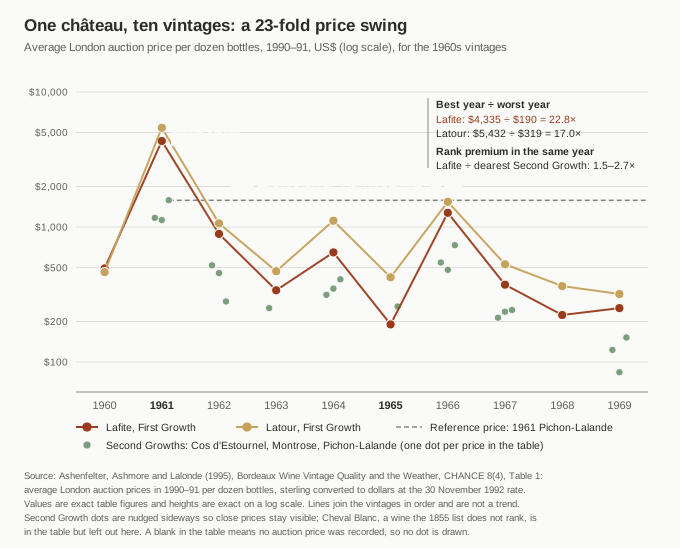
In 1990 and 1991, a dozen bottles of 1961 Château Lafite sold at London auction for an average of $4,335. A dozen of the 1965 sold for $190. Same château, same First Growth rank, same decade, and a price gap of about 23 to 1. Bordeaux vintages are the reason, and this guide explains how they work: how the weather writes a vintage, what a First Growth rank does and does not tell you, where vintage charts break down, and how to use a year on a label without being ruled by it. The organising idea is that every bottle from a classified château carries two rankings. One was fixed in 1855, by price, and its top tier has changed only once. The other is reset every autumn by the weather, and in the numbers below it moves prices far more: a 1961 Pichon-Lalande, a Second Growth, cost more than 18 of the 20 Lafite and Latour prices from the same decade, and only the 1961 Lafite and Latour cost more.
In this article
- 1 The Short Version
- 2 Two Rankings on One Label: 1855 and the Year
- 3 What Auction Prices Say About Bordeaux Vintages
- 4 How the Weather Writes Bordeaux Vintages
- 5 Left Bank, Right Bank: One Year, Two Results
- 6 How Far to Trust a Vintage Chart
- 7 Is the Weather Recipe Changing?
- 8 How to Use Bordeaux Vintages When You Buy and Drink
- 9 Vintages and First Growths: Your Questions Answered
- 9.1 What is a vintage in Bordeaux?
- 9.2 What makes a good Bordeaux vintage?
- 9.3 Which Bordeaux vintages are considered great?
- 9.4 What are the five First Growths of Bordeaux?
- 9.5 Can the weather predict the quality of a Bordeaux vintage?
- 9.6 Is a First Growth from a weak year better than a Second Growth from a great one?
The Short Version
- A vintage is the year the grapes were picked. It records one growing season’s weather, not the age of the bottle.
- A First Growth is one of five châteaux ranked top in 1855: Lafite Rothschild, Latour, Margaux, Haut-Brion and Mouton Rothschild. The brokers who drew up the list went by reputation and price.
- The weather explains most of the gap between vintages. In the 1995 study behind this guide, three weather measures lifted the share of vintage-price variation explained from 21% to 83%.
- The year can outweigh the rank. In 1990–91 London auction prices, one château’s best 1960s vintage cost about 23 times its worst.
- Charts are blunt. The same equation misses a typical vintage’s price by about a third, and Bordeaux’s two banks can have different years.
- Use the year to judge timing and value, not to rule bottles in or out.
Two Rankings on One Label: 1855 and the Year
A Bordeaux label gives you two pieces of information that are easy to run together. The château name tells you who made the wine. The year tells you which growing season it came from. Their histories could hardly differ more: the château’s rank was settled in 1855 and has barely moved, while the year’s rank is settled by the weather and is different every time.
The 1855 ranking began with Napoleon III, who wanted a classification of Bordeaux’s best wines for visitors to that year’s Exposition Universelle in Paris. According to Wikipedia, brokers from the wine trade ranked the wines by each château’s reputation and trading price. The authors of the price study used below make the same point, citing Edmund Penning-Rowsell’s classic The Wines of Bordeaux (1985): the 1855 classification was based on price alone. Our Bordeaux vs Burgundy guide tells the 1855 story in more detail. What matters here is how short the top tier is. Five châteaux are First Growths (premiers crus in French):
- Château Lafite Rothschild, in Pauillac
- Château Latour, in Pauillac
- Château Margaux, in Margaux
- Château Haut-Brion, in Pessac, in Graves: the only red wine on the 1855 list from outside the Médoc
- Château Mouton Rothschild, in Pauillac: promoted from Second Growth to First Growth in 1973, after decades of lobbying by Philippe de Rothschild
Two things follow from that history. First, the rank belongs to the château name, not to a fixed patch of ground: Wikipedia notes that the vineyards of some classified estates have expanded, shrunk and been divided without any reclassification. Second, the rank says nothing about any one year. For that you need the other number on the label. Our guide to French wine labels shows how a Bordeaux label is laid out, with the château name in the largest type.
What Auction Prices Say About Bordeaux Vintages
In 1995, Orley Ashenfelter, David Ashmore and Robert Lalonde published a paper in the magazine Chance that contains a small table which makes the point better than any argument. It lists average London auction prices in 1990–91 for six Bordeaux châteaux across the ten vintages of the 1960s, by then fully mature. Prices are per dozen bottles, in US dollars, with sterling converted at the exchange rate of 30 November 1992. The authors chose large producers whose wines turned up often at auction. Two are First Growths, Lafite and Latour. Three are Second Growths: Cos d’Estournel, Montrose and Pichon-Lalande, short for Pichon Longueville Comtesse de Lalande. The sixth, Cheval Blanc, was not ranked in 1855, the paper notes, so the chart below leaves it out.
Start with a single château. A dozen 1961 Lafites averaged $4,335. A dozen 1965s averaged $190, a ratio of 22.8 to 1. Latour’s range was nearly as wide: $5,432 for the 1961 against $319 for the 1969, 17 to 1. Now compare ranks. In the five vintages where the table has all six prices (1961, 1962, 1964, 1966 and 1967), Lafite cost between 1.5 and 2.7 times as much as the dearest of the three Second Growths in the same year. The swing between Lafite’s best and worst vintages was more than eight times the biggest premium that the First Growth rank bought in any of those five years.
The sharpest comparison runs across years. The 1961 Pichon-Lalande, a Second Growth, averaged $1,579 a dozen. That was more than 18 of the 20 Lafite and Latour prices in the table, and only the 1961 Lafite and Latour cost more. A dozen 1965 Lafites cost about an eighth of that. A First Growth from a poor year was cheaper than a Second Growth from a great one. In 1965 the order even flipped within a single year: Pichon-Lalande averaged $258 a dozen to Lafite’s $190.
Three cautions. The dollars are a snapshot from 1990–91, not today’s prices, so read the pattern rather than the amounts. Six châteaux is a small sample. And price is not taste. But price is the fair yardstick here, because price is how the 1855 brokers built the ranking in the first place, and two cross-checks suggest the table is picking up real differences between years. The authors’ benchmark vintages, 1961, 1962, 1964 and 1966, were chosen because the weather data said they should be good, and all four fetched more than $600 a dozen at both First Growths. Sebastian Payne MW, the former chief wine buyer at The Wine Society, writes in Decanter about the runs of dire weather that growers once had to endure, and names 1960, 1963 and 1965 among them. All three sit under $500 at both First Growths.
How the Weather Writes Bordeaux Vintages
If the year matters this much, what decides it? The 1995 paper tested the obvious suspect. It took the vintages from 1952 to 1980, leaving out 1954 and 1956, which are now rarely sold, and compared each vintage’s price with the age of the wine and with three weather measures. Age alone explained about 21% of the variation in vintage prices. Add the weather and the figure rises to 83%. The three measures were:
- Warmth from April to September. Each extra degree Celsius in the growing season’s average temperature raised the predicted price of a vintage by about 85%.
- Rain in August and September. Each extra 100 mm cut the predicted price by about 32%.
- Rain from October to March. A wetter winter before the vintage added about 12% for each extra 100 mm.
In the authors’ words, “Great vintages for Bordeaux wines correspond to the years in which August and September are dry, the growing season is warm, and the previous winter has been wet.” These are fitted coefficients, not laws, and each holds the other two measures fixed, so read them as the direction and rough size of an effect. The paper does not label units in its table; its chart axes, 14.5 to 19.0 for summer temperature and up to 350 for harvest rain, fit degrees Celsius and millimetres, which is how this guide reads them.
The best test case is 1961. The paper calls it the vintage with the lowest August–September rainfall in Bordeaux history, and in the price data above it is the dearest vintage for both First Growths. The weather was extreme in the direction the equation rewards, and the market paid for it.
The equation tells you what matters but not why. For the why, Payne’s Decanter article sets out the five conditions that the late Denis Dubourdieu, professor of oenology at the University of Bordeaux, said make a perfect vintage for red Bordeaux. Read them as a calendar:
- Conditions one and two, flowering: early, rapid flowering and fruit-set in weather warm and dry enough to ensure pollination, which sets up the grapes to ripen together.
- Condition three, July: a warm, dry month that brings water stress on gradually, slowing vine growth and then stopping it at véraison, when the grapes change colour.
- Condition four, August and September: dry, warm weather, but not excessively warm, so that every grape variety ripens fully.
- Condition five, harvest: fine, dry, medium-warm weather, so growers can pick at full ripeness without dilution or rot.
Payne says 2005 and 2015 ticked all five boxes, and that 2010 came close. Slightly cool, wet weather in June caused coulure (grapes missing from the bunch after poor flowering) and millerandage (berries of uneven size that ripen unevenly) in the Merlot, and yields were low, but summer and autumn were dry and not too hot. If vintage is a new idea to you, our guide to what a vintage is covers the basics, including why the year on the label is the harvest year, not the bottling year.
Left Bank, Right Bank: One Year, Two Results
One weather report cannot cover a whole region. Bordeaux is large, and Payne points out that it can rain heavily in one area and not in another. The grapes matter too, because Merlot normally ripens earlier than Cabernet, so a year can suit one and not the other. His examples: 1964, 1975 and 1998 were great years for Right Bank Merlot and less good for the Médoc, while the Médoc won in 1996 and 2002. A truly good vintage, he says, “occurs when all grapes ripen to perfection, even in less favourable districts.”
It also helps explain why Bordeaux blends: grapes that ripen on different schedules cushion a difficult year. Our Cabernet Sauvignon guide explains why Bordeaux growers turned to earlier-ripening Merlot after the mildew outbreak of 1852, and our Merlot guide covers the Right Bank’s Saint-Émilion and Pomerol. A vintage chart that gives Bordeaux one score for the year is averaging two stories.
How Far to Trust a Vintage Chart
Weather formulas make some wine writers angry, and the 1995 paper reprints the reaction. Its authors quote Robert Parker calling the approach “a Neanderthal way of looking at wine”, Britain’s Wine magazine saying the formula’s “self-evident silliness invited disrespect”, and The Wine Spectator objecting that its predictions “come exactly true only 3 times in the 27 vintages since 1961”, even though the formula was specifically designed to fit price data that already existed.
Both sides have a point. The fit is real: the weather lifts the explained share of vintage-price variation from 21% to 83%. But the typical miss, the root mean squared error in the paper’s Table 2, is 0.287 on the log scale, which works out at roughly a third of the price either way. And the equation was fitted to the same 27 vintages it describes, which flatters any formula. A rule that separates good years from poor ones is not a price list.
The authors also tested it in public. In 1986, they said, the weather pointed to an average year and a considerably lower price than the other vintages of the decade, yet the vintage was launched with great fanfare as one of the two finest of the decade and sold at similar, and sometimes higher, prices to early buyers. They expected its price to drift down relative to the other 1980s vintages; this guide has not checked how that turned out. In 1972, the 1962 and 1964 vintages, which the weather rated well above the 1967 and 1969, fetched nearly identical prices to them. By about 1979 the 1967s and 1969s had fallen to roughly what the weather would have predicted. Ashenfelter’s 2008 paper in The Economic Journal repeats the case, and adds that the weather equation implies far greater variability in early, en primeur prices than is actually observed.
The weather is not the whole story either, and the 2010 vintage shows why. It did not meet Dubourdieu’s conditions, yet the blind-tasting group that Payne belongs to, which meets each January to taste the crus classés and their equivalents, ranked 2010 first of the 16 vintages from 2000 to 2015, ahead of 2009 and 2005 in joint second. The uneven fruit-set of that year, Payne writes, “required a great deal of care in the vineyards, highlighting the inadequacy of vintage charts, and proving that the people factor can be more important than the weather.”
Crop size muddies the comparison too. Payne notes that 1982 and 1990 were large crops, and that several famous names made up to twice as much grand vin as they do today. In 1990 Bruno Prats wanted a limit of 9 tonnes per hectare on yields for St-Estèphe; in 2018, Payne writes, a classed growth might declare 4 to 4.5. And a famous year can flatter itself: “A vintage’s reputation reflects the price, but not the quality, of all its wines.”
So a vintage chart is good at direction and weak at detail. It can tell you that a year was warm and dry, or cool and wet, and that the market has noticed. It cannot tell you which of a thousand châteaux made the wine you are holding, or what the people in the vineyard did on the morning of the harvest.
Is the Weather Recipe Changing?
The 1995 paper noticed something odd in its own charts. Of the vintages from 1981 to 1992, all but 1986 came from a growing season warmer than what is historically “normal”, and the authors added: “It is no accident that many Europeans believe global warming may already be here!”
Payne’s view, in Decanter, is that the hit rate of good or decent years has been high in the past two decades, compared with the very uneven record of the 1960s and 1970s. In Bordeaux, which historically lay towards the northern limit for ripening Merlot and Cabernet Sauvignon, he says climate change has been largely beneficial. Growers have not faced a run of dire years like 1956 to 1958, or 1960, 1963 and 1965, and leading châteaux are richer and better equipped to cope when the weather turns.
The risks are different now. Payne cites summer heat spikes above 36°C for days, most memorably in 2003, when the nights brought no relief either, and more frequent hailstorms. The equation’s warmth term is a straight line fitted to vintages from 1952 to 1980, and the authors themselves worried about stretching it: they asked whether it is appropriate to predict outstanding quality for 1989 and 1990 when the temperature that produced them was “so far outside the normal range”. A recipe that rewarded warmth while Bordeaux sat near the cool edge of ripening may not keep rewarding it once heat spikes arrive.
How to Use Bordeaux Vintages When You Buy and Drink
If you came for a list of the best Bordeaux vintages, Payne’s verdicts are in the questions below, with the warning that any list is one panel’s view. Here is a method instead. Put together, the evidence suggests using a vintage chart for timing and for value, not as a veto.
- Match the year to your patience. The 1995 paper notes that wines from the best vineyards are astringent when young and lose their astringency as they age. Our tannin guide explains what happens in the bottle. Payne says age has proved 1949, 1953, 1959, 1961 and 1982 to be great claret vintages, and that 2000 and 2005 were still to show their full potential when he wrote.
- Look for the off-year bargain. The paper says the 1973 vintage, of somewhat above-average quality, has always sold at relatively low prices, and that insiders know the wines are often bargains. Payne’s pleasure as a buyer was finding lovely wines in less-heralded years, and one of his examples is Ducru-Beaucaillou 2003, a Saint-Julien Second Growth from the year of the great heat spike.
- Check which bank the chart is talking about. A year that suits Merlot may not suit Cabernet, so look for separate verdicts on the Left Bank and the Right Bank.
- Do not let the rank cover a weak year. In the 1990–91 table a dozen 1965 Lafites cost about an eighth of a dozen 1961 Pichon-Lalandes. A First Growth label from a poor year is still a poor year, and in the five vintages with complete prices the premium for the label was only 1.5 to 2.7 times.
- Keep and serve old bottles properly. A wine meant to age needs a steady cellar, and our guide to storing wine at home gives 10–15°C as the ideal range. Serious reds of ten years or more usually throw sediment, so read our decanting guide before you pull the cork.
In short, let the château tell you the style, the year tell you the timing and the bank tell you the grape.
Vintages and First Growths: Your Questions Answered
What is a vintage in Bordeaux?
A vintage is the year the grapes were harvested, which is the year printed on the label. It is not the year the wine was bottled or released. Because Bordeaux weather changes from year to year, the vintage tells you about one growing season: how warm it was, how much rain fell in winter and at harvest, and whether the grapes ripened evenly.
What makes a good Bordeaux vintage?
In a 1995 study of 27 vintages, three weather measures best explained vintage prices: a warm growing season, a dry August and September, and a wet winter beforehand. Denis Dubourdieu’s fuller list adds early, even flowering, a warm dry July that stresses the vines gently, and a dry, medium-warm harvest. Decanter reports that 2005 and 2015 met all five of his conditions.
Which Bordeaux vintages are considered great?
Decanter’s Sebastian Payne MW says age has proved 1949, 1953, 1959, 1961 and 1982 to be great claret vintages, and that 2000 and 2005 had yet to show their full potential. A blind-tasting group he belongs to ranked the 16 vintages from 2000 to 2015 with 2010 first, 2009 and 2005 tied for second and 2013 last. Treat any list as one panel’s view, and check the Left Bank and the Right Bank separately.
What are the five First Growths of Bordeaux?
Lafite Rothschild, Latour and Mouton Rothschild in Pauillac, Margaux in Margaux, and Haut-Brion in Pessac, in Graves. They head the 1855 classification, which brokers drew up from each château’s reputation and trading price. The First Growth tier has changed once: Mouton Rothschild was promoted from Second Growth in 1973.
Can the weather predict the quality of a Bordeaux vintage?
Partly. In the 1995 study, three weather measures raised the share of vintage-price variation explained from 21% to 83%, yet the typical miss was still about a third of the price, and The Wine Spectator noted exact matches in only 3 of 27 vintages. Use the weather as a guide to the character of a year, not as a price list or a verdict on any one château.
Is a First Growth from a weak year better than a Second Growth from a great one?
Not by the market’s measure. In 1990–91 London auction prices for 1960s vintages, a dozen bottles of 1961 Pichon-Lalande, a Second Growth, averaged $1,579, more than 18 of the 20 Lafite and Latour prices in the same table. Price is not the same as taste, but price is how the 1855 ranking was made, and it shows how much the year can outweigh the château.