
The Champagne region is home to more than 360 producers, but a relatively small group of historic houses — known as Maisons, or by the older collective term Grand Marques — account for around 90% of all Champagne sold worldwide. These are not interchangeable luxury brands; each developed a distinct house style over one or more centuries, shaped by family history, grape preferences, vineyard holdings, and winemaking philosophy. Knowing the difference between a Bollinger and a Taittinger, or a Veuve Clicquot and a Ruinart, is the single most useful piece of knowledge for choosing a bottle that actually matches the occasion and your taste, rather than picking on name recognition alone.
In this article
- 1 Houses vs Growers: The Two Worlds of Champagne
- 2 The Grand Marques: 24 Historic Houses
- 3 The Oldest Houses: Where Champagne’s Modern History Begins
- 4 The Grandes Dames: Houses Built by Pioneering Women
- 5 The Prestige and Connoisseur Houses
- 6 Choosing a House Based on Your Taste
- 7 Frequently Asked Questions
Houses vs Growers: The Two Worlds of Champagne
Before exploring individual houses, it helps to understand the two fundamentally different models of Champagne production. Houses (Maisons) are large, established producers that buy the majority of their grapes from independent growers across the region, blending fruit from many different vineyards and villages to achieve a consistent house style year after year. This is the traditional and still dominant model — Moët & Chandon alone produces around 20 million bottles annually.
Grower Champagne (Champagne de Vignerons, often marked “RM” for Récoltant-Manipulant on the label) comes from small, independent producers who grow their own grapes and make their own wine, rather than selling fruit to the big houses. These wines have become fashionable among sommeliers and enthusiasts for their individuality and direct expression of a specific vineyard or village, in contrast to the consistent, blended house styles of the Maisons. Both approaches produce excellent wine; the choice is about style, not quality hierarchy.
The Grand Marques: 24 Historic Houses
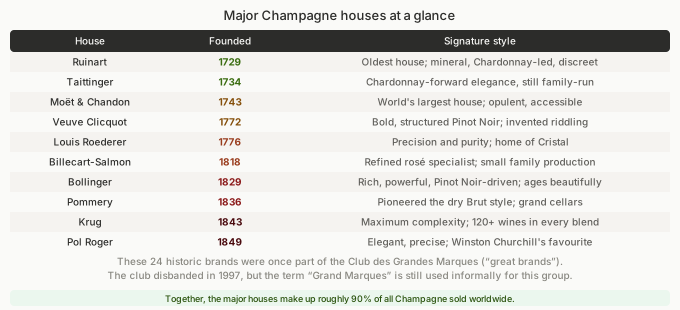
Twenty-four major Champagne brands are historically known as the Grand Marques — “great” or “famous” brands — a designation that traces back to an official trade association, the Club des Grandes Marques. The club itself disbanded in 1997, but the term is still used informally to describe this group of historic, large-scale producers, distinguishing them from both newer commercial brands and small grower-producers.
The Oldest Houses: Where Champagne’s Modern History Begins
Ruinart — Founded 1729
Ruinart is the oldest established Champagne house, founded by Nicolas Ruinart in 1729 — just decades after still wine from the region first began showing the unwanted bubbles that would eventually define it. The house began in the linen trade; bottles of Champagne given as goodwill gestures to clients gradually became the primary business. Now part of the LVMH group, Ruinart has always positioned itself as the more discreet, gastronomic choice among the grand houses — mineral-driven, Chardonnay-led, and aimed at fine restaurants and serious collectors rather than mass-market visibility. Its Blanc de Blancs is considered one of the purest expressions of Chardonnay in all of Champagne.
Taittinger — Founded 1734
Founded as Maison Fourneaux in 1734, the house took the Taittinger name after Pierre Taittinger purchased it in 1932. Still family-run today under Pierre’s great-grandchildren, Taittinger is known for an unusually high proportion of Chardonnay in its blends, producing wines of notable finesse and elegance compared to the fuller, Pinot Noir-driven style of several rival houses. The cellars sit beneath the ruins of a 13th-century abbey, where monks made wine centuries before the house existed. Its prestige cuvee, Comtes de Champagne, is a 100% Chardonnay Blanc de Blancs from Grand Cru vineyards and one of the most celebrated wines of its style in the entire region.
Moët & Chandon — Founded 1743
Founded by wine merchant Claude Moët, joined later by son-in-law Pierre-Gabriel Chandon, Moët & Chandon is the world’s largest and most widely recognised Champagne producer, part of the LVMH group. Its accessibility and consistency have made it the default Champagne for countless celebrations globally, and its Avenue de Champagne headquarters in Epernay is one of the most visited wine tourism destinations in France. Moët also owns and produces the famous prestige cuvee Dom Pérignon, named after the Benedictine monk credited with refining the méthode champenoise, though sold as a separate, standalone luxury brand rather than under the Moët name.
The Grandes Dames: Houses Built by Pioneering Women
Several of Champagne’s most important houses owe their survival and success to widowed women who took over the business after their husbands’ deaths — a remarkable pattern in 19th-century French commerce that shaped the entire industry.
Veuve Clicquot — Founded 1772
Founded by Philippe Clicquot in 1772, the house owes its name and its legend to Barbe-Nicole Ponsardin, the “Veuve” (widow) Clicquot, who took control after her husband’s death in 1805 at just 27 years old. Madame Clicquot is credited with inventing the riddling table (a technique still used today to clarify sediment from the bottle) and with developing the recipe for the first known rosé Champagne made by blending in red wine rather than brief skin contact. Veuve Clicquot’s style is bold and structured, with a Pinot Noir-forward backbone that gives its wines real presence. The house’s prestige cuvee, La Grande Dame, is named in her honour.
Pommery — Founded 1836
A near-identical story: founded in 1836, the house was left to Madame Pommery after her husband’s death just two years later. She built the house into a major success, including its extraordinary cellars, and is credited with pioneering the dry Brut style at a time when most Champagne was considerably sweeter — a stylistic shift that eventually became the international standard. Pommery’s cellars today are famous for housing contemporary art installations alongside millions of ageing bottles.
The Prestige and Connoisseur Houses
Louis Roederer — Founded 1776
Still independently family-owned, Louis Roederer is best known for Cristal, created in 1876 specifically for Tsar Alexander II of Russia and now one of the most collectible and widely imitated prestige cuvees in the world. The house controls a significant proportion of its own Grand Cru and Premier Cru vineyards (an unusual degree of self-sufficiency for a house of its size), which gives it precise control over fruit quality. The overall style across the range emphasises purity and longevity over immediate power.
Bollinger — Founded 1829
One of the few remaining genuinely independent major houses, family-owned since its founding. Bollinger is known for a rich, full-bodied, distinctly Pinot Noir-driven style with real ageing potential — a deliberate contrast to the lighter, more Chardonnay-forward styles of several rivals. Its flagship NV, Special Cuvee, is aged around three years (double the legal minimum) and has become culturally associated with James Bond, appearing in numerous films. Bollinger maintains its own cooperage, making oak barrels by hand for part of its production — a rarity in modern Champagne.
Krug — Founded 1843
Krug is widely regarded as the most uncompromising and complex of the prestige houses. Its flagship NV, Grande Cuvee, blends well over 120 individual base wines from ten or more vintages — a degree of complexity unmatched by any other NV Champagne. Every Krug bottle carries a unique ID code linking it to a public database detailing the exact blend, an unusually transparent practice for the historically secretive Champagne trade. Clos du Mesnil and Clos d’Ambonnay, Krug’s rare single-vineyard wines, are among the most expensive and sought-after Champagnes produced anywhere.
Pol Roger — Founded 1849
A relatively recent house by Champagne standards, but one with an outsized cultural reputation, largely thanks to Sir Winston Churchill, who became devoted to Pol Roger’s wines and is said to have named one of his racehorses after the house. Still family-owned, Pol Roger is known for elegant, precise, beautifully balanced wines across its range, and its prestige cuvee is named Cuvee Sir Winston Churchill in his honour.
Billecart-Salmon — Founded 1818
Founded when Nicolas François Billecart married Elisabeth Salmon, and family-run for seven generations since. Billecart-Salmon produces only around 2 million bottles a year (a fraction of the major houses’ output), which has made it a perennial favourite among sommeliers seeking quality and individuality over scale. The house is particularly celebrated for its rosé, considered by many critics among the most refined and elegant in all of Champagne.
Choosing a House Based on Your Taste
- Want bold and structured? Veuve Clicquot or Bollinger — both Pinot Noir-driven, powerful, and built to make a statement.
- Want elegant and Chardonnay-forward? Taittinger or Ruinart — finesse and precision over raw power.
- Want maximum complexity, regardless of cost? Krug — the most layered, ambitious NV blend produced anywhere in the region.
- Want refined rosé? Billecart-Salmon — the connoisseur’s choice for pink Champagne.
- Want consistency and wide availability? Moët & Chandon — the house most likely to deliver a familiar, reliable experience anywhere in the world.
- Want value with real pedigree? Pol Roger or Pommery — historic houses producing genuinely excellent wine without the absolute top-tier pricing of Krug or Cristal.
For a deeper look at how non-vintage Champagne is actually made — the blending of base wines and reserve wines that defines each house’s style — see our guide to non-vintage Champagne. For how Champagne compares to Prosecco and Cava, our Prosecco vs Champagne vs Cava guide covers the full picture.
Frequently Asked Questions
What are the major Champagne houses of France?
The most widely recognised major Champagne houses include Moët & Chandon, Veuve Clicquot, Ruinart, Taittinger, Louis Roederer, Bollinger, Krug, Pol Roger, Pommery, Billecart-Salmon, Perrier-Jouët, Laurent-Perrier, Piper-Heidsieck, Charles Heidsieck, and Lanson. Twenty-four major historic brands are collectively known as the Grand Marques, a designation tracing back to an official trade association (the Club des Grandes Marques) that disbanded in 1997. Together, these established houses account for roughly 90% of all Champagne sold worldwide, with the remainder coming from smaller independent grower-producers.
What is the oldest Champagne house?
Ruinart, founded by Nicolas Ruinart in 1729, is the oldest established Champagne house. It was followed by Taittinger (founded as Maison Fourneaux in 1734), Moët (1743), and Lanson (1760). Ruinart began in the linen trade, with bottles of Champagne initially given to clients as goodwill gestures before becoming the house’s primary business. Today Ruinart is part of the LVMH group and maintains a reputation as one of the more discreet, gastronomically-focused houses, known particularly for its Chardonnay-led Blanc de Blancs.
What is the difference between a Champagne house and grower Champagne?
A Champagne house (Maison) buys grapes from many independent growers across the region and blends them to produce a consistent house style, repeated year after year regardless of harvest variation. Grower Champagne (marked “RM” for Récoltant-Manipulant on the label) comes from small, independent producers who grow their own grapes and make wine exclusively from their own vineyards, producing wines with more individual, vintage-specific character. Houses dominate the market by volume — around 90% of all Champagne sold — but grower Champagne has become increasingly fashionable among sommeliers and collectors for its individuality and direct sense of place.
Which Champagne house makes Dom Pérignon?
Dom Pérignon is produced by Moët & Chandon but sold and marketed as a completely separate, standalone luxury prestige brand rather than under the Moët name. It is named after the Benedictine monk Dom Pérignon, who is popularly but inaccurately credited with inventing Champagne; his real contribution was refining production techniques and blending practices in the late 17th century at the Abbey of Hautvillers. Dom Pérignon is exclusively a vintage Champagne, made only in years the house considers exceptional, and is one of the most internationally recognised prestige cuvees in the world.
Which Champagne house has the best Rosé?
Billecart-Salmon is the house most consistently praised by critics and sommeliers for its rosé Champagne, known for exceptional refinement, delicate red fruit, and elegant structure rather than the bolder, more assertive style some other houses produce. Veuve Clicquot also has a strong historic claim, as Madame Clicquot is credited with developing the original recipe for blended rosé Champagne (mixing in still red wine rather than using brief skin contact) in the early 19th century, a method still used by many houses today. Laurent-Perrier’s Cuvee Rosé is another widely respected example.
Who owns the major Champagne houses?
Champagne house ownership is split between large luxury conglomerates and remaining independent family businesses. LVMH (Moët Hennessy Louis Vuitton) owns Moët & Chandon, Veuve Clicquot, Dom Pérignon, Ruinart, and Krug. The Pernod Ricard and Vranken-Pommery groups own several other major brands. Independently family-owned houses still include Bollinger, Taittinger, Pol Roger, Louis Roederer, and Billecart-Salmon — several of which take particular pride in their independence as part of their brand identity and marketing.