How to open Champagne safely comes down to three dials: temperature, grip and angle. Chill the bottle to fridge temperature, loosen the wire cage but keep a hand over the cork from then on, tilt the bottle about 45 degrees away from everyone, and turn the bottle, not the cork, while pressing down on the cork until it eases out with a sigh instead of a pop. The surprise is where the energy goes. In a Reims study that filmed corks leaving bottles at 4, 12 and 18°C, the cork carried only about 5% of the energy released, and the authors think most of the rest left as the bang. This guide covers the steps, the numbers behind them, the eye-injury record, the points where experts disagree and how sabrage works.
In this article
- 1 How to Open Champagne at a Glance
- 2 How to Open Champagne Step by Step
- 3 Why the Cork Needs Managing: Five Litres of Gas in One Bottle
- 4 How to Open Champagne Quietly (and Why Cold Is Not Enough)
- 5 How Dangerous Is a Champagne Cork? What the Eye-Injury Records Say
- 6 Where the Advice Splits: What Is Measured and What Is Habit
- 7 How to Sabre a Bottle of Champagne, and Why It Works
- 8 Prosecco, Cava and Pét-Nat: What Changes
- 9 After the Pop: Pouring and Keeping the Rest
- 10 Opening Champagne: Your Questions Answered
How to Open Champagne at a Glance
- Chill: fridge-cold, about 4°C (39°F), is safest. In the Reims model that bottle holds about 4.6 bar under the cork, against 7.5 bar at 18°C.
- Cage: peel off the foil and loosen the wire with six half turns of the tab. The American Academy of Ophthalmology (AAO) takes the cage off and covers the cork with a towel; either way, a hand stays on the cork from now on.
- Angle: about 45 degrees, pointing away from you and everyone else.
- Turn: hold the cork still and turn the bottle, pressing down on the cork as it starts to rise.
- Sigh: resist the cork so it leaves with a hiss, not a bang, and keep the bottle tilted for a second or two afterwards.
How to Open Champagne Step by Step
1. Chill it properly. Our serving temperature guide puts sparkling wine at 6 to 10°C and gives the fast route: an ice bucket of ice and cold water, 15 to 20 minutes. Set a timer if you use the freezer: a forgotten bottle can freeze, push its cork out or crack. Cold is the one rule with lab data behind it: in the Reims film a cork left a 4°C bottle at about 39 km/h (24 mph) and an 18°C bottle at about 54 (33 mph).
2. Foil off, cage loose. Wine Folly loosens the cage with six half turns of the tab, just enough to lift it over the lip of the bottle, and leaves it on, with one hand holding cage and cork together. The AAO says to remove the wire hood and lay a towel over the top before gripping the cork. The two agree on the part that matters: once the cage is loose, nothing but your hand is holding that cork in.
3. Tilt and aim. Hold the bottle at about 45 degrees. The AAO adds that the base should sit slightly lower than the opening and that everything points away from you and any bystanders.
4. Turn the bottle, not the cork. Hold the cork still and rotate the base. Wine Folly says this is “much easier and safer” than turning the cork and cage. The AAO’s version is to twist the base slowly and firmly until the pressure starts to push the cork out on its own, pressing down so it cannot leave too quickly.
5. Let it sigh. Wine Folly’s promise is that, done slowly, the cork comes out with just a little hiss. Keep the bottle tilted for a second or two afterwards so the pressure escapes without the wine, then pour.
Why the Cork Needs Managing: Five Litres of Gas in One Bottle
Whether the label says non-vintage or vintage, a Champagne bottle is a small pressure vessel with a plug in it. The second fermentation leaves about 9 g of CO₂ in each 75 cL bottle, which would fill roughly 5 litres as gas, and nearly all of it sits dissolved in the wine, about 12 g per litre, until the cork moves. Only a 25 mL pocket of gas sits under the cork, but that pocket is what pushes. The BMJ’s Christmas-issue authors put the pressure at about three times that of a car tyre.
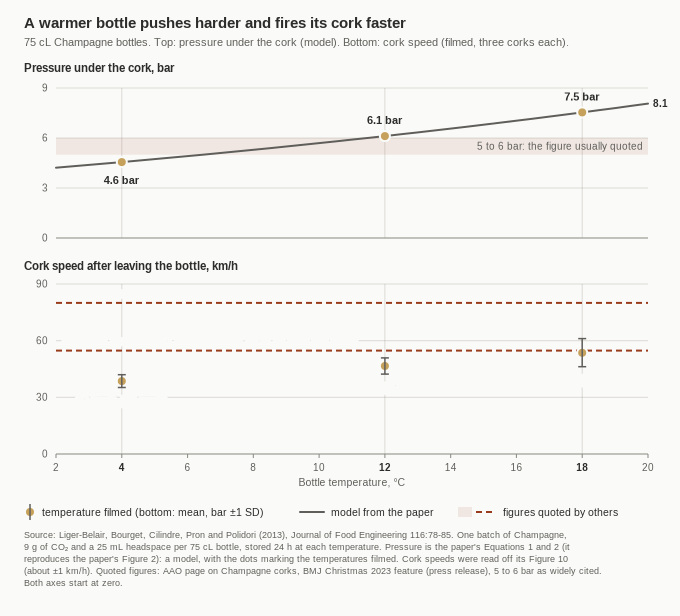
How hard it pushes depends on temperature, because CO₂ stays dissolved better in cold liquid. The Reims paper’s model, which reproduces its own Figure 2, gives about 4.6 bar under the cork at 4°C, 6.1 bar at 12°C, 7.5 bar at 18°C and 8.1 bar at 20°C. The 5 to 6 bar usually quoted lines up with a bottle at roughly 6.5 to 11.5°C, about the serving range, while one left at 20°C holds a third more than the top of that range.
The lab also filmed the corks. Their mean speed rose from about 39 km/h at 4°C to 47 at 12°C and 54 at 18°C, three corks at each temperature, so the 18°C cork carried nearly twice the energy of the 4°C one. Temperature sets how hard the bottle pushes, your grip decides how much of that push the cork gets, and the angle decides where it goes if the first two fail. The chart shows the first dial at work.
How to Open Champagne Quietly (and Why Cold Is Not Enough)
Quiet and safe turn out to be the same thing. The Reims authors say it in passing: it is “far safer to uncork a bottle of champagne with a subdued sigh”. The reason is where the energy goes. In their analysis, set against the energy the expanding gas releases (a model), the cork’s own motion came to only about 5%, whatever the temperature, and they think most of the rest left as a sound shock wave, the bang itself. A slow, held-back opening gives the gas a gentler way out. The catch is that the study filmed popped corks only, so that last step is reasoning, not measurement.
Cold helps, but it does not make the cork harmless: even the 4°C bottle fired its cork at about 39 km/h. And the gas leaves faster than the cork. In a later Reims study of bottles stored at 20 and 30°C, Decanter reported, the gas left at “almost Mach 2” for about a millisecond and the jet from a 20°C bottle was nearly −90°C, whereas a bottle chilled and opened at 8 to 10°C “is not enough to produce such a transverse shockwave”.
How Dangerous Is a Champagne Cork? What the Eye-Injury Records Say
Rare among eye injuries as a whole, serious for the eye it hits. A review in the British Journal of Ophthalmology (Kuhn and colleagues, 2004) searched eye-injury registries in the United States, Hungary and Mexico. Of 12,889 injuries, 90 (0.7%) came from bottle tops or glass splinters, and Champagne corks caused 20% of those in the US, 71% in Hungary and none in Mexico. “Most eyes improved, but 26% remained legally blind.”
Then there are the individual cases. The AAO describes a Prosecco cork that struck the eye of cyclist Biniam Girmay on the Giro d’Italia podium in 2022: he was hospitalised with bleeding in his left eye and had to withdraw. The BMJ authors add that a cork can travel from bottle to eye in under 0.05 seconds, so the blink reflex cannot save you.
How fast is the cork? The numbers disagree. The AAO says up to 34 mph (about 55 km/h), “fast enough to shatter glass”. The BMJ feature says up to 80 km/h and a flight of up to 13 m. The only measurements I found, the Reims team’s three corks per temperature, reached about 54 km/h at 18°C, and the top of the error bar there is 61. The BMJ figure may describe warmer or shaken bottles; I found no measurement that reaches it, and the feature was not externally peer reviewed.
If a cork does hit an eye, the AAO says to seek medical care right away, even if it seems minor, because some damage only shows up later: one of its specialists describes a patient who developed cataracts and advanced glaucoma almost 20 years after a cork injury.
Where the Advice Splits: What Is Measured and What Is Habit
Every guide gives the same handful of rules, but they are not equally well supported. This is what I could find behind each one.
- Chill it: the one rule with data. The Reims paper measures cork speed and models pressure at three temperatures, using one batch of bottles and one type of cork.
- Do not shake it: the AAO says shaking builds pressure and fires the cork at extremely high speed. None of the sources above measures how much, so take it as sound caution rather than a number.
- Aim away at 45 degrees: the AAO, the BMJ authors and Wine Folly give it for opening, and Decanter for sabring. None of the pages I read cites a test of the angle, so it is expert convention.
- Cage on or off, towel or no towel: a genuine split. The AAO removes the cage and uses a towel; Wine Folly loosens the cage, keeps it on and uses none. Both keep a hand on the cork.
- Turn the bottle: the AAO and Wine Folly agree. I found no test, but it keeps one hand still on the cork.
How to Sabre a Bottle of Champagne, and Why It Works
Sabrage is a showpiece, not a safety method. Wikipedia describes it as a ceremonial technique: a blade is slid along the neck, and when it hits the lip the glass breaks, separating the collar from the neck, with the cork and collar leaving together. The origin stories, Napoleon’s hussars among them, are legends, as Wikipedia puts it.
The physics is stress concentration. The lip at the top of the neck concentrates stress, and so does the faint vertical seam on the glass; where they meet, Wikipedia says, “the strength of the glass is reduced by more than fifty percent”. A blow there starts a crack that runs on, driven by the blade’s momentum and the pressure in the bottle, and the collar flies off, typically 5 to 10 metres. The blade needs no edge; Decanter’s source calls the sabre “very blunt”.
Decanter’s guide, from Nathan Evans of the Confrérie du Sabre d’Or, is to strip the foil and cage, start with a good-quality bottle that is very cold, tilt it at 45 degrees away from you and find where the two seams meet, the weakest point. Run the sabre up and down the seam, then deliver one clean strike from the shoulder and elbow, elbow high, wrist firm. In the Confrérie rank is earned by size: a magnum makes a chevalier, a methuselah a grand commandeur (see bottle sizes).
The sources split on the details. Decanter takes the cage off; Wine Folly repositions it to the first lip of the bottle “just to be safe”. Decanter wants the bottle very cold; Wine Folly chills it in the freezer for an hour, well past the 15 to 20 minutes our serving temperature guide allows. Wine Folly also says to skip Prosecco, which at about 3 atmospheres “tends to be a dud”.
The honest part: I found no peer-reviewed study of sabrage. The stress explanation is an engineering argument, and Wikipedia’s “more than fifty percent” carries no citation in the text I read, so treat it as a plausible estimate, not a measurement. Decanter’s Evans warns that “broken glass can often ricochet back off a hard surface”, and Wikipedia advises letting a little wine flow to wash off loose shards and checking the first glass poured for them. If you try it, do it outdoors, aim into open space, wear eye protection (our suggestion, not a source’s) and take a lesson first, as Evans recommends.
Prosecco, Cava and Pét-Nat: What Changes
The steps work for any corked sparkling wine. Wine Folly filmed them on a Crémant d’Alsace and says the method works for all sparkling wines. What changes is pressure: it puts Champagne at 5 to 7 atmospheres and Prosecco, made by the tank method, at about 3. Less is not none, though; the cork on that 2022 podium was a Prosecco cork. Cava is made like Champagne (see Prosecco vs Champagne vs Cava), so treat it the same way. Pét-nat usually wears a crown cap instead, so no cork flies, but it can foam more than corked fizz, so open it slowly over a sink.
After the Pop: Pouring and Keeping the Rest
Pour at a slant, as Wine Folly does, into a flute or a tulip rather than a coupe; our guide to wine glasses explains why. Seal what is left with a sparkling stopper and keep it cold: how long wine lasts once opened gives one to three days for sparkling wine.
Opening Champagne: Your Questions Answered
How do you open Champagne without it spraying?
Chill it well, do not shake it and hold the bottle at about 45 degrees. Wine Folly adds that you should keep that angle for a second or two after the cork leaves, so the pressure escapes without the wine. Turn the bottle, not the cork, and let the cork ease out.
How do you open Champagne quietly?
Hold the cork and cage firmly, turn the bottle slowly and press back on the cork as it rises, so it leaves with a hiss rather than a pop. In a Reims study the cork took only about 5% of the energy released when it popped, and the authors think most of the rest left as the bang. The study filmed popped corks only, so the gain from a slow opening is reasoning, not measurement.
Should you twist the cork or the bottle?
The bottle. The American Academy of Ophthalmology and Wine Folly both say to hold the cork still and turn the base, and Wine Folly calls that much easier and safer than turning the cork.
How do you open Prosecco?
The same way. Wine Folly puts Prosecco at about 3 atmospheres against 5 to 7 for Champagne, but a Prosecco cork still hit cyclist Biniam Girmay in the eye in 2022. Pét-nat under a crown cap has no cork, so open it slowly over a sink.
Can a Champagne cork really injure your eye?
Yes. The American Academy of Ophthalmology says a cork can fly up to 34 mph, and a review of eye-injury registries found that 26% of cases caused by bottle tops or glass splinters left the person legally blind. See an ophthalmologist right away after any blow to the eye.
How do you sabre a bottle of Champagne?
Use a very cold bottle with the foil and cage removed, tilt it about 45 degrees away from everyone and slide a blunt sabre along the seam to the lip in one clean stroke, as Decanter describes. The blow cracks the glass where the lip meets the seam and the collar flies off, typically 5 to 10 metres according to Wikipedia. Do it outdoors, after a lesson.