The best wine with seafood is a dry, high-acid white or a dry sparkling wine: Muscadet, Chablis, Albariño, Sauvignon Blanc or Champagne for oysters, shrimp, crab and scallops, and a fuller, lightly oaked Chardonnay once butter or cream arrives with lobster. Red wine is the risky choice, but colour is not the reason. In a 2009 study by Mercian, a Japanese wine producer, tasters rated 38 red and 26 white wines with dried scallop, and the fishy aftertaste rose with the iron in the wine. This guide covers wine with seafood dish by dish, from oysters to mussels, and says when a chilled light red is safe. Its organising idea is to pair the plate and the glass, not the animal: the sauce sets the weight, and what is in the wine decides whether the match clashes or sings.
In this article
- 1 Wine with Seafood at a Glance
- 2 Why Red Wine With Seafood Can Taste Fishy
- 3 What Makes Shellfish and Wine Click
- 4 Oysters: Muscadet, Chablis and Champagne
- 5 Shrimp and Prawns: Let the Sauce Talk
- 6 Lobster and Crab: Let the Sauce Decide
- 7 Scallops: Match the Cooking
- 8 Mussels and Clams: Cook With What You Pour
- 9 When Red Wine Works with Seafood
- 10 A Four-Question Shortcut
- 11 Where the Evidence Stops
- 12 Wine with Seafood: Your Questions Answered
Wine with Seafood at a Glance
- Oysters, raw: Muscadet, Chablis, Champagne or Picpoul de Pinet. Decanter calls bone-dry Muscadet one of the classic oyster matches, and in Fiona Beckett’s Decanter tasting a zesty Sauvignon Blanc “proved a surprisingly good match”.
- Oysters, grilled: Albariño, whose acidity, Wine Folly says, “contrasts wonderfully with the dense, gooey texture of an oyster”.
- Shrimp and prawns: Albariño, Rueda or a dry sherry with garlic butter; Champagne with herb-roasted prawns; a touch of sweetness, or a dry rosé, with cocktail sauce.
- Lobster: a fuller white such as a buttery Chardonnay, or vintage Champagne or Bandol rosé; something crisper if the sauce is sharp.
- Crab: Pouilly-Fumé or dry German Riesling for dressed crab; a buttery white Bordeaux for baked spider crab.
- Scallops: it depends on the cooking: Riesling raw, Vouvray or white Rioja seared, Champagne baked.
- Mussels and clams: Muscadet, the wine Nantes cooks its mussels in.
- Red wine: only a light, low-tannin red, chilled, with roasted shellfish.
Why Red Wine With Seafood Can Taste Fishy
White wine with fish is one of the best-known rules in wine, and in 2009 it got a proper test. Takayuki Tamura and colleagues at Mercian published a study in the Journal of Agricultural and Food Chemistry. Tasters rated the unpleasant fishy aftertaste of dried scallop paired with 38 red wines, 26 white wines, two sherries, a port, a madeira and a botrytised wine. The wines were then analysed, and iron stood out: the more total iron and ferrous iron a wine contained, the stronger the fishy aftertaste.
Then came experiments that go beyond correlation. Adding ferrous iron to a model wine (a lab-made stand-in for wine) made the aftertaste stronger, and binding the iron in a red wine with a chelating agent suppressed it. The team also found six odour compounds, among them hexanal, heptanal and nonanal, in dried scallop soaked in red wine, and in a model wine their formation rose with the dose of ferrous iron. The American Chemical Society’s own explainer sums up the chemistry: iron-rich wine can promote the oxidation of the unsaturated fats in fish and seafood, and the result is an unpleasant smell from the back of the mouth.
That explains the rule better than colour does. Red wines are generally higher in iron than whites, so white with fish is right on average, but the researchers noted that some reds go well with seafood and suggested that low-iron reds might suit it. A 2012 follow-up involving Tamura tested the idea from the other end: wine treated with dead yeast cells and phytic acid, which together remove iron, produced no perceived fishy aftertaste in wine-and-seafood pairings. The catch is that iron is not on the label. The ACS explainer notes that soil and fermentation both influence it, so it is hard to judge from the label alone.
White is not a free pass, either. In 2010 a different Japanese team, Fujita and colleagues, paired dried squid with white wine and with sake. The wine pairings had more fishy off-odour and unpleasant taste. Adding DHA, an unsaturated fat found in fish and squid, raised bitterness and fishy-smelling aldehydes in white wines but left sake largely unchanged, and of the ingredients that separate wine from sake, only sulphite did it. The authors blamed sulphur dioxide, a sulphite commonly added to preserve wine.
What Makes Shellfish and Wine Click
The other half of the idea is what flatters shellfish. Wine Folly’s shortest answer, for grilled oysters, is that “nothing goes better with shellfish than a nice squeeze of lemon”, so for raw and lightly cooked shellfish pour something that does the same job: high acid, little or no oak, little sweetness. Fiona Beckett and chef Mark Hix reached the same place after tasting nine shellfish dishes for Decanter. Young, clean wines generally beat older ones “that have been subject to a degree of oxidation”, and dry whites were “a much more reliable choice than off-dry, aromatic ones”. Our guide to wine pairing principles gives acidity the same job: lemon on fried fish and a glass of Muscadet both cut the oil.
Then there is Champagne and oysters, one of the most famous matches in wine and one whose chemistry had barely been measured. Schmidt, Olsen and Mouritsen’s open-access paper in Scientific Reports (2020) measured the umami compounds in 18 Champagnes and in two oyster species from the same Danish waters. Glutamate, the amino acid behind umami, was detectable in 17 of the Champagnes, at 1.4 to 7.5 mg per 100 ml, and every one fell below the 29 to 30 mg per 100 ml at which glutamate can be tasted on its own. The oysters were in a different league: 160 mg per 100 g for the Pacific oyster and 257 for the flat European oyster, about 60% more, along with the nucleotides inosinate and guanylate, which amplify glutamate’s effect on the tongue. The chart sets them side by side.
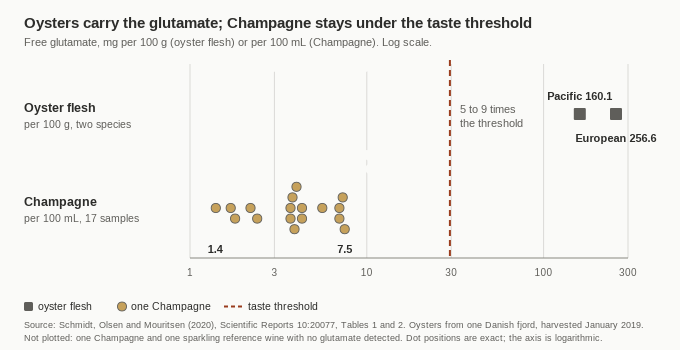
The authors’ argument is that a Champagne sitting under the threshold can still help: a sip after swallowing an oyster meets the traces of inosinate left in the saliva, and the umami lingers. They also found more glutamate in Champagnes with long yeast contact, the highest readings coming from vintages of 2000 to 2008 aged 11 to 19 years on the lees. For scallops their sums are friendlier still: a Champagne above 3.6 mg per 100 ml would carry the pairing over the threshold, and 12 of the 18 they tested were above it.
Oysters: Muscadet, Chablis and Champagne
Raw oysters want acid and nothing heavy. Muscadet is the textbook answer: Decanter’s fish guide calls bone-dry Muscadet one of the classic matches for oysters and other seafood, and Wine Folly says its “true calling” is seafood, “particularly if you’re a fan of bivalves”. Look for sur lie on the label, which our Loire Valley wine guide explains. Chablis, the unoaked Chardonnay that Decanter’s fish guide lists with Muscadet as a reliable choice for delicate fish, is the other classic. Picpoul de Pinet, which Beckett calls the Languedoc’s favourite oyster white, and Assyrtiko both suit oysters, as our guide to underrated wines explains. A brut Prosecco is the cheaper bubble, since its bright acidity suits seafood. Hix’s caveat is about vinegar: as far as wine is concerned oysters are better without shallot vinegar, and with a splash of it an oaked white Bordeaux did slightly better than the Sauvignon.
Shrimp and Prawns: Let the Sauce Talk
Shrimp and prawns usually arrive in a sauce, so the sauce does the talking. With tiger prawns in garlic butter, Beckett and Hix expected sherry to suit the garlicky, buttery juices, and Tio Pepe, a dry sherry, “hit the spot”, with a crisp Rueda also liked. For herb-roasted lobster, prawns and razor clams in garlic butter, Albariño was good and Champagne was “the star pairing”. A shellfish cocktail with a horseradish-and-Tabasco marie-rose sauce needed a touch of sweetness: an English Bacchus was the best match by far, a youthful Albariño worked, and Hix suggested a dry rosé or a chilled minor red Burgundy.
Lobster and Crab: Let the Sauce Decide
Lobster is where the sauce takes over. In Beckett’s tasting cold shellfish normally called for crisp wines, but “sweet, rich lobster meat needs a more full-bodied white”, especially with a rich mayonnaise. A big, buttery Marlborough Chardonnay was Hix’s favourite; an Alto Adige Pinot Grigio worked in a different register; lesser whites such as Pouilly-Fuissé foundered; and the other possibilities were vintage Champagne and, Hix’s idea, Bandol rosé. Change the sauce and the answer moves: a mustardy lobster thermidor suited crisper wines, such as that Pinot Grigio, better than expected. Our Chardonnay food-pairing guide sets out how oaked and unoaked styles treat lobster, crab and other seafood.
Crab is more delicate. Dressed crab needs a wine that lets you taste the crab: Pouilly-Fumé “worked predictably well”, a modern dry German Riesling is another candidate, and a lightly oaked Pouilly-Fuissé disappointed. Baked spider crab, a rich dish spiced with ginger, garlic and chilli, took a buttery white from Pessac-Léognan, especially with the brown meat and buttery crumbs, though Sauvignon Blanc also worked, by contrast.
Scallops: Match the Cooking
Scallops are the clearest case for pairing the cooking, not the shellfish. Decanter’s 2025 guide, built from sommeliers’ answers, sorts them by cooking method. Raw scallops or ceviche suit Riesling, a bone-dry New World one for Eugenio Egorov of The Stafford or an off-dry Mosel Kabinett if the dish is citrusy, though he calls junmai daiginjo sake the ideal companion. Scallops seared in butter want weight from lees or oak: Muscadet that has spent time on its lees, Vouvray, white Rioja, Lugana or Savatiano. Baked or roasted scallops take Champagne, ideally with a touch of oak, or a skin-contact Grüner Veltliner or Xarel·lo. Add chilli and garlic, and Beckett’s tasters found a Grüner Veltliner had the edge while Riesling and Bacchus were overwhelmed.
Mussels and Clams: Cook With What You Pour
Mussels and clams are often steamed in wine, so use one you would happily drink. Wine Folly describes the Nantes classic: mussels flash-cooked in a splash of Muscadet with shallots and green herbs, tossed with chips. For clam or mixed-seafood pasta, our guide to wine with pasta runs through Soave Classico, Vermentino, Picpoul and Muscadet.
When Red Wine Works with Seafood
Red wine is not banned; it just has a narrower door. Decanter’s scallop guide says “it’s wrong to assume that red wines cannot be paired with fish and seafood, especially if served slightly chilled”, and names Trousseau, St-Laurent, Zweigelt and Spätburgunder (German Pinot Noir) for roasted scallops. Beckett’s tasting found a chilled New Zealand Pinot Noir much better with herb-roasted shellfish than with the mustardy thermidor. The common thread is light body, soft tannin and a chill: our guide to low-tannin wines lists the reds that fit, and our wine with salmon guide covers Pinot Noir and Gamay with fish. The study measured iron, not tannin, so treat low tannin as a proxy rather than a guarantee: I found no source that measured iron in these styles.
A Four-Question Shortcut
My shortcut, built from the sources above and not from any trial, runs as four questions in order.
- Raw or plainly cooked? Pour the youngest, cleanest, most acidic dry white you have, and serve it cold.
- Butter, cream or mayonnaise? Step up a weight: a lightly oaked Chardonnay, vintage Champagne or a white from Pessac-Léognan.
- Chilli or a sweet-sharp sauce? Stay dry and clean for chilli, since Grüner Veltliner beat Riesling and Bacchus with chilli scallops, and allow a touch of sweetness for a cocktail sauce.
- Want red? Make it light, low in tannin and chilled, and accept that it is a gamble.
Where the Evidence Stops
None of this is as settled as the confident rules suggest. The iron study used dried scallop and the sulphur dioxide study dried squid, so how far either result reaches into a plate of fresh oysters, crab or lobster is untested in the abstracts I could read. I could not open the Tamura paper itself, because the publisher blocks automated requests, and relied on its abstract and on coverage by the American Chemical Society, Reuters and the Royal Society of Chemistry. The two teams blame different things, iron in one and sulphur dioxide in the other, and I found no repeat of either with fresh shellfish.
The Champagne numbers are measurements plus arithmetic, not a tasting; the authors say the idea should be “validated by a sensory panel”. Their own sums also depend on how much oyster is left in the mouth. At a 5% residue the Pacific oyster needs only 0.2 mg per 100 ml of glutamate in the Champagne to cross the threshold, but at 2.5% it needs 9.1, more than any Champagne they measured, and for the European oyster at 5% the formula returns a negative number, meaning the oyster clears the bar without any help. The pairing advice from Decanter and Wine Folly is expert opinion, not trial evidence, and Beckett’s tasting was nine dishes with one chef.
Wine with Seafood: Your Questions Answered
What is the best wine with seafood?
A dry, high-acid, unoaked white or a dry sparkling wine. Muscadet, Chablis, Albariño, Sauvignon Blanc and Champagne cover most shellfish, and a fuller, lightly oaked Chardonnay suits lobster in butter, cream or mayonnaise. In Fiona Beckett’s Decanter tasting, young, clean wines beat older ones, and dry whites beat off-dry, aromatic ones.
Can you drink red wine with seafood?
Yes, if it is light, low in tannin and slightly chilled. A 2009 Japanese study found that the fishy aftertaste of wine with dried scallop rose with the iron in the wine, and its authors suggested low-iron reds might suit seafood. Decanter’s sommeliers name Trousseau, Zweigelt and Spätburgunder for roasted scallops.
What wine goes with oysters?
Bone-dry Muscadet, Chablis, Champagne or Picpoul de Pinet for raw oysters, and Albariño for grilled ones. Decanter calls Muscadet one of the classic oyster matches. A 2020 study measured far more free glutamate in oysters than in Champagne, which may help explain the pairing, though its authors say a tasting panel should confirm it.
What wine goes with shrimp and prawns?
A crisp, dry white such as Albariño or Rueda, or a dry sherry, with garlic butter. For a cocktail with marie-rose sauce, Fiona Beckett’s tasters wanted a touch of sweetness and liked an English Bacchus and Albariño. Herb-roasted prawns in garlic butter went best with Champagne.
What wine goes with lobster and crab?
Lobster in butter, cream or mayonnaise wants a fuller white: a buttery Chardonnay, vintage Champagne or a Bandol rosé. Dressed crab wants a cleaner wine such as Pouilly-Fumé, and baked spider crab took a buttery white Pessac-Léognan. Match the sauce more than the shellfish.
What wine goes with scallops?
It depends on the cooking. Decanter’s sommeliers suggest Riesling or sake for raw scallops, Vouvray, white Rioja or Muscadet aged on its lees for seared ones, and Champagne for baked ones. A chilled light red such as Zweigelt or Spätburgunder can also work with roasted scallops.