
Our guide to dry wine covers one end of the sweetness spectrum in detail. This one covers the other end — and it turns out “sweet” is not really one category at all. A glass of Sauternes and a glass of vintage Port both taste unmistakably sweet, but they arrive there through almost opposite processes: one by concentrating sugar in the grape before fermentation ever finishes on its own, the other by stopping fermentation early on purpose. Dessert wine is really just the umbrella term for a handful of very different techniques that all land in the same place. This guide walks through both routes, the specific wines each one produces, and how to actually serve, store, and pair the results.
In this article
- 1 Dessert Wine, at a Glance
- 2 The Two Ways to Get Sweet
- 3 Route One: Noble Rot — Sauternes and Tokaji
- 4 Route Two: Freezing — Eiswein and Icewine
- 5 Route Three: Drying — Vin Santo and Passito
- 6 Route Two Entirely: Fortified Wine
- 7 Dessert Wine’s Real Superpower: It Actually Ages
- 8 How to Serve Dessert Wine
- 9 Storing an Opened Bottle
- 10 What to Pair With Dessert Wine
- 11 Getting Started With Dessert Wine
- 12 Frequently Asked Questions About Dessert Wine
Dessert Wine, at a Glance
- Two production routes: concentrating sugar in the grape itself (noble rot, freezing, or drying) or fortifying the wine with spirit to stop fermentation early.
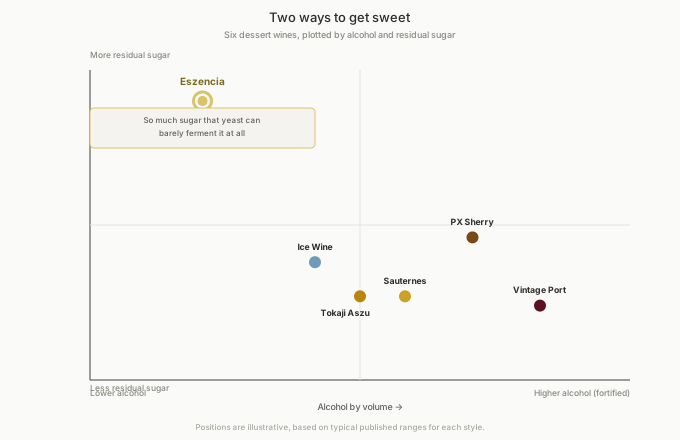
- Residual sugar: ranges enormously, from around 120 g/L in a typical vintage Port up to 450+ g/L in the rarest Tokaji Eszencia.
- Alcohol by volume: anywhere from roughly 5% (Eszencia, barely fermented at all) to 20% (fortified styles like Port).
- Famous examples: Sauternes and Tokaji Aszú (noble rot), Eiswein and Icewine (freezing), Vin Santo and Passito (drying), Port, Sherry, and Madeira (fortified).
- Serving size: smaller than a standard pour — typically 2–3 oz (60–90 ml), given the concentration of sugar and flavour.
- Ageing potential: among the longest of any wine style; a well-stored Sauternes or vintage Port can improve for a century or more.
- Once opened: lasts considerably longer than a typical still wine, thanks to sugar and (in fortified styles) alcohol both acting as natural preservatives.
The Two Ways to Get Sweet
Every wine starts the same way: yeast eats the sugar in grape juice and converts it into alcohol and carbon dioxide, and fermentation keeps going until either the sugar runs out or the alcohol level gets high enough to kill the yeast, usually somewhere around 15–16% ABV. A dry wine is simply one where fermentation was allowed to run its full course, leaving little or no sugar behind. Dessert wine happens when winemakers interrupt that default outcome, and there are exactly two ways to do it. The first is to start with so much sugar concentrated in the grape itself that even a complete fermentation still leaves plenty of sugar left over — achieved by shrivelling the grape through fungus, cold, or drying before it’s ever pressed. The second is to stop fermentation deliberately, part-way through, by adding a high-proof grape spirit that kills the yeast outright, locking in whatever sugar hadn’t fermented yet and pushing the alcohol level up in the same move. Nearly every dessert wine in the world falls into one of these two families, and the difference explains far more about how each wine tastes, ages, and gets served than the word “sweet” on its own ever could.
Route One: Noble Rot — Sauternes and Tokaji
The strangest and most celebrated concentration method starts with a fungus. Botrytis cinerea is the same organism that, under the wrong conditions, rots a vineyard’s fruit into something unusable. Under exactly the right conditions — misty, humid mornings followed by dry, breezy afternoons — it instead perforates the grape skin in a way that lets water evaporate out while sugar, acid, and flavour compounds stay behind and concentrate. Winemakers call this “noble rot,” and it’s one of the few cases in food and drink where a fungal infection is actively hoped for rather than feared. The catch is that botrytis develops unevenly across a vineyard and even within a single bunch, which is why the best noble-rot wines require multiple hand-picking passes through the vines over several weeks, taking only the berries that have shrivelled correctly on each pass.
Sauternes, from a small pocket of Bordeaux where morning mist off the Ciron river meets warm afternoon sun, is the noble-rot wine most people encounter first — a blend built mainly around Sémillon, with Sauvignon Blanc and a touch of Muscadelle, typically finishing around 14% ABV with roughly 135 g/L of residual sugar. Château d’Yquem, the only estate given Bordeaux’s rare Premier Cru Supérieur ranking in the historic 1855 classification, is the benchmark: a bottle from its legendary 1811 vintage sold at auction in 2011 for $117,000, a world record for white wine, and the wine critic Robert Parker once described an aged Yquem as “liquefied crème brûlée” — not a bad description of what botrytis does to a glass of wine over a century.
Tokaji Aszú, from northeastern Hungary, works the same fungus on a different grape — mainly Furmint, high in natural acidity, which keeps the finished wine from tasting cloying despite serious sweetness. Individually hand-picked, botrytis-shrivelled berries, called aszú, are traditionally measured by the “puttonyos” system: historically, 3 to 6 baskets of aszú berries added per barrel of base wine, correlating to roughly 60–150 g/L of residual sugar. Since a 2013 regulatory change, EU rules require a minimum of 120 g/L residual sugar for a wine to legally carry the “Aszú” designation at all, and the old puttonyos count has largely disappeared from labels as a result — a case of the sweetness scale getting simpler right as the wine itself was getting more precisely regulated. Tokaji’s reputation is old enough to have its own royal endorsement: in 1703, Prince Francis II Rákóczi of Transylvania sent a gift of Tokaji to Louis XIV of France, who reportedly responded with the phrase “Vinum Regum, Rex Vinorum” — “wine of kings, king of wines.” It’s worth flagging that our guide to Nebbiolo uses the near-identical phrase “the King of Wines, and the Wine of Kings” for Barolo — a genuine, and slightly funny, historical coincidence rather than a case of one wine borrowing the other’s slogan; the two phrases were coined roughly 150 years apart, about wines from opposite ends of Europe.
Route Two: Freezing — Eiswein and Icewine
The second concentration method skips fungus entirely and uses cold instead. Ice wine grapes are left on the vine well past normal harvest, sometimes into December or January, until a hard freeze — genuinely cold, not just a light frost — drops through the fruit. The water inside each grape turns to ice while the sugar, acid, and flavour compounds stay dissolved in a smaller pocket of unfrozen liquid. Pressed while still frozen, usually in the middle of the night when temperatures are lowest, the grapes yield only a thin trickle of intensely concentrated juice, since most of the water stays behind as ice in the press.
The technique has a genuinely documented accidental origin. On February 11, 1830, in Dromersheim, a district of Bingen on Germany’s Rhine, farmers facing a poor 1829 harvest had left an unpicked crop on the vines as cattle feed. When an unusually severe winter brought temperatures down to around -22°C (-8°F), workers arriving to collect the frozen grapes decided to press them anyway rather than let the harvest go to complete waste — and discovered the frozen fruit produced a small quantity of remarkably sweet, concentrated juice. That accident became Eiswein, and Germany still requires it by law to be made only from grapes naturally frozen on the vine, harvested at a minimum must weight comparable to a Beerenauslese. Canada has since become the world’s largest producer of the style, rebranded as Icewine, thanks to the Niagara Peninsula and Okanagan Valley’s unusually reliable hard freezes most winters — a climate advantage most European regions, dependent on an unpredictable cold snap arriving at the right moment, simply can’t count on every vintage.
Route Three: Drying — Vin Santo and Passito
The third concentration method is the most low-tech of all: harvest normally, then dry the grapes after picking instead of before. In Italy, this technique is called appassimento, and it’s traditionally done by laying grape bunches on straw mats or hanging them from rafters in a ventilated loft for weeks or months, letting water slowly evaporate from the fruit while sugar concentrates inside. Vin Santo, Tuscany’s classic version, dries Trebbiano and Malvasia grapes this way before a long, slow fermentation and ageing in small sealed barrels called caratelli, often for several years, producing a wine with a distinctive nutty, oxidative character alongside its sweetness. Passito di Pantelleria, from a small volcanic island between Sicily and Tunisia, applies the same drying method to Zibibbo (Muscat of Alexandria), yielding something intensely aromatic and honeyed. A related, less-sweet cousin worth knowing: Recioto della Valpolicella, made from the same dried Corvina-based grapes used for Amarone, except fermentation is stopped while meaningful sugar remains, rather than pushed to full dryness the way Amarone is.
Route Two Entirely: Fortified Wine
Fortification takes a completely different path to sweetness. Instead of concentrating sugar in the grape before fermentation, winemakers let fermentation begin normally and then interrupt it on purpose, adding a neutral, high-proof grape spirit partway through. The alcohol spike kills the yeast outright, stopping fermentation mid-process and locking in whatever grape sugar hadn’t converted yet — while simultaneously pushing the wine’s overall alcohol up to somewhere between 17% and 20% ABV, well above what fermentation alone could ever produce.
Vintage Port, from Portugal’s Douro Valley, is the clearest example: grape spirit is added roughly two to three days into fermentation, when the wine is still quite sweet, leaving around 120 g/L of residual sugar in a wine that typically finishes near 20% ABV. Only in years judged exceptional does a producer “declare” a vintage — a decision announced roughly 18 months after harvest — which is part of why the term “vintage” carries even more weight for Port than for most other wines; our guide to what vintage actually means covers why that year-to-year variation matters so much across wine generally. Pedro Ximénez (PX) Sherry, from Jerez in southern Spain, is a genuine hybrid of both major dessert-wine routes: the grapes are first dried in the sun on esparto mats for one to two weeks, concentrating their sugar the same way Vin Santo does, and only then fermented and fortified, producing one of the most viscous, intensely raisiny wines made anywhere, often poured as much over vanilla ice cream as into a glass. Madeira, from the Portuguese island of the same name, is fortified and then deliberately heated and oxidized — a process discovered, according to island tradition, after barrels shipped through tropical heat on long sea voyages came back tasting better, not worse. The result is arguably the most stable wine in the world: an opened bottle of Madeira, thanks to its oxidative style, can last for months or even years without spoiling.
Dessert Wine’s Real Superpower: It Actually Ages
Dessert wine has an image problem: treated as an occasional, slightly old-fashioned add-on to a meal rather than something worth taking seriously. The reality is closer to the opposite. High sugar, high acid, and — in fortified styles — high alcohol are three of the most effective natural preservatives a wine can have, which is exactly why some of the longest-lived wines on earth are dessert wines rather than the trophy reds usually associated with serious cellaring. That 1811 Château d’Yquem sold in 2011 wasn’t a museum piece kept purely for display; its buyer, sommelier Christian Vanneque, said at the time he intended to actually drink it. Vintage Port routinely improves for 40 to 80 years in bottle, and well-stored bottlings from the 19th century are still opened and enjoyed today. Almost no dry red or white wine can make that same claim with a straight face, which makes dessert wine, somewhat counterintuitively, one of the more serious categories a collector can put in a cellar.
How to Serve Dessert Wine
Pour less than you would for a standard glass — around 2 to 3 oz (60–90 ml) is typical, since the concentration of sugar and flavour means a little goes considerably further than with a dry wine. Serve most dessert wines cooler than a typical red but not ice-cold: Sauternes and Tokaji do well around 50–54°F (10–12°C), while fortified styles like Port and PX Sherry are more forgiving, generally fine slightly warmer, closer to 55–60°F (13–16°C); our guide to wine serving temperature covers the full range across every style. The wide alcohol swing across this category — from Eszencia’s roughly 5% ABV up to a fortified Port’s 20% — is worth knowing before you pour, since it’s a considerably bigger range than almost any other wine style covers; our guide to wine alcohol content puts that range in context against other wine types.
Storing an Opened Bottle
This is where dessert wine has a genuine practical edge over almost every other style: it lasts. A dry white typically holds up for only three to five days once opened, but a Sauternes or Tokaji, thanks to its sugar and acid, can stay in good condition in the refrigerator for one to two weeks, and a fortified wine like Port or Madeira, with alcohol doing extra preservation work on top of that, can last a month or more, sometimes considerably longer for Madeira specifically. Our complete guide to how long opened wine lasts breaks this down style by style — dessert wine is consistently one of the most forgiving categories on that list, which makes it a genuinely practical choice for anyone who only wants a small glass at a time rather than committing to a full bottle in one sitting.
What to Pair With Dessert Wine
The classic pairing rule for sweet wine is that the wine should be at least as sweet as the food, ideally sweeter, or the wine ends up tasting thin and sour by comparison — a version of the same balance principle covered in our guide to wine and cheese pairing. That guide’s own top match applies especially well here: blue cheese and Sauternes, or blue cheese and vintage Port, both trade on the same contrast between salty, pungent cheese and honeyed sweetness that makes the pairing a genuine classic rather than a gimmick. Foie gras and Sauternes is the other iconic combination, prized for centuries in Bordeaux specifically because the wine’s acidity cuts through the dish’s richness. PX Sherry, dense with raisin and molasses notes, pairs unusually well with dark chocolate and coffee-based desserts, while a lighter ice wine suits fresh fruit tarts or a simple cheese plate without a rich, formal dessert course. Wine Folly’s full breakdown of dessert wine styles has additional pairing notes across the category.
Getting Started With Dessert Wine
A half-bottle is often the right starting point, both because dessert wine is served in smaller pours and because half-bottles age at roughly the pace full bottles do while costing considerably less. A basic Sauternes or a Late Bottled Vintage (LBV) Port — a more affordable, earlier-drinking relative of true vintage Port — are both accessible, genuinely representative entry points rather than watered-down versions of the real thing. From there, a Tokaji Aszú shows the noble-rot style from a different angle entirely, and a small pour of PX Sherry over vanilla ice cream is, frankly, one of the easiest ways to convert a skeptic in a single glass. Jancis Robinson’s writing on the pressures facing Sauternes today is also worth a read for anyone getting seriously interested in the category, since noble-rot wine is genuinely more vulnerable to a changing climate than most other styles on this page.
Frequently Asked Questions About Dessert Wine
What makes a wine a dessert wine?
A dessert wine is any wine with noticeable residual sugar left after fermentation, typically sweet enough to serve alongside or in place of dessert. Winemakers get there in one of two ways: concentrating sugar in the grape itself before fermentation (through noble rot, freezing, or drying) or fortifying the wine with spirit to stop fermentation early and lock sugar in.
What is the difference between Sauternes and ice wine?
Both concentrate sugar in the grape before pressing, but through opposite mechanisms. Sauternes relies on noble rot (Botrytis cinerea), a fungus that shrivels the grape and lets water evaporate while sugar concentrates. Ice wine relies on a hard freeze, which turns the grape’s water to ice, leaving a small amount of intensely concentrated, unfrozen juice behind when pressed.
Why is Port sweet if it’s made like a regular red wine?
Port is fortified: grape spirit is added roughly two to three days into fermentation, while significant sugar is still present. The added alcohol kills the yeast, stopping fermentation before it can finish and leaving that unfermented sugar behind, while also raising the wine’s final alcohol to around 20% ABV.
Does dessert wine actually age well?
Yes, often better than dry wine. High sugar, high acid, and (in fortified styles) high alcohol all act as natural preservatives, which is why dessert wines like Sauternes and vintage Port are among the longest-lived wines in the world, with well-stored examples improving for many decades and, in some documented cases, over a century.
How long does an opened bottle of dessert wine last?
Considerably longer than most still wine. A noble-rot wine like Sauternes or Tokaji typically keeps for one to two weeks refrigerated after opening, while a fortified wine like Port or Madeira can last a month or longer, thanks to the combined preserving effect of high sugar and, in fortified styles, high alcohol.
What food pairs best with dessert wine?
Blue cheese is the classic match for both Sauternes and vintage Port, pairing the wine’s honeyed sweetness against the cheese’s salt and pungency. Foie gras and Sauternes is another traditional combination, while PX Sherry suits dark chocolate and coffee desserts, and lighter styles like ice wine work well with fresh fruit tarts.