In 1943, a winemaker named Georges Vernay started his own estate in Condrieu, on the west bank of France’s Rhône, with what Wine Spectator’s James Molesworth later called “the single hectare (2.5 acres) of Condrieu in existence at the time”. By the 1960s, according to the Wine & Spirit Education Trust (WSET), the Condrieu vineyards, and with them the world’s entire plantings of the grape they grow, had shrunk to less than 10 hectares. That grape is Viognier, and by 2016 it covered some 16,000 hectares, from the Rhône to Virginia to Chile. This guide explains why a grape this perfumed nearly vanished, what Viognier wine tastes like and why it smells sweeter than it is, where it grows, whether a splash of it in Syrah really does what winemakers claim, and what to eat with it.
In this article
- 1 Viognier at a Glance
- 2 The Grape That Almost Vanished
- 3 Why It Is So Hard to Get Right
- 4 The Comeback, in Hectares
- 5 What Viognier Tastes Like
- 6 Where It Grows
- 7 A Dab of Viognier in Your Syrah
- 8 How to Serve It and How Long to Keep It
- 9 What to Eat With It
- 10 How It Compares With Chardonnay
- 11 Frequently Asked Questions About Viognier
Viognier at a Glance
- Grape: Viognier (pronounced vee-own-yay), a white grape most closely tied to the northern Rhône in France.
- Where it grows: about 16,000 hectares worldwide by 2016, just over half of it in France, followed by Italy, the United States, Chile, South Africa, Argentina and Australia.
- Smells of: apricot, peach, honeysuckle and white flowers, sometimes with tangerine or mango.
- Structure: full-bodied and rich, low in acidity, no tannin, usually around 13–15% ABV.
- Sweetness: almost always dry, even though the nose suggests otherwise.
- Serve: lightly chilled, at about 7–13°C (45–55°F), not straight from the back of the fridge.
- Drink: young, usually within a few years of the vintage.
- Best with: mildly spiced dishes, ham and pork with fruit glazes, salmon with herbs and chicken in creamy sauces.
The Grape That Almost Vanished
Viognier was once fairly common, and its fall had clear causes. Phylloxera, the American root louse that devastated European vineyards in the middle and later 19th century, hit it hard, and many vineyards were abandoned in the chaos of the First World War. What survived clung to steep granite slopes that often need terracing, where yields are low and the labour is heavy. Hillside wine is expensive to make and a poor bet when demand and prices are low, and the 1950s and 1960s were particularly hard for Condrieu.
The WSET adds a detail that stings. The growers left caring for the last vines earned their main income from cherries, plums and apricots, which were much more lucrative in the Paris markets. Apricot, the very fruit Viognier smells of, was paying better than the grape.
Georges Vernay saw it through. He started his estate in 1943 on that single hectare, planted by his father in 1936, and by Molesworth’s account it grew to 17 acres within a few years while still holding the only vines in the appellation. From 1965 to 1995 he presided over the Condrieu growers’ association, working with fellow growers Pierre Perret, Alfred Gerin and Edmond Duclaux to replant the slopes, and he earned the nicknames “the Pope of Condrieu” and “Mr. Viognier”. The WSET credits him with the grape’s local revival.
Where the grape came from is murkier. The WSET calls it probably native to Condrieu, but the legends are better stories. One says the Roman emperor Probus brought the vine to the region in AD 281. Another has it travelling with Syrah on a cargo boat that outlaws captured near Condrieu. The name may come from Vienne, a major Roman outpost, or, in the more dramatic version, from the Latin via Gehennae, “road of the valley of hell”, probably an allusion to how hard the grape is to grow. DNA profiling at the University of California, Davis, reported a close relationship with Freisa, a Piedmont grape that has a parent–offspring relationship with Nebbiolo, which makes Viognier a genetic cousin of the star of our Nebbiolo guide.
Why It Is So Hard to Get Right
Condrieu’s growers were not being sentimental about a lost cause. Viognier really is awkward. It buds early, so it is prone to spring frost. Its yields have historically been low and unpredictable because of poor flowering and fruit set, although better clones and easier sites such as the Languedoc have helped. It is prone to powdery mildew, and the Condrieu clone, which gives small berries, is less productive than clones planted elsewhere in France. That is one reason Condrieu costs what it does.
But the deeper problem is timing, and it is the organising idea of this guide: Viognier is a grape of narrow margins. Pick it too early and the aromas never fully develop. Pick it too late and, according to the WSET, it loses both flavour and acidity, leaving an overly alcoholic, unbalanced wine. With acidity naturally low to begin with, there is little room before a rich wine turns heavy and shapeless.
Even a perfectly timed harvest has to survive the winery. Viognier’s aromas are easily destroyed by too much oxygen, which makes barrel fermentation a skilled job. In Condrieu, growers often pick at a sugar level that gives wine of around 13% alcohol, and the Mistral wind helps by cooling the vines after the heat of summer. Elsewhere the formula is the same: a long, warm season, but not so hot that sugar and alcohol race ahead of the aromas.
The Comeback, in Hectares
The revival began when the wider world rediscovered Rhône wines. Demand rose from the early 1970s and more strongly from the late 1970s, and Marcel Guigal’s négociant business in Ampuis, which bought Condrieu from small growers, helped widen the market. New plantings followed in an appellation that was far from fully planted and still held many abandoned vineyards. Condrieu reached 14 hectares in 1982, 98 hectares by the end of the century and 135 in 2005, and Wine Spectator reported 470 acres, about 190 hectares, in 2017.
Outside the Rhône the change was far bigger. Kym Anderson of the University of Adelaide has charted the grape’s spread, and the WSET summarises his figures: over 3,000 hectares by 2000, 11,400 by 2010 and 16,000 by 2016, enough to have just arrived among the world’s 50 most planted varieties. The chart puts both stories on one page. Because the numbers span four orders of magnitude, it uses a logarithmic scale, where each gridline is ten times the one below.
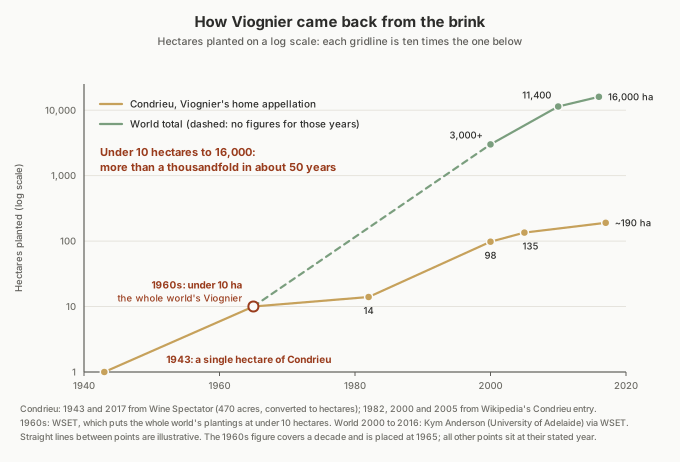
Read the gold line first: one hectare in 1943, under 10 in the 1960s, about 190 by 2017. Then the green one, which is the real surprise. From under 10 hectares worldwide to 16,000 is a rise of more than a thousand times in about fifty years, for a grape the WSET describes as known only locally half a century ago. And notice what the gold line is not: Condrieu is no longer where most Viognier lives. Wine Folly’s country breakdown, which also cites University of Adelaide figures, puts France at 8,823 of 16,063 hectares, about 55%, so Condrieu’s roughly 190 hectares are only about 2% of the French total. Most Viognier now comes from somewhere else, and is made differently.
What Viognier Tastes Like
The first thing you notice is the smell. A good Viognier is intensely aromatic: apricot and peach, honeysuckle and other white flowers, often tangerine or mango, with vanilla and sweet spice where oak has been used. In the mouth it is a different animal. The WSET describes it as full-bodied, low in acidity and medium to high in alcohol, and Wine Folly points to its characteristically oily texture. There is no tannin, and alcohol usually runs around 13–15%, which puts it alongside rich Chardonnay among the fuller white wines.
Here is the trap: the nose promises sugar that the glass does not deliver. Viognier is overwhelmingly dry, but the ripe-fruit perfume, the alcohol and the soft, low-acid texture all read as sweetness. Our guide to what dry wine means explains how low acidity lets the same amount of sugar taste sweeter, and it uses Viognier as its example. There is history in it too: because Condrieu’s grapes ripen to high sugar levels, fermenting them fully dry used to be difficult, and producers often made off-dry wines. Sweet late-harvest versions still appear in some years, but they are the exception.
The perfume has a chemical explanation, at least in part. Viognier is rich in terpenes such as linalool, geraniol and nerol, floral compounds found in the skins and the same family that perfumes Muscat and Riesling. The apricot and peach notes are harder to pin down. Researchers at the Australian Wine Research Institute have studied lactones, compounds that are key flavour components of real peaches and apricots, and their results suggest these help create the “apricot” and “peach” character in Viognier and Chardonnay wines. But the institute’s own project description admits that the key compounds behind “stone fruit” flavour in wine were not known when the work began, so treat any tidy chemical story with caution.
Where It Grows
Condrieu is the benchmark. Its seven communes run along about 19 km (12 miles) of the Rhône’s west bank, roughly 40 km south of Lyon, on steep granite slopes that soak up heat by day and give it back to the vines at night. It is Viognier only, and the wines are now mostly dry, where a century ago they were often off-dry to sweet. Enclosed within it, Château-Grillet is a separate micro-appellation of about 3.4 hectares (8.5 acres), also 100% Viognier, with a single estate.
The rest of France grows far more. Much of it is in the south, especially the Languedoc, where better clones and easier sites have improved yields, and it is often sold as Pays d’Oc, usually as the good-value option.
Beyond France, the WSET names two pioneers: Josh Jensen of Calera in California and Peter Wall of Yalumba in Australia. Wine Folly’s breakdown puts Italy second with about 1,800 hectares, then the United States with about 1,500, Chile, South Africa and Argentina with roughly 800 each, and Australia with about 750. American plantings have risen sharply since the late 1980s, led by California’s Central Coast, and in 2011 the Virginia Wine Board decided to designate Viognier as the state’s signature grape for national branding. Californian bottles tend to be noticeably higher in alcohol than Viognier from other regions.
The WSET’s own summary is that style and price vary with where the grape is grown, how much it is allowed to crop and how it is made, so the label is only a starting point. Condrieu on the bottle means 100% Viognier from the Rhône. Anything else can run from a lean, mineral wine to a rich, oaked, high-alcohol one.
A Dab of Viognier in Your Syrah
Viognier has a second career as a supporting actor in red wine. In Côte-Rôtie, the great Syrah appellation just north of Condrieu, red wines can legally include up to 20% Viognier, though Wine Spectator’s Harvey Steiman reported in 2005 that most producers use only what is interplanted in their vineyards, usually 1% to 5%. Because Viognier ripens earlier than Syrah, it is normally picked separately and added to the fermenting red, a technique called co-fermentation. Australian winemakers took up the idea too: the WSET notes that Syrah–Viognier blends have had a following around the world, especially in Australia. Côte-Rôtie’s floral lift is one reason it stands out in our guide to full-bodied red wines.
The usual explanation is colour. The theory is that phenolic compounds in the white grapes bond with the red pigments, a process called copigmentation, locking in a deeper, more stable colour. Wikipedia and Wine Folly both repeat it as fact, and Matt Steel, then making wine at Green Point in Australia’s Yarra Valley, told Wine Spectator: “We think the Viognier helps fix the color of the Shiraz, especially in a cooler climate like ours.”
The evidence is thinner than the lore. In 2010, Rod Chittenden and Paul Kilmartin published a study of colour in Syrah co-fermented with Viognier, comparing 100% Syrah against co-ferments containing 2%, 5% and 10% crushed, destemmed Viognier. Copigmentation did happen, peaking within the first two weeks of fermentation, but the abstract concludes that “over the course of the study the control, with Syrah only, was not consistently different in colour enhancement due to co-pigmentation than the Syrah co-fermented with Viognier.” The authors’ explanation is that the Viognier did not supply enough of the right phenolic co-factors.
That is one set of experimental wines, and it does not prove the practice pointless: the same abstract notes that the highest additions formed colour fastest. But it does make the colour story shakier than it sounds. The sturdier reasons are flavour and texture. In Steiman’s report, Steel’s Shiraz co-fermented with 12.5% Viognier showed a distinctive peach-and-spice character and a rounder mouthfeel, and Chester Osborne of d’Arenberg described his method this way: “I keep adding Viognier until I can taste it. If the Viognier seems to be taking over, we add more Shiraz.” The WSET’s summary of the practice mentions only aromatic complexity. And not everyone is convinced: Steiman noted that some Australian winemakers and critics absolutely hate the idea.
How to Serve It and How Long to Keep It
Serve Viognier lightly chilled, at about 7–13°C (45–55°F): the cooler end for lean, unoaked bottles and the warmer end for rich or oaked ones. Straight from the back of the fridge, a full-bodied white can taste muted, and our serving temperature guide singles out Viognier as a wine whose character a hard chill hides. An ordinary white wine glass is fine, and Wine Folly says decanting is rarely necessary because the aromatics are already strong.
Most Viognier is made to be drunk young, because its floral aromas fade first. Wine Folly gives it three to five years in the cellar, and Wikipedia notes that bottles more than about three years old tend to lose many of the floral aromas that make the wine distinctive. Authorities disagree about top Condrieu, though. As collected in Wikipedia’s Condrieu entry, one Master of Wine says to drink it within three years of harvest, the Oxford Companion to Wine says two to four years and the writer Tom Stevenson suggests four to eight, while Wine Spectator’s James Molesworth has noted that some vintages will age gracefully. The sensible rule is to buy Viognier for its perfume and drink it while the perfume is there.
Once opened, it is one of the whites that tires fastest. Our guide to how long wine lasts once opened groups Viognier with oaked Chardonnay and Roussanne as fuller whites that are more vulnerable to oxidation, and suggests finishing them within three to four days in the fridge.
What to Eat With It
Viognier rewards food that is aromatic but not sharp. Its low acidity tends to leave it happiest with dishes built on fruit, nuts, saffron, herbs and gentle spice, and less happy with the tang of tomato sauce or a vinaigrette.
- Scallops and salmon. Wine Folly suggests delicate meats and scallops flavoured with stewed fruit, almonds, citrus or aromatic herbs such as Thai basil and tarragon. Salmon with dill, fennel or saffron works for the same reason, and our salmon pairing guide singles out Viognier for it.
- Ham and pork with fruit. A tropical glaze, such as pineapple, echoes the wine’s stone-fruit notes, and its slightly oily richness mirrors the fat in smoked ham. Our ham pairing guide goes into the detail.
- Chicken and turkey in creamy or aromatic sauces. The wine has the body for a cream sauce and the perfume to stand up to tarragon or roast skin and herbs.
- Gentle spice. Wikipedia lists Thai food among the dishes Viognier suits, and Wine Folly’s suggested dish is a chicken tagine with apricots and almonds over saffron rice. Go easy on fierce chilli heat, which a wine of 13–15% alcohol tends to amplify.
- Soft cheese and mushrooms. Ash-ripened goat cheese and chanterelle mushrooms both suit its aromatic depth, body and floral character.
How It Compares With Chardonnay
If you like rich, full-bodied Chardonnay, Viognier is the natural next step, and Wine Folly says as much. The difference is where the flavour comes from. Chardonnay is close to a blank page, a neutral grape that records the vineyard and the winemaker’s choices, as our Chardonnay guide explains. Viognier arrives with its perfume already written: Wikipedia contrasts Chardonnay with Viognier’s more natural aromatics of peach, pear, violets and minerality. Chenin Blanc, a rich white of a different kind, leans towards baked apple and quince rather than stone fruit. And in the wider Rhône, Viognier is often a blending partner for Roussanne, Marsanne and Grenache Blanc.
Frequently Asked Questions About Viognier
How do you pronounce Viognier?
It is pronounced vee-own-yay, with the “gn” sounding like the “ny” in canyon. The most common theory is that the name comes from Vienne, the French city that was a major Roman outpost, though a more colourful legend derives it from the Latin via Gehennae, “road of the valley of hell”.
What does Viognier taste like?
Viognier is intensely aromatic and full-bodied. Expect apricot, peach, honeysuckle and white flowers, sometimes tangerine or mango, with a rich, slightly oily texture, low acidity and no tannin. Oak, where it is used, adds vanilla and sweet spice. Although it smells sweet, most Viognier is dry.
Is Viognier sweet or dry?
Overwhelmingly dry. The ripe-fruit perfume, the alcohol and the soft, low-acid texture make it seem sweeter than it is, so many people expect sugar that is not there. Sweet late-harvest versions are made in some years, but they are the exception.
What is the difference between Viognier and Chardonnay?
Both can be full-bodied and lush, which is why Chardonnay drinkers often take to Viognier. Chardonnay is the more neutral grape and takes much of its flavour from place and winemaking. Viognier has more natural aromatics, such as peach, apricot, honeysuckle and violets, so it smells distinctive before the winemaker has done anything to it.
Why is Viognier added to Syrah?
In Côte-Rôtie, red wine can legally include up to 20% Viognier, though 1% to 5% is typical. Winemakers say it adds floral aroma and a rounder texture, and the traditional explanation is that it stabilises colour. That last claim is the weakest: a 2010 study of Syrah co-fermented with 2%, 5% and 10% Viognier found that the Syrah-only wine was not consistently different in colour enhancement from copigmentation.
What food goes with Viognier?
Anything aromatic but not sharp. Good matches include scallops and salmon with dill, fennel or saffron, ham and pork with a fruit glaze, roast chicken or turkey in a creamy sauce, mildly spiced Thai dishes and a chicken tagine with apricots and almonds. Be careful with very acidic dishes, which can leave a low-acid wine tasting flat, and with fierce chilli heat, which a 13% to 15% wine tends to amplify.